

Bishop Philip Egan, in whose diocese is located the largest church of the Society of Saint Pius X in the U.K, has warned Catholics against attending Society Masses and urged SSPX members “to full communion”.
“The SSPX and its members reject teachings of the Second Vatican Council and many of the developments since. With this ordination, they have formally broken away from the Church.”
Such was part of the statement from Bp. Egan, who has led the Diocese of Portsmouth since September 2012.
Noting his “sorrow” over the “defiant act” of the 1st July episcopal consecrations carried out by the Society, Egan urged the diocese to pray for the SSPX and “all involved”.
Referencing the Vatican’s declaration of a “schismatic act” on the part of the Society, Egan wrote that the practical implications of such a statement mean “that all the bishops and priests who belong to the SSPX and the laypeople who exclusively attend their services are now excommunicated.”
SSPX Masses are “illicit” and do not fulfil the Sunday obligation, he added. “The sacraments they celebrate – of marriage and confession – are invalid.”
The bishop further urged “all Catholics not to take part in their activities and boldly to reaffirm their unity with the Pope and with the bishops in communion with him.”
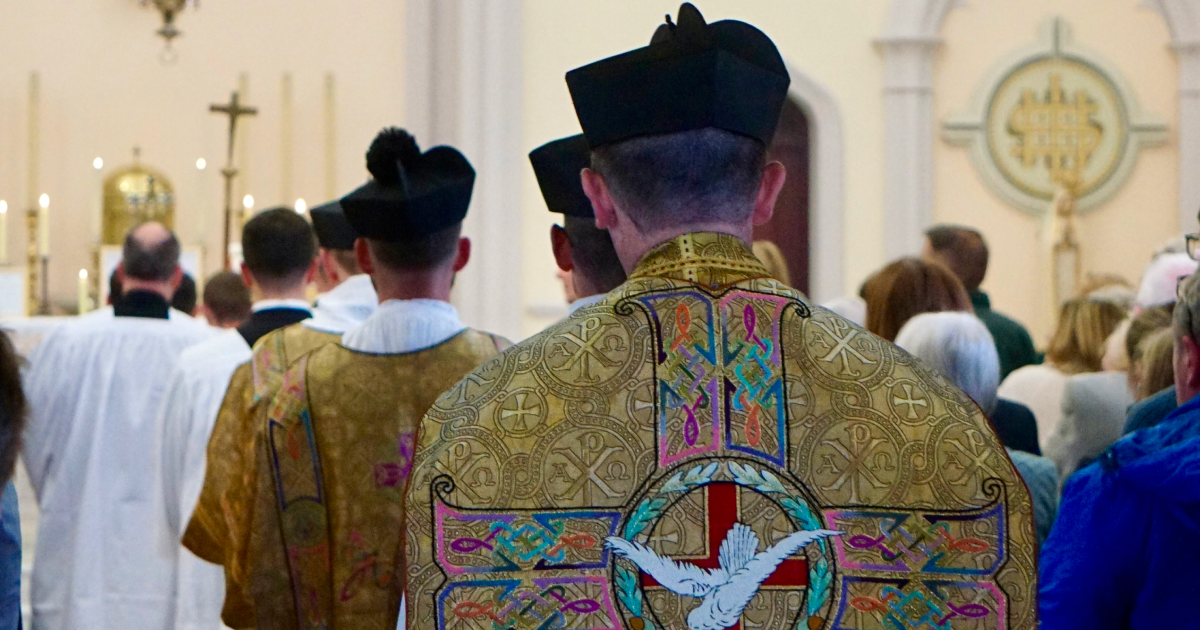
Egan’s Diocese of Portsmouth is home to the SSPX’s largest establishment in the U.K., with the over 10-acre campus at Newbury housing the Society’s school and newly expanded church of St. Michael’s. The private school boasts both primary and secondary education and has steadily become a hub for traditional-minded families in the area.
St. Michael Archangel church on the same site is the feather in the cap of the SSPX U.K. district, after being built in just under two years to the cost of around £2 million.
Egan has previously visited the SSPX’s Newbury campus and, in former years, the relationship between him and the Society was warm. The episcopal consecrations appear to be a clear demarcation in those relations, although the Catholic Herald understands that tensions had already begun in recent years.
Portsmouth is also home to the Fraternity of St. Peter, a former Ecclesia Dei order also focussed on celebrating the traditional Mass. While not mentioning this community by name, Egan urged Catholics in the diocese to attend the traditional Masses “already offered in the Diocese in Bournemouth, Southampton, Portsmouth and Reading”, rather than the “illicit celebrations” of the SSPX. He also acknowledged that many Catholics, “especially the young, feel drawn towards the pre-conciliar liturgy and its spirituality.”
“I appeal to the priests and laity of the SSPX, urging them to full communion with the Catholic Church,” wrote Egan. “There is a canonical process for this: please ask Bishop’s Office.”
While Egan is echoing the Vatican’s tone in urging Catholics away from attending Society liturgies, several canonical questions remain less clear than he and other bishops have written. The Holy See’s Decree only refers to the automatic excommunication of the six bishops involved in the consecration ceremony. While it does warn clergy and faithful “not to join the schism” of the SSPX at the risk of incurring excommunication also, the Decree does not declare them already excommunicated automatically.
The accompanying Note argues that SSPX Confessions and Marriages are invalid, due to lacking authority, and further argues that the SSPX priests are in schism and excommunicated.
However, even canonists critical of the Society have argued that the Note cannot expand on the penalties of the Decree. Such canonists also note that since the SSPX received direct permission from Pope Francis to offer Confessions and Marriages, then it is only Pope Leo XIV who can revoke that – something which has not happened.
The Vatican’s warning about “formal adherence” to the schism of the Society referenced a 1996 document which outlined both the external and internal requirements to be met in order to be formally adhering to a schism.
One of the external elements is, as Egan wrote, the exclusive attendance of SSPX liturgies. Yet the document warns that even this is “not an unambiguous sign, since it is possible for some faithful to take part in the liturgical services of Lefebvre’s followers without, however, sharing their schismatic spirit”.
The Vatican’s 1996 text noted that “formal adherence” to the schism “must involve two complementary elements” of the internal and external proofs.
The Society have consistently rejected the licit nature of the excommunication decree against members, but have nonetheless begun the canonical process of appealing the Decree. A response from the Vatican is expected within 30 useful days from the 11th July submission of the Society’s appeal.
Michael Haynes is an English journalist in the Holy See Press Corps. He serves as Vatican Correspondent for the Catholic Herald, while readers can follow him at Per Mariam and on X @MLJHaynes.