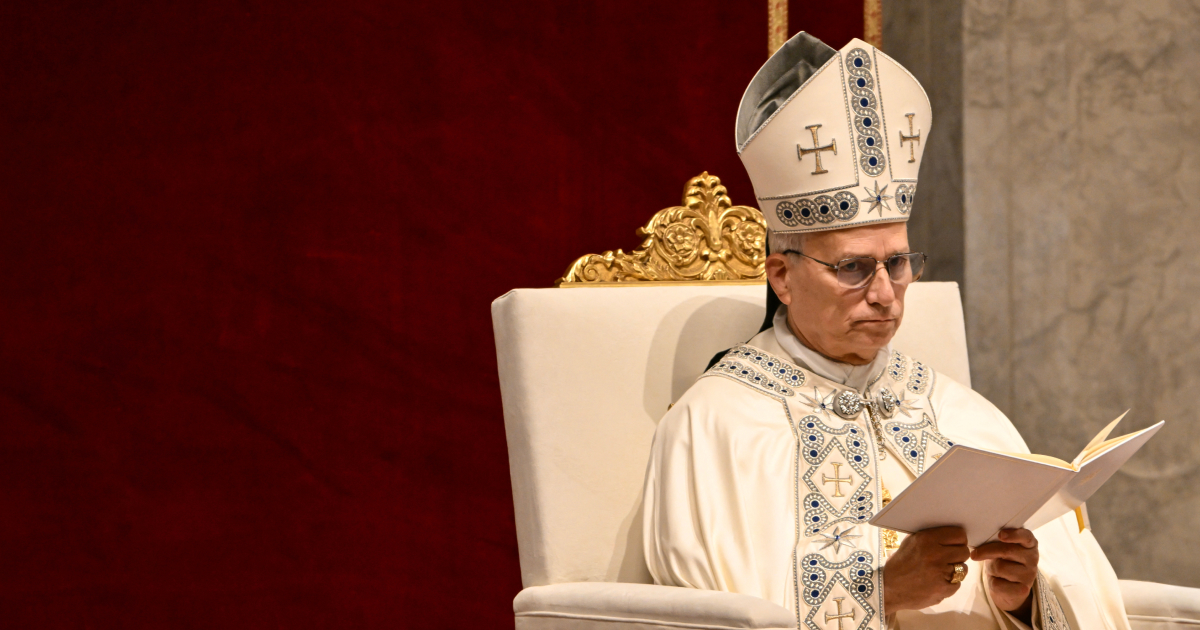


On Monday morning Pope Leo XIV received judges and officials of the Apostolic Tribunal of the Roman Rota at the Vatican, using his first annual address to the court to warn against what he described as a “dangerous relativisation of truth” in the Church’s judicial system regarding marriage.
Speaking in the Clementine Hall at the opening of the Rota’s judicial year, the Pope insisted that ecclesiastical justice must never be reduced either to a cold application of law or to a form of compassion detached from objective truth. Justice in the Church, he said, must always be exercised as a genuine pastoral service, rooted in the unity of truth and charity.
“These are not two opposing principles,” the Pope told the assembled auditors and officials, “but two intrinsically united dimensions, which find their deepest harmony in the very mystery of God, who is Love and Truth.”
The Pope thanked the members of the Rota for their work, describing it as a “precious service” to the universal Church and to the Petrine ministry itself. Drawing on his own experience of judicial ministry, he said he understood the demands and pressures faced by those entrusted with judging cases that often touch the most painful aspects of people’s lives.
At the centre of the address was a warning against what the Pope described as “misunderstood compassion”. He cautioned that excessive identification with the personal difficulties of the faithful could lead to decisions that lack a solid foundation in truth. “Sometimes there is a risk,” he said, “that excessive identification with the troubled vicissitudes of the faithful may lead to a dangerous relativisation of truth.”
Such an approach, he added, was particularly damaging in cases of matrimonial nullity, where a subjective or overly pastoral reading of the facts could undermine the Church’s teaching on the indissolubility of marriage. Decisions taken without adequate attention to objective truth, he said, risk weakening both justice and mercy.
At the same time, the Pope warned against an opposite temptation: a rigid and detached administration of justice that ignores the dignity and personal history of those who come before ecclesiastical tribunals. A merely bureaucratic or technical approach, he said, was equally incompatible with the Church’s understanding of justice as a service to persons and to their salvation.
The Pope placed his remarks firmly in continuity with his predecessors, recalling addresses to the Roman Rota delivered by popes from Pius XII to Francis. He reaffirmed the role of the tribunal as a point of reference for diocesan courts throughout the world and stressed that its jurisprudence serves the wider unity of canon law in the Church.
He returned several times to the principle that the ultimate purpose of canonical justice is the salvation of souls. Judicial activity, he said, cannot be understood simply as the resolution of disputes or the application of norms, but as an ecclesial service that affects consciences and lives.
Addressing in particular the shorter process for marriage nullity introduced under Pope Francis, Leo XIV urged caution and rigour. While acknowledging the pastoral intention behind procedural reforms, he insisted that any prima facie grounds for nullity must be judged carefully and confirmed through a properly conducted process. “It must be the process itself,” he said, “that confirms the existence of the annulment or determines the need to resort to the ordinary process.”
Concluding his address, Leo XIV described judges as called not only to decide cases but to serve peace within the Church. Justice, he said, is inseparable from peace, and when justice is wounded, ecclesial communion itself suffers.
Pope Leo XIV’s speech to the Rota, while expected, was seen as a broader and deliberate reassertion of juridical realignment after a decade in which the canonical rule of law was increasingly treated as activism and a sign of pastoral reform rather than legal rigour.
From the beginning of his pontificate, Pope Leo XIV has signalled that questions of law and governance will not be left hanging on contingencies. His early decision to regularise the legal position of the Vatican City State’s President, Sister Petrini, correcting an ambiguity that had quietly breached the city state’s own constitutional norms, was an early indication of Leo’s attention to the normalisation of the judiciary. The address to the Roman Rota continues this pattern. It marks a clear tonal shift from the approach associated with Pope Francis, whose reforms often prioritised accessibility and pastoral intent over juridical restraint.
As Pope Leo observed during his speech, the Rota operates under constant pressure between objective truth on the one hand and compassion for wounded individuals on the other. This tension, raised by Pope Leo, is evident when His Holiness mentioned marriage nullity cases, where providing pastoral solutions has eclipsed the harder task of determining whether a valid sacrament ever existed. Over recent decades ordinary Catholics have assumed annulments are routine rather than exceptional. Before the Second Vatican Council, nullity was rare not because marriages were stronger but because jurisprudence was anchored in the presumption that marriage enjoys the favour of law.
The roots of the present unease lie partly in the 1983 Code of Canon Law. Canon 1095, with its references to psychological incapacity and defects of discretion, has over time been subject to expansive interpretations that became normalised. In many diocesan tribunals, these grounds have become the default basis for nullity, creating a perception that subjective immaturity can undo an objective sacrament. Pope Leo XIV’s critique cannot be separated from this inherited legal framework.
Pope Leo XIV’s address is not a rejection of these developments, however, but an attempt to contain them, as his appeal to the supreme law of the Church, the salus animarum, places judicial activity back within a teleological framework.
The unresolved tension is whether such exhortations can succeed without deeper juridical reform. Leo XIV appears committed to restoring normalcy to the courts rather than revision, by public proclamation rather than rewriting law. Whether this will be sufficient remains uncertain, but it is clear where the direction is going.