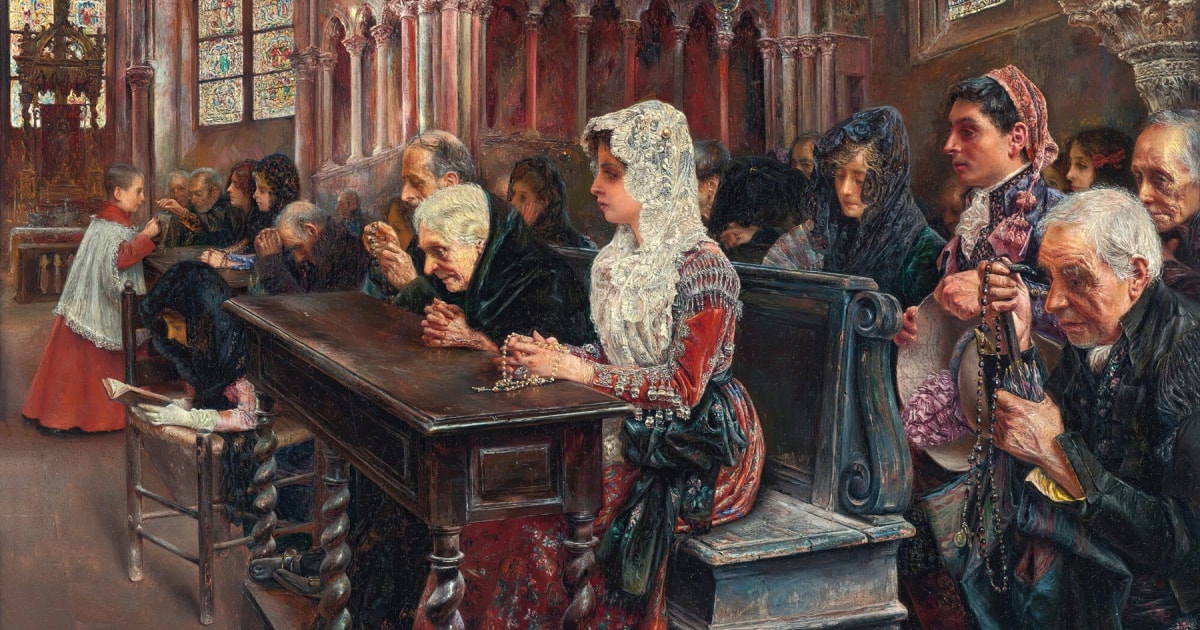
If you were to travel back in time and ask a medieval peasant, ‘Why do you belong to the Church?’, he might look at you strangely. For the medievals, the Church was simply the air they breathed. Everyone they knew was Catholic. One might as well ask him why he was a Briton or why he was a man. He would be aware that non-Catholics existed in the form of heretical sects or pagan religions, but the thought of becoming one of them would never occur to him.
Contrast this with today: every Catholic in the West would understand the question, even if they could not give a convincing answer. We are all aware that being Catholic is a positive choice we make, and that there are many other options. One could become Lutheran or Muslim, or nothing at all.
In the 20th century, this awareness led to an increase in the study of ecclesiology: the nature of the Church and what it means to be a member. Vatican II spent a good deal of its time expounding the nature of the Church. However, that robust understanding has yet to trickle down to the laity.
The laity is infected with the ideals of American pluralism – the idea that a strong society is made up of different religious backgrounds. Pluralism does have benefits, such as more opportunities for evangelisation and fewer instances of religious persecution, but it does have one major drawback: it makes Catholicism optional.
This problem is American in origin, though it is spreading into the rest of the West. For decades, American neighbourhoods resembled medieval towns: centred around religion and community, with those who believed as you did. One’s religion was a natural part of one’s identity. However, the world of New York’s Little Italy and Pittsburgh’s Polish Hill has gone. Pluralism, combined with new technologies and suburban sprawl, eroded this identity. Catholicism (and all faiths, for that matter) became optional.
This fragmentation has a cost that most Catholics underestimate. When you are baptised, you become a permanent member of the Body of Christ. Catholic neighbourhoods are a natural outgrowth of that understanding. Your natural tie to your community mirrored your supernatural tie to the Church. When we lost our Catholic neighbourhoods, we lost that symbol. Now one’s Catholicism is something one must opt into, again and again, against the gravitational pull of a culture that has no use for it.
The Pew Research Center conducted a study of former Catholics, and the most common reason why Catholics leave the faith (for another religion or for none at all) is gradual drift. This is to be expected. The will can only withstand so much opting in. Over time, it tires and opts not to choose at all.
One way to stop this drift would be to recover the preaching of Baptism and of the Kingdom of God: the proclamation that ‘the time is fulfilled, and the kingdom of God is at hand’ (Mk 1:15). We are living in the reign of Christ. He has inaugurated His Kingdom on earth, and we have been made members by virtue of our Baptism.
That proclamation is almost gone from the American pulpit. Our priests live in the same pluralist society that we do and have inculcated its values. They have absorbed, many without realising it, the assumption that the Church is one institution among many. When that is one’s unspoken framework, one does not preach the Kingdom. One preaches good behaviour or personal salvation. Religion is preached as important but not totalising.
Pluralism is not new. The Church has encountered pluralist societies before. She is historically the second religion. She enters Rome or Athens or precolonial America and encounters another faith. Her missionaries combat that faith first and foremost by preaching the Kingdom.
What is novel in Church history is a pluralist society in which the Church’s evangelists have accepted the position of being one faith among many. The Church never grew by convincing people that she was the best religion, but rather that she is the one true religion. She is the only right worship of God, the only source of His grace, and the only path to enter the Kingdom.
The 20th-century Magisterium sought to restore this sense of the Kingdom against pluralism. Pius XII, in Mystici Corporis, taught that the Church is nothing less than the living Body of the Lord Himself made present throughout history. Lumen Gentium went further: the Church is ‘the kingdom of Christ now present in mystery’ and the ‘visible sacrament of this saving unity’ (Lumen Gentium 3–5).
The Church is the sacrament of the Kingdom of God: a sign of the Kingdom that makes the Kingdom present. She is not pointing to the Kingdom from a distance; rather, she is the Kingdom itself breaking into the world. A Catholic who understands this cannot treat the Church as one option among many, any more than a man can treat his wife as one woman among many.
The cost of American pluralism has been the loss of this vision in our ecclesiology. We have stopped seeing the Church as the City of God establishing its outpost on earth, and started seeing her as one sanctuary in a crowded marketplace of sanctuaries.
To recover this vision, we do not need to quote Lumen Gentium in every homily, but every homily should assume it. Everyone who preaches should speak as a herald of a Kingdom that has already begun, addressing citizens of that Kingdom about how to live in light of the King’s return. He should assume that his people are not consumers of religious services, but living members of Christ’s Body, called to a holiness so total that, when people look at them, they no longer see them but see the Lord Himself.
The night is drawing near, and the day is far spent. We do not have time for a Church that thinks of herself as one association among many. The Kingdom of God is at hand. Our people deserve to hear this announced clearly and often, until the pluralism in our own minds breaks apart and we see again what the Church actually is. Until that happens, Catholics will keep drifting away.
Patrick Neve is a former comedian with a Master’s degree in systematic theology.