
Bernini e i Barberini (Palazzo Barberini, Rome; until 14 June 2026)
Set in the quiet environs of the Quirinal, beyond the tourist crowds of nearby Trevi, the Palazzo Barberini has stood for four centuries as an embodiment of the baroque – less for its style than for the cut-throat story it tells about life as a 17th-century artist in Rome. This expansive building – at once both urban palazzo and suburban villa – bears the imprint of three of the period’s foremost craftsmen: Carlo Maderno, Francesco Borromini and Gian Lorenzo Bernini.
Between this artistic troika, however, there existed less a collaboration than a rivalry. When Maderno, the project’s chief architect, died in 1629, his long-time assistant Borromini was passed over for promotion. Cardinal Francesco Barberini, brother to Pope Urban VIII and patron of the project, was keen to curry favour, so he bestowed the honour on Bernini: the papal court’s rising star.
Their rivalry plays out across the palace: Bernini’s grand, square staircase stands in deliberate contrast to Borromini’s helicoidal concept. Where Bernini conceived the baroque as monumental and theatrical, Borromini treated it as fluid and inventive. Though something of the latter was able to find expression, it was the former vision that came to define the age.
This field of artistic contest makes the Palazzo an apt setting for the Gallerie Nazionali di Arte Antica’s second exhibition in its baroque trilogy. Following a show on Caravaggio in 2025, the focus now turns to Bernini himself in this year’s Bernini e i Barberini.
Rather than attempt a full survey of his vast and turbulent career, the exhibition adopts a narrower lens: his relationship with Urban VIII, the patron who recognised and cultivated his genius. This lends the show clarity, though at a cost. By privileging this relationship, it sidesteps some of the most troubling – and therefore most interesting – episodes of Bernini’s life, along with the sharper dynamics of baroque patronage.
It begins with his early years in the studio of his father, Pietro Bernini. A capable sculptor in his own right, the elder Bernini’s style is typically Mannerist, poised between Renaissance idealism and baroque drama. His Allegory of the Four Seasons, rediscovered in the 1960s, is represented here, with Winter the most striking. It shows a cloaked figure with squinting eyes and a bulbous nose, the chiaroscuro of his drapery evoking the weight of snow.
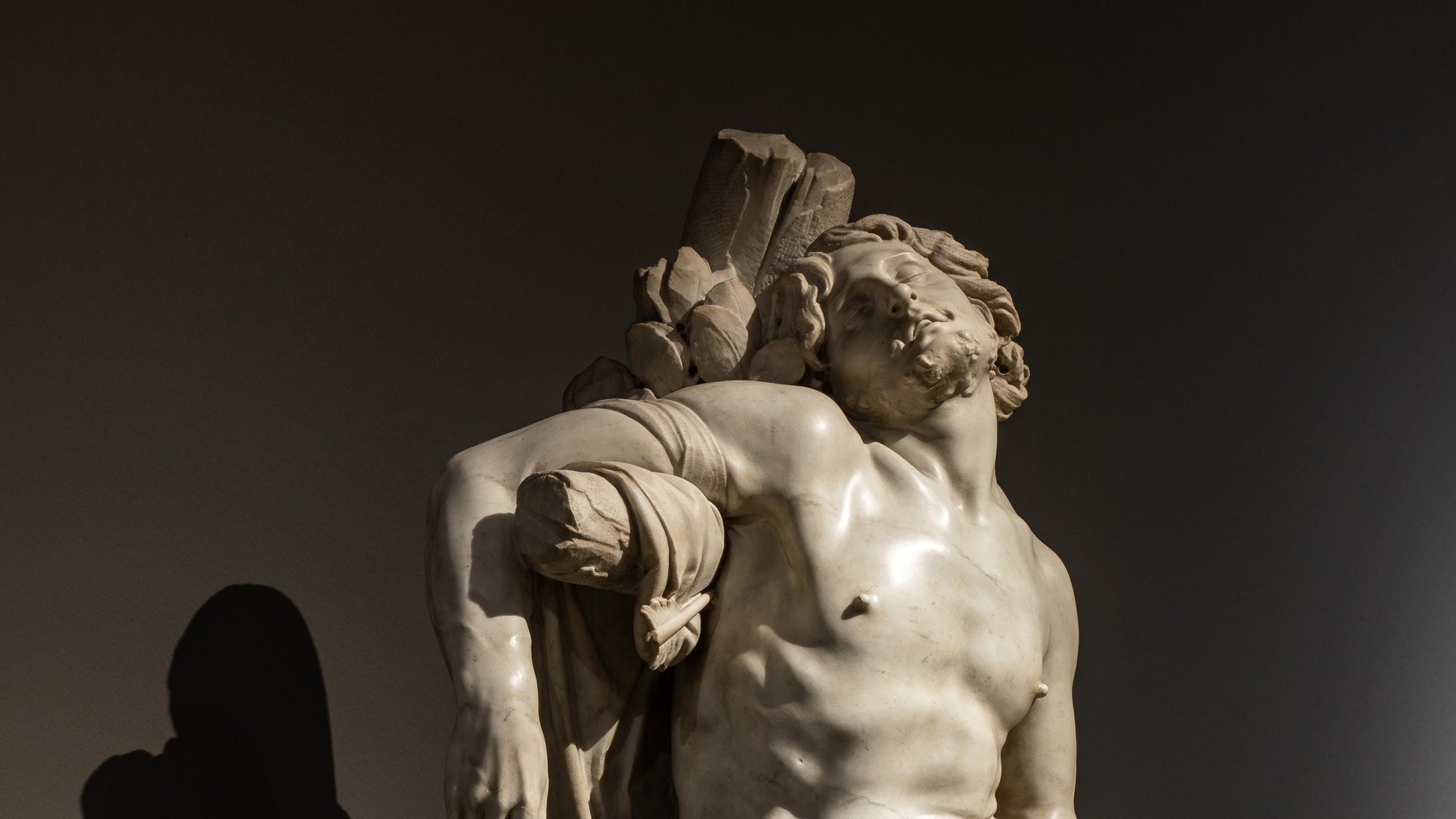
Once attributed to the younger Bernini, these works now appear unmistakably Pietro’s, especially when set beside his son’s early pieces. Gian Lorenzo’s St Sebastian, displayed in the same room as his father’s collection, provides the clearest contrast.
Here the saint, loosely bound to a post, tilts between life and death as an arrow protrudes from his chest. His body slackens, his thighs seem about to give way, and his head tilts back to reveal a last flicker of life in his hooded eyes.
Produced in 1617, this piece marks both the emergence of Bernini from his father’s workshop and the beginning of a transformation in European sculpture. Bizarrely, the exhibition couches this moment in the language of “emancipation”, with the young artist’s patron – then Cardinal Barberini, still some 10 years away from becoming Pope – credited as freeing him from paternal constraint. Yet contemporary sources, especially the biographies by Bernini’s son Domenico and art historian Filippo Baldinucci, suggest a father-son relationship which was collaborative and instructive, furnishing Gian Lorenzo with the skills needed to forge his career.
From here the show moves to St Peter’s Basilica: the site that would define both Bernini’s career and the visual identity of the Catholic Church. By the time Urban VIII was on the throne, the basilica was structurally complete, its construction having begun a century earlier under Julius II. Following its consecration – the 400th anniversary of which falls this year – the new Pope was anxious to leave his mark on its decoration, entrusting much of this work to Bernini.
At the centre of the artist’s accomplishments in this domain lies the Baldacchino: a vast bronze canopy rising nearly 100 feet above the high altar, supported by spiralling Solomonic columns. Both spectacular and devotional, it marks the tomb of St Peter while evoking Jerusalem, its design a homage to the columns said to have been brought to Rome from the Temple by Constantine.
The exhibition presents etchings, engravings and workmen’s notebooks of the Baldacchino, revealing the extraordinary logistical and artistic ambition behind its creation. Alongside these are studies of Bernini’s other momentous contribution to the basilica’s interior: his St Longinus. In this work we see Bernini at the height of his powers as a sculptor.
The Roman soldier, whose lance pierced the side of Christ at Calvary, converted by the water which poured from the wound. The Gospel of Matthew records him after the death of Christ confessing: “Truly this was the Son of God.” Bernini captures this moment of profound realisation: the saint’s arms are spread open, one hand holding his spear and the other splayed in amazement, staring wide-eyed at the cross which crowns the Baldacchino.
With this arrangement we see the archetype of Bernini’s defining technique, the bel composto (or beautiful composition). It is a method he pioneered of synthesising multiple artistic media – in this instance sculpture, architecture and ornamentation – to create a singular, dramatic whole. In doing so he better captures, through visual and spatial immersion, the narrative he is attempting to depict: the high drama of Calvary, and the spiritual and psychological effects it had on its witnesses.
What is missing from this otherwise edifying section, however, is any meaningful engagement with Bernini’s greatest professional failure: the bell towers of St Peter’s. Commissioned by Urban VIII, Bernini again took over this project following the death of Maderno. When cracks began to appear in the façade, longstanding rivals of his – led by none other than Borromini – leapt at the opportunity to accuse the artist of incompetence. The project collapsed, and the towers were demolished under Pope Innocent X, a rival to Urban VIII. Though later exonerated (the structural flaws were in fact the fault of Maderno), the episode nearly ruined Bernini. Through it we are offered a vital insight into the levels of artistic jealousy which permeated baroque Rome.
The exhibition then turns to portraiture, a major source of Bernini’s fame and income. The busts on display represent the largest collection of Bernini’s portraits ever assembled in one place, and through them we see the range he could draw from the single subject of Urban VIII.
In a piece from 1630, the artist combines a bronze head with a serpentine base and a mozzetta in porphyry – the imperial purple marble, notoriously difficult to sculpt – to depict a stately image of the Pope, with creased cheeks and wrinkles around his eyes. Ten years on, the artist renders an altogether different version of the same face: carved from white marble, it shows him in mozzetta and camauro looking serene, unblemished by age. Through these varying registers of presence and realism, the face of his patron is transformed into an image of enduring spiritual and temporal power.
We then move to the final room, which shifts focus to the artist himself. Chief among its works is the bust of Costanza Bonarelli, Bernini’s mistress. Its description marks it out as “one of the greatest sculptures in all Western portraiture”. I am not exactly sure why. It is undoubtedly excellent: her parted lips and tousled hair depart from the formality of his previous works, portraying a candour and immediacy rare in sculpture. And yet, inspired as they are, these details do not seem any more skilfully rendered than those of the popes or luminaries which we saw earlier.
Its circumstances, however, are indeed unique. It was produced without a patron’s commission, and is one of the first Early Modern sculptures to depict a non-aristocratic woman: an unguarded declaration of the artist’s infatuation, and one which portends the dark turn their relationship took.
Costanza, the wife of one of Bernini’s assistants, later had an affair with the artist’s brother. Bernini responded by beating him in the street, pursuing him into St Peter’s with a sword, and arranging for Costanza’s face to be slashed. While he escaped punishment thanks to his high connections, the disfigured Costanza was committed to an institution for adulterous women and had to grovel her way out.
To confront these aspects of Bernini’s life is not to diminish him or distract from his work – or indeed from the concerns of this particular exhibition – but to understand more fully the man behind it all and the complexity from which it sprang. His life, like his art, resists idealisation. It embodies the baroque itself: dramatic, imperfect, and charged with tension between the earthly and the divine. Much like his St Sebastian, Bernini stands poised between two worlds, rooted in the grit and grubbiness of Rome, yet with his gaze fixed on something greater than himself.