
June 7, 2026

Saint Columba: the apostle of Iona

Andrew Cusack
More
Related
Min read
share

SAINT OF THE WEEK: 9 June - Saint Columba

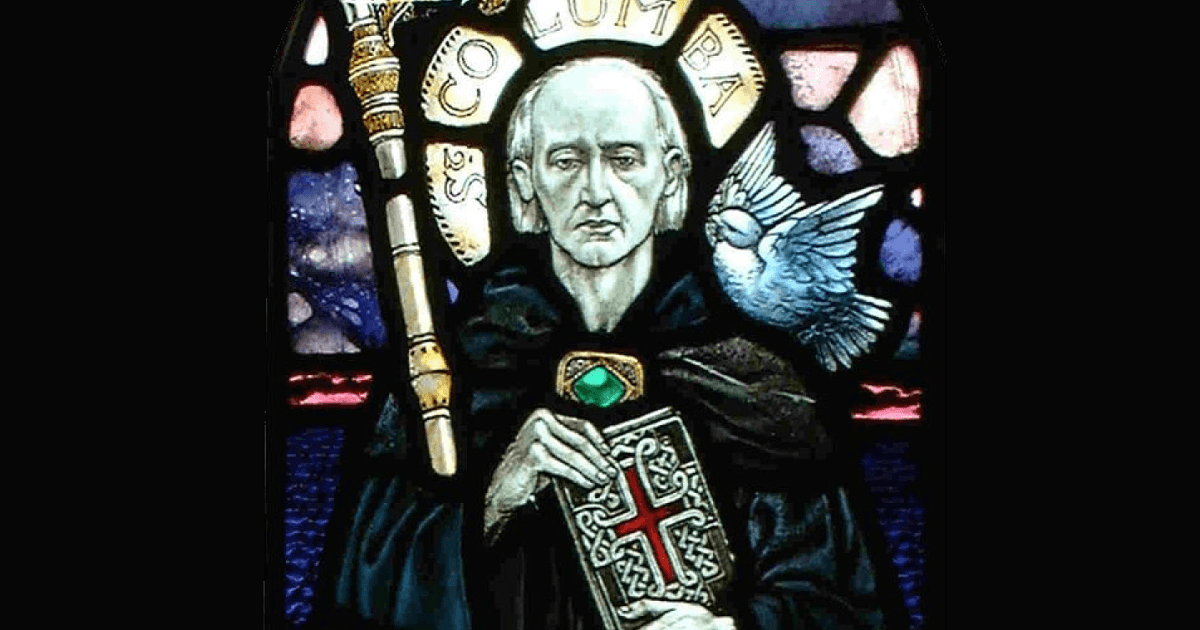
St Columba was just one of those effortlessly brilliant and holy Irish saints. He was born Colmcille – Columba is simply the Latin form of his name – in Tyrconnell in north-western Ireland in AD 521. As a young boy from an illustrious noble background, Columba studied under St Finnian of Movilla and St Finnian of Clonard. Given this monastic education, it was unsurprising that he entered religious life.

Columba’s virtues were recognised quickly and his ascent was swift. He had a unique talent for founding monasteries, around which towns often grew, and in the 540s was responsible for founding abbeys at Derry, Kells in what is now County Meath and Swords in County Dublin. Like many great men, however, he also had his flaws. Greatest of these was a dispute with St Finnian of Movilla over a copied manuscript which, when elevated to the disputed judgements of local warlords, caused the Battle of Cúl Dreimhne around AD 560 – possibly the earliest known fight over copyright in history.
His woe over his part in this violent conflict may have been one of the contributing factors in his decision to leave Ulster in a currach accompanied by 12 companions. Their destination was Scotland, where his kinsman Conall mac Comgaill, King of Dál Riata, gave him the island of Iona. Here he founded one of the most important abbeys in the history of the isles, which acted as a centre for learning as well as a base for these Gaelic monks to send out missions to the neighbouring Pictish tribes, while also acting as arbiters in disputes among them.

Not all the Picts welcomed Columba’s mission. When Columba called upon the reticent Pictish king Bridei mac Maelchon, he found the gates of Bridei’s fortress uncharacteristically locked against him. Columba blessed the closed gate with the sign of the Cross and it flung open before him. The connivances of man would be no obstacle to this Irishman’s zeal in spreading the Gospel.

Less associated with the working of wonders, St Columba impressed the peoples of his day by his wisdom as an abbot, the sanctuary he provided to travellers, his ability to heal the sick, his success at converting kings and thereby their tribes, and a closeness to God. His legacy is extensive, not only in the monastic communities he founded across what are now Ireland and Scotland but also among the peoples whose attachment to the Catholic Faith he secured and strengthened.

Many places across these lands bear his name in varying forms. Derry’s ancient cathedral of St Columb is now in Anglican hands, but the city’s St Columb’s College thrives as one of the best-achieving schools in both the United Kingdom and Ireland. The Benedictine abbey and Augustinian nunnery on Iona flourished for centuries before decline and dissolution at the Reformation. An ecumenical community has rebuilt the abbey church in the past century.

Churches, schools and towns across Ireland and Scotland are dedicated to his memory, as is an Airbus A330 operated by Aer Lingus. Donegal County Council has proposed a national public holiday in honour of St Colmcille, and the former principal of the divinity school at the University of St Andrews, the Rev Dr Ian C Bradley, has suggested that Columba would be a far more appropriate patron saint for Scotland than the eponymous apostle honoured by his own university.

Fifteen centuries have passed since Columba crossed the sea from Ireland to Iona in a small currach. The kings he counselled, the fortresses he forced his way into and the tribes he converted belong now to history. The Faith he preached, however, and the communities he founded to sustain it, remain among the most enduring monuments to one of Ireland’s greatest sons.

Continue reading with a free account

Create a free account to read up to five articles each month
Create free account

You have # free articles remaining this month.

Subscribe to get unlimited access.
Sign up

subscribe to the catholic herald today

Our best content is exclusively available to our subscribers. Subscribe today and gain instant access to expert analysis, in-depth articles, and thought-provoking insights—anytime, anywhere. Don’t miss out on the conversations that matter most.
Subscribe