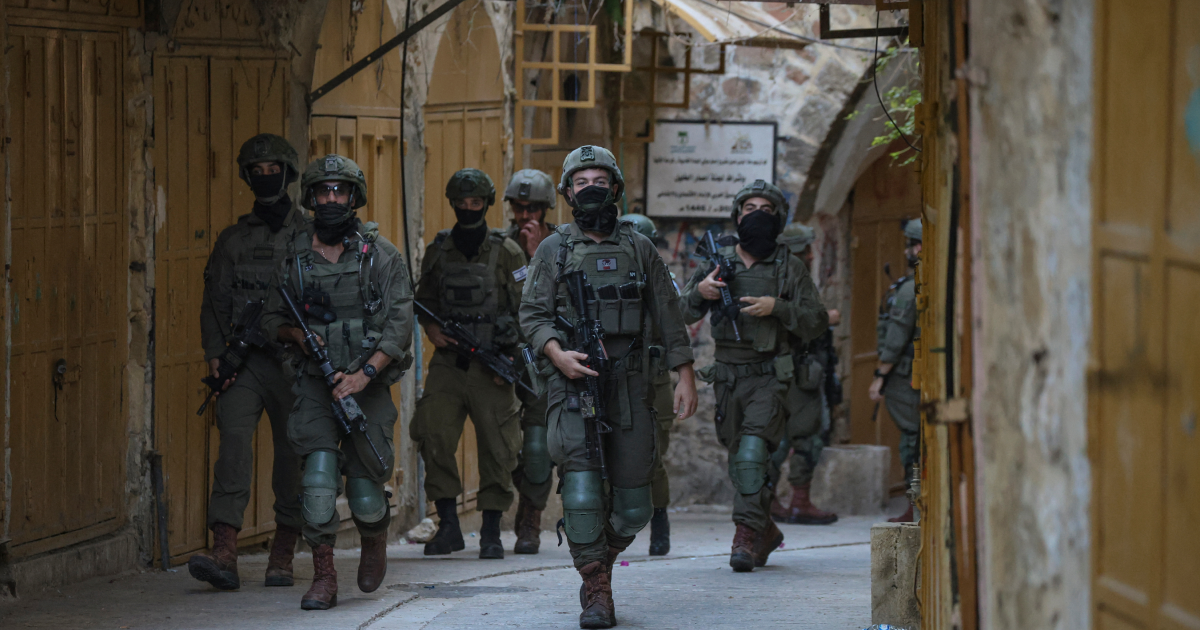


The Bishops’ Conference of Scotland has welcomed the UK Government’s announcement that it will sanction imports from illegal Israeli settlements in the West Bank. Justice & Peace Scotland, the human rights and social justice advocacy arm of the bishops’ conference, said the move was a “much-needed step” to prevent the further expansion of settlements.
The sanctions imposed by the UK Government will ban goods produced in settlements as well as act against those who facilitate the expansion of settlements, such as individuals and companies.
In a September 9 statement, Justice & Peace Scotland said it particularly welcomed the Government’s recognition of the Israeli settlements in the West Bank to be unlawful “and that settlement expansion and settler violence are contributing to the displacement of Palestinian communities.”
“Today’s use of economic and diplomatic measures to uphold international law is a positive and long-awaited step towards holding Israel accountable for its repeated breaches of international obligations,” the statement read. “Through our participation in the Holy Land Coordination, we have witnessed the impact of settlement expansion and settler violence first-hand.”
“In 2025, we met Daoud Nassar of the Tent of Nations farm in Bethlehem, whose family has spent decades defending the ownership of their land. The farm is surrounded by Israeli settlements and the family face constant violence, vandalism and repeated attempts to dispossess them.
“In 2026, in Taybeh, members of the parish of Christ the Redeemer told us of homes and property being attacked and of farmland and olive trees being damaged by settlers in an attempt to drive them from their land. These experiences demonstrate the very real consequences of settlement expansion for Palestinian communities.”
The issue of settler violence in Taybeh, the last remaining Christian village in the West Bank, recently drew criticism from the Bishops’ Conference of England and Wales. Bishop James Curry, Lead Bishop for the Holy Land for the bishops’ conference, called on the Israeli government to find a way of protecting Palestinian communities from the violence, calling it “unacceptable”.
Justice & Peace Scotland said that equal rights, security and dignity for both Palestinians and Israelis could not be achieved without respect for international legal frameworks, arguing for a need for accountability. It encouraged the measures taken by the UK Government “as a means of addressing injustice and helping to break the cycle of violence and loss of life for all who live there.”
“We continue to call for measures to address conflict that are consistent with the principles of Catholic Social Teaching and the Gospel’s call to nonviolence. Pope Leo XIV has repeatedly emphasised the need for peace founded on justice and respect for the dignity of every person,” it said.
“The announcement is a hugely welcome and much-needed step, but the UK Government must continue to use all appropriate diplomatic, economic and legal mechanisms to uphold international law and prevent further settlement expansion. We pray for all people living in the Holy Land and for a future in which Palestinians and Israelis can live with equal rights, security, dignity and lasting peace.”
Foreign Secretary Ed Miliband said the sanctions “not only call out injustice and suffering but acts”, describing them as the beginning of a new approach to the conflict between Israel and Palestine.
“The British government agrees that there is ethnic cleansing of Palestinians in areas of the West Bank, perpetrated by settler terrorists,” he said. "And all too often the Israeli government has turned a blind eye to this and worse, members of it have made statements and taken actions to support the forced displacement of Palestinians."
The decision was met with condemnation by Israeli Foreign Minister Gideon Saar, who announced the closure of the UK consulate in East Jerusalem.
Prime Minister Andy Burnham said the measures were aimed towards facilitating a two-state solution, meaning the peaceful coexistence of both a Palestinian and an Israeli state.
The two-state solution is endorsed by the Church, with Latin Patriarch of Jerusalem Cardinal Pierbattista Pizzaballa recently stating it was the “only” way forward. Last month, Pope Leo XIV called for an end to the “repeated acts of violence” against Palestinians as he endorsed the existence of both states, stating that it should be done “for a just and lasting peace”.