



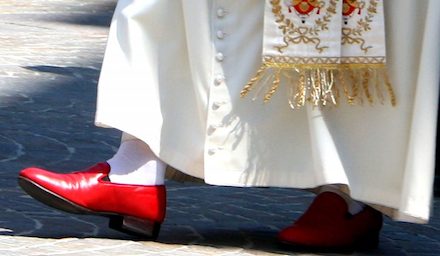
Father Longenecker has an amusing blog this week, headlined “archbishops should live in palaces”. “I think the Pope should live in the Apostolic Palace”, he says, “and I think Archbishop Wilton [Archbishop Wilton Gregory of Atlanta, who is moving out three months after moving in] should live in his brand new $2.2m home. I think Bishops should live in these grand homes–-but they should do so like one of those impoverished English aristocrats who can’t afford to heat their vast Downton Abbey, and so live in one room in the attic wearing three sweaters and eating cat food casseroles that they cook in a microwave.} I think the bit about the catfood could be a joke: but Fr Dwight is serious enough about the rest. He thinks that bishops should live in these grand buildings in community with other priests or brothers if they are religious, and should open them up as hostels for recovering addicts and the other end of the buildings maybe as women’s shelters and that they should bring in some Mother Teresa nuns to run these now possibly over-ambitious establishments. You get the idea. This, he says, would “be a far more significant sign of contradiction than simply moving out to a mean little room somewhere because it would say something more profound about worldly wealth and property.” I agree with all that. Cardinal Bergoglio lived alone in a small flat in Buenos Aires and cooked for himself, but wasn’t that because he actually preferred to live like that? And I don’t see there’s anything wrong, either, with a bishop living in a certain degree of modest comfort: after a hard day on the stump, why shouldn’t he have somewhere decent to come back to, and why shouldn’t he have a hot meal waiting for him when he gets there, and his bed turned down and maybe a sweetie on his pillow? Fr Dwight goes on to argue that there’s nothing intrinsically good about poverty. I agree with that, too, but I think that when a bishop moves out of his “palace” and a pope refuses to move into the papal apartments, they’re making a point not about poverty but about humility (their own). And though Pope Francis may indeed be a genuinely humble person what I object to particularly in the media coverage of his pontificate is that because of the way he has chosen to live in the Vatican, in a flat in the Casa Santa Marta rather than where popes are supposed to live, he is ipso fact a lot more humble than previous popes, who after all simply surrendered themselves to the way things had always been done, as a way of identifying themselves with the traditions their predecessors had always embodied, as a visible indication of a hermeneutic of continuity. Nothing I say now, with one or two minor exceptions, is intended as a major criticism of the current pontiff: I think he is playing a blinder, and I am not one of those reactionaries who interprets his frisky ways as an indication that he is some kind of liberal: I am, rather, one of those reactionaries who thinks that in spite of all those spontaneous remarks that have to be corrected later, he is just as reactionary as I am. He’s giving the Vatican a considerable shakeup, which was long overdue: and I am confident, or at least hopeful, that in the end, he will leave the institution he now governs in better heart than he found it, and no less faithful to the Magisterium Pope John intended Vatican II to articulate and not to undermine (remember his opening words to the Council fathers? “The Councils–both the twenty ecumenical ones and the numberless others …. all prove clearly the vigour of the Catholic Church and are recorded as shining lights in her annals.” Pope John’s intentions were wilfully betrayed: and I have no doubt that attempts will be made to betray those of Pope Francis, too. These are uncertain times. But I agree with Fr Z’s analysis, that Pope Francis is himself endorsing, even emboding, Pope Benedict’s ideas on the hermeneutic of continuity. I mentioned an exception to my declaration that I do not intend in this post to criticise Pope Francis: it is this. That by refusing to move into the papal apartments, and by all the other ways in which he rejects what his predecessors did (including the red shoes and the scarlet velvet mozzetta) he SEEMS to be (though of course he is not) indicating a superior humility to that of his more lofty predecessors: in particular, the media seem to think that he is obviously more humble, more identified with the poor and marginalised, than reactionary pope Benedict—who in fact simply attempted to convey the lofty character not of himself but of his sacred office, by dressing and behaving according to papal custom. Pope John, after all, was crowned with the papal tiara, and allowed himself to be carried aloft on a sedia gestatoria. Does anyone really think—has anyone ever remotely suggested—that that meant that he wasn’t after all a humble and holy father of all Catholics, a true Vicar of Christ? In the early days, Fr Z (like I and many others did) still lived in hopes that the present pope would dress and ceremoniously comport himself as popes have always done. On the day of his inauguration mass, Fr Z wrote this:
3:11 PM
Should Pope Francis have abandoned the trappings of his office? The media image now is of a pontiff rejecting the traditions of the Church
Pope Benedict was no less a pontiff of profound personal humility because he wore red shoes and lived in the papal apartments
William Oddie

7 min read



Already a subscriber? Sign in
5freearticles every month
Continue reading with a free account. No card needed.
- Five free articles every thirty days, on any device you sign in on
- The Catholic Herald newsletter, every morning
- Subscribe whenever you like for everything: every article and the magazine
Related articles
 Newsroom
Church leaders urge Drumcree dialogue: ‘Too much is at stake’
The Catholic and Church of Ireland Archbishops of Armagh have urged a renewed commitment to peace and reconciliation amid the Drumcree stand-off
Corrie Douglas-Young Newsroom
Thousands of Irish children to join global Rosary campaign
Corrie Douglas-Young Newsroom
TikTok priest urges young people to stand with persecuted Christians
Nathalie Raffray Newsroom
Baby born at 25 weeks reunites with neonatologist two years after leaving hospital
The Catholic Herald Newsroom
Joe Biden honoured by Planned Parenthood after defending abortion rights
Christine Rousselle
subscribe to the catholic herald today
Our best content is exclusively available to our subscribers. Subscribe today and gain instant access to expert analysis, in-depth articles, and thought-provoking insights—anytime, anywhere. Don’t miss out on the conversations that matter most.
Subscribe



