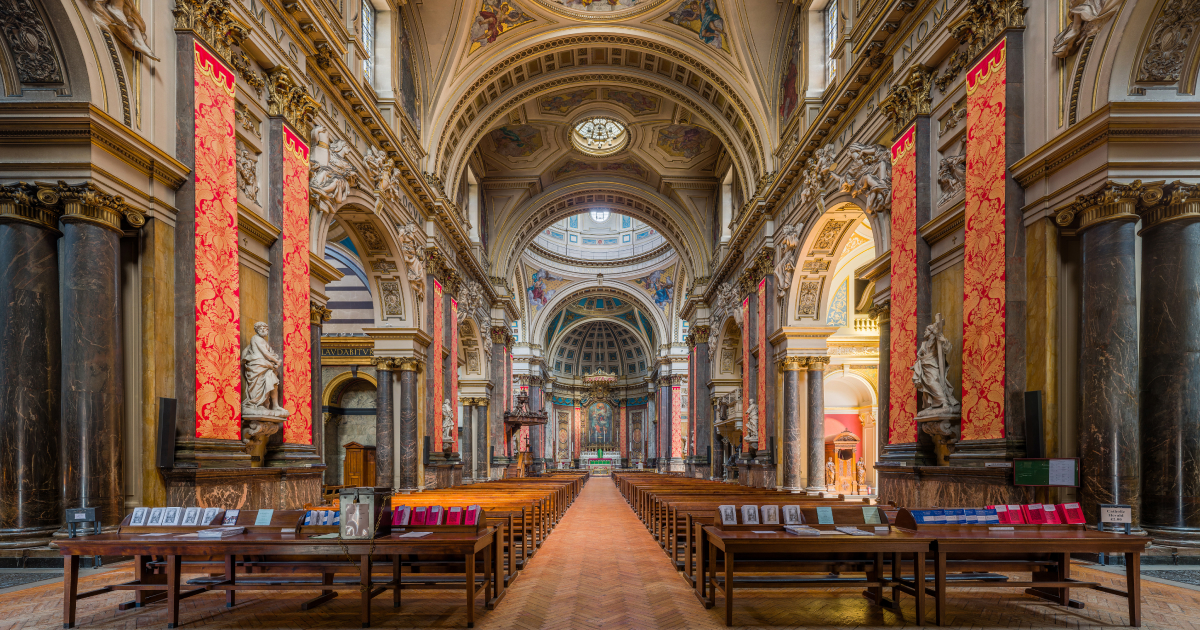


Sohrab Ahmari converted to Catholicism 10 years ago after attending Mass at Brompton Oratory, captivated by the beauty of the liturgy. There were other factors, but that was the proximate cause. He wrote a book about his conversion, From Fire, by Water (Hodder & Stoughton, £20), which he has now revisited. The new preface discusses his development as a Catholic in the intervening decade; he is as convinced as ever, but more open in his faith, and post-liberal rather than neo-con in his politics. I first met him during Pope Francis’s visit to the United Arab Emirates in 2019; he seems now a more reflective version of that energetic Iranian-American, then comment editor for the New York Post.
We met in the offices of the online magazine UnHerd in London – he is its United States editor – and the following evening he was due to make the case for Catholicism in a public debate at UnHerd on whether the Reformation was a mistake. The convert is now the face of the faith.
Because he is Iranian by birth and background, I asked what he made of the US war against Iran. He had his doubts. “I’m not one of those who say, ‘I speak for 92 million people,’ but before this, about 10-15 per cent of people were very pro-regime and roughly the same proportion were opposed; now more of the remaining 70 per cent are falling behind the regime. People don’t like to be bombed.”
Would he have converted if he had remained in Iran? He thought for a bit. “Not definitely or probably, but not inconceivable,” he said. “My mother and grandmother were more likely to take me to a church than to a mosque. My nanny was Armenian Orthodox.”
What are the chances for the Church evangelising in Iran? “The Church has an official position in Iran, unlike the evangelical house Christians; it has a diplomatic presence. It ministers to the existing bloc of Catholics, to Chaldeans, Nestorians, all the Churches in communion with Rome. It has a cardinal. But that means it has to play by the rules: don’t evangelise. The Church cannot be missionary there.”
“Also, despite what people say, Islam is part of identity in Iran. A subset is deeply anti-clerical – and that too affects the Catholic Church.”
Having said all that, Shiite Islam is, he agrees, more “Catholic” than Sunni Islam: “There’s the cult of saints (the 12 descendants of Muhammad), relics and pilgrimages… it’s more incarnational, you might say.” He was impressed by Pope Emeritus Benedict XVI’s observation in The Spirit of the Liturgy that there are figures in other cultures that perform expiation: “We could say that there’s something in the human soul that yearns for sacrifice. Except that for Catholics, it’s not symbolic. We believe that this definitely happened, 2,000 years ago.”
This recognition of Christian elements in other religions is part of his mellowing. “If you’re confident enough in the faith, you can approach other traditions neither with phobia nor undue deference… For instance, I can say now there are some things that Marx got right.” He had been a Marxist as a student and now thinks that there are sound elements in its analysis of social conditions. He was influenced by Fr Josef Pieper, a German theologian, who wrote on Aquinas that it was precisely because Thomas was so secure in the faith that he could engage so constructively with Aristotle as a philosopher.
Similarly, Sohrab’s politics changed during his decade as a Catholic, which he attributes in the book to “my immersion in the Church’s teaching on civil society… We live together to secure the common good of the whole, not to maximise individual autonomy”. He reflects that “my version of political Catholicism is, how do we work on the common good so as to remove impediments to the Church’s salvific work?” Specifically, casual work in the gig economy, long hours and low pay are not a good basis on which to raise children as Catholics.
He has two young children of his own; his wife, Ting, is from a Chinese family. He was at a church in New Mexico where there was a shrine to Our Lady of Guadalupe at which visitors could post petitionary notes to the Virgin. He wrote one to ask that his wife might join the Church. “The next day she said that she had decided to become a Catholic.”
Although his own conversion finally came about after attending a Latin Mass – novus ordo – at Brompton Oratory, he says he is happy anywhere. “I’m not super-picky.” But he says: “I like the Traditional Latin Mass. I think of it as a treat. I’m glad it’s there.” In short, he does not enter the culture wars over the liturgy: “The US is a very polarised society, even in the life of the Church.”
Although he admires JD Vance, the vice-president, he sees the tensions between the administration and the US bishops. “The most difficult issue,” he says, “is immigration. You don’t have to endorse everything the Trump administration has done – it’s sometimes cruel – but what it looks like to Americans on the Right is that when the Church talks about the common good, it sees it from the point of view of migrants, not from the point of view of people here, including poorer people. I wish there were a way to have a dialogue between the vice-president, who’s smart and sophisticated, and the Church. I worry that the hierarchy doesn’t see the issue through the eyes of those who say it’s unsustainable in its economic effects – people, say, in the north of England or the American Midwest. They don’t factor in the white working classes as much as they should.”
He’s not one of the Catholic pundits who subscribes to papal authority – “the traditionalists who want authoritative fortress Catholicism” – only to pounce on any papal pronouncement they don’t agree with. “I love the Pope,” he says. “I’m very much in the ‘pray and obey’ camp. But then I loved Pope Francis too. I’m looking forward to learning from him about the future of work, and AI.”
So here is a convert who, after a decade as a Catholic, is still learning, still growing, still curious, still entering into the mind and heart of the Church. And still palpably happy in the faith.