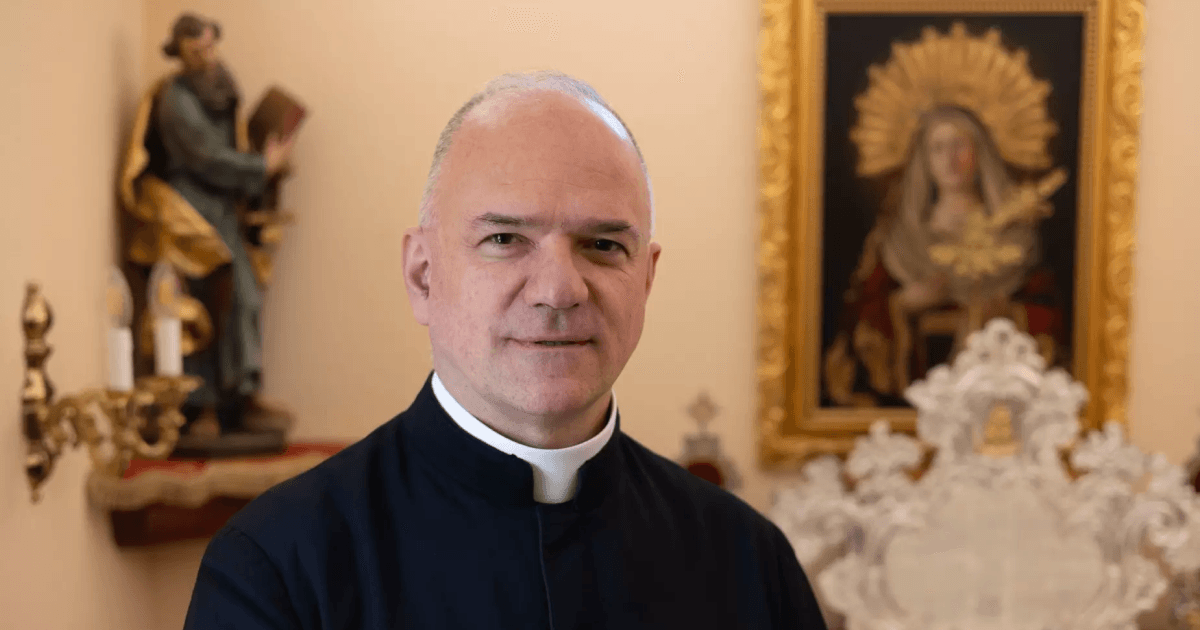
The Superior General of the Society of Saint Pius X has claimed that it is “tradition itself” which has been excommunicated, following the episcopal consecration of four bishops without papal mandate.
Penning a letter to faithful attending Society Masses, the Superior General of the SSPX sought to encourage them in their continued support for the group, while also decrying the Holy See’s Decree of censure. Referencing the huge crowds gathered at the SSPX seminary of Econe to witness the 1 July consecrations, Father Davide Pagliarani said that the “scene has been deeply engraved on my memory, and I shall never be able to forget it.”
“It was the most beautiful image that could be given of the Society”, he said.
The consecrations had been prohibited by the Holy See, with the warning that the bishops consecrating and receiving the order would incur the penalty of automatic excommunication. This was duly followed through, with the Vatican issuing formal notice of this via a 2 July Decree.
The Decree also warned that “clerics and the lay faithful are warned not to join the schism of the Priestly Fraternity of St. Pius X, as they would thereby incur ipso facto the penalty of latae sententiae excommunication.”
“Right up until the last day, I hoped for a gesture of goodwill, or at least of simple understanding, on the part of the Holy See,” wrote Pagliarani. “But the consecrations were condemned, and the harshness of the sanctions imposed is unprecedented.”
The Superior General’s missive did not reference the letter received from Pope Leo XIV one day before the consecrations, in which the pontiff urged the Society against proceeding with the event. Leo praised many aspects of the SSPX’s life and also promised the possibility of “dialogue” should the Society halt the consecrations.
Both on the day and since then, Pagliarani did not consider Leo’s letter to be sufficient to prevent the consecrations from proceeding.
“The sanctions”, he wrote in his 19 July letter, “are intended to strike you [faithful] too, in a rather cruel way. This is certainly painful, but do not be too surprised by it.”
According to Pagliarani, the Holy See’s censures were aimed not so much at the bishops, priests or faithful, but rather at what they promote. He attested:
“Ultimately, it is Tradition itself, which we cherish above all else, that is excommunicated in all those who embody it. It is evident that, before God, such a condemnation cannot be valid, for it would condemn what lies at the very heart of the life of the Church.”
Such a statement appears to be in juxtaposition to Leo XIV’s letter sent to the Society on the eve of the consecrations, in which he lauded their devotion to Tradition and the ancient liturgy. “The Church recognises the devotion to liturgical life, commitment to priestly formation, apostolic zeal and desire for fidelity to Tradition that characterise many people and communities connected to your Fraternity,” said Leo.
In urging the SSPX faithful to continue in their commitment to the Society, Pagliarani once again framed the consecrations as an answer to the Church’s internal crisis and a means to secure the preservation of Tradition. “If Providence permits such a crisis that the teaching of the Faith becomes mysteriously obscured, that same Faith must continue to live in souls, despite all the contrary winds that seek to extinguish it,” he opined.
A large part of the confusion regarding the situation of the SSPX following the 1 July consecrations, and the ensuing rhetoric, stems from the Holy See’s response to the ceremony.
An accompanying Note from the Holy See sought to go further than the penalties of the 2 July Decree, attesting that the priests of the SSPX are automatically in schism. The Note added that faithful who “formally adhere to the Priestly Fraternity of St. Pius X are to be considered schismatic and excommunicated” under the terms of the Vatican’s 1996 Note explaining what formal adherence entails. Additionally, it argued that the SSPX’s Confessions and Marriages would be invalid, due to the lack of proper authority.
This has led to numerous statements from commentators and even bishops, attesting that Catholics who even attend an SSPX Mass will incur automatic excommunication. It has also given support to the rhetoric from the SSPX in recent days as priests have lambasted the Holy See for excommunicating SSPX faithful for attending the Masses which they had done for so long.
However, the accompanying note to the Vatican’s 2 July Decree has been contested by numerous canon lawyers, who argue that is has no legal weight and thus cannot be enforced, since it attempts to issue further penalties than the Decree itself.
In particular, since the SSPX were granted faculties for Confessions and Marriages directly by Pope Francis, it is Pope Leo who must directly remove those faculties. Since no such papal decree has been issued, those sacraments are still valid.
Furthermore, the claim by all parties that Catholics are excommunicated simply for attending a Society Mass is false. The 1996 Note cited by the Vatican clearly outlines the external and internal requirements in “formal adherence” to a schism.
Detailed study of the 1996 text reveals that it is difficult for the Church to judge whether a lay-person has formally adhered to a schism, but it does explicitly state that “occasional participation in liturgical acts or activities of the Lefebvrian movement—without adopting the attitude of doctrinal and disciplinary disunity characteristic of that movement—is not sufficient to constitute formal adherence to the movement”.
Last week the Society announced it had begun the process of appealing the 2 July Decree regarding the excommunication of bishops, and the Vatican’s response is expected within the next month.
Michael Haynes is an English journalist in the Holy See Press Corps. He serves as Vatican Correspondent for the Catholic Herald, while readers can follow him at Per Mariam and on X @MLJHaynes.