On December 13, the Superior General of the Priestly Fraternity of Saint Pius X, Fr Davide Pagliarani, reiterated that the Catholic Church is now in a state of emergency more acute than that which led Archbishop Marcel Lefebvre to consecrate bishops without papal mandate in 1988, raising fresh questions about the future direction of the traditionalist society.
Fr Davide Pagliarani spoke in Friedrichshafen, southern Germany, on December 13, where he appeared alongside Bishop Bernard Fellay, the former Superior General of the Fraternity and one of the four bishops consecrated by Archbishop Lefebvre. Significantly, in his address the current Superior General gave his most substantial and direct public acknowledgement to date of a possible future consecration.
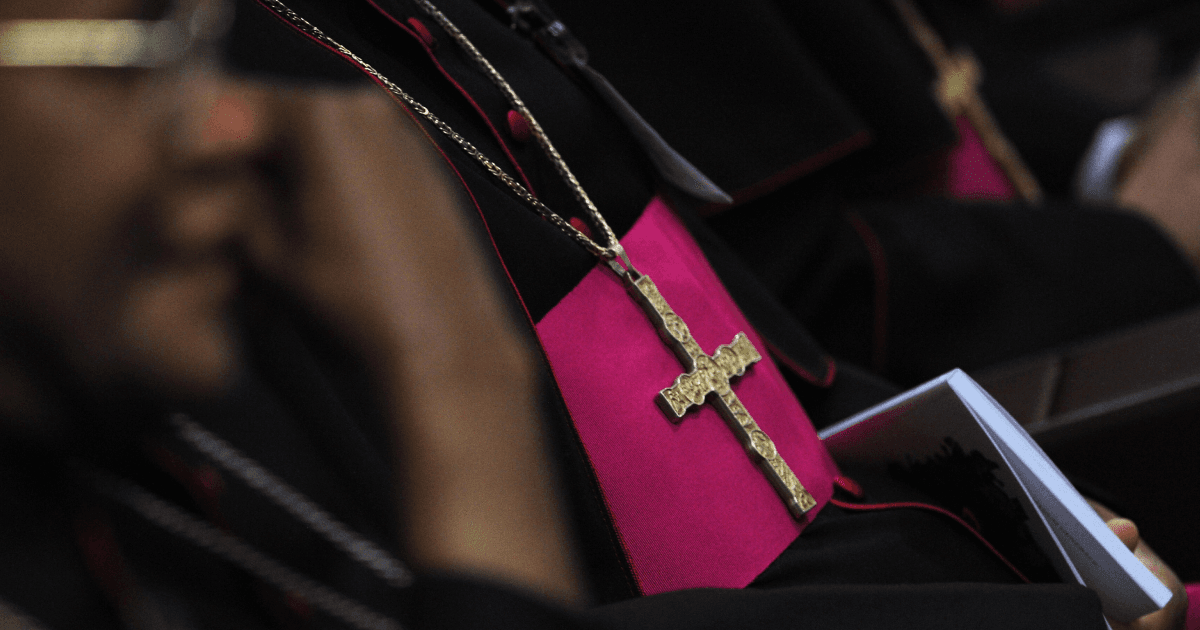
“The question of future bishops’ consecrations is the million dollar question,” Fr Pagliarani said, stressing that no direct information could be given at this time. “I am not here to give dates or names.”
The issue of bishops has long been central to the identity and survival of the Priestly Fraternity of Saint Pius X, which operates outside the Church’s canonical structures. The SSPX argues that it possesses “supplied jurisdiction” on the grounds of a state of necessity in order to provide the sacraments while remaining outside those structures.
Fr Pagliarani returned explicitly to that argument, asking whether similar conditions prevail today. “Does a state of necessity exist in the Church today, as it did in 1988 when Marcel Lefebvre consecrated four bishops? This state of necessity is more clearly recognisable today than in 1988,” he said.
His assessment was framed largely in terms of the legacy of Pope Francis. “After the pontificate of Pope Francis, we find ourselves in an emergency situation,” Fr Pagliarani told his audience. He continued, “Although the Pope has passed away, his decisions remain epoch making, problematic, and far reaching. This pontificate exemplifies the state of necessity within the Church from start to finish.”
Fr Pagliarani pointed to what he described as serious deficiencies at parish level. “In ordinary parishes, the means for the salvation of souls are often lacking,” he said. “The preaching of the truth and the administration of the sacraments are no longer guaranteed.”
He insisted, however, that any consideration of new bishops should not be understood as a matter of institutional self interest. “The consecration of bishops is not about an internal problem of the Priestly Fraternity, but about the good of the Church.” At the same time, Fr Pagliarani emphasised that such steps could not be taken lightly or hastily. “It is not only necessary to prepare the ceremony of bishops’ consecration, but also hearts,” he said. “Such decisions must be made through prayer.”
Only five days earlier, on December 8, The Catholic Herald reported that the German outlet Corrigenda had interviewed Fr Franz Schmidberger, a former Superior General of the SSPX, who said that discussions were under way but that no decisions had yet been taken. “It is being considered, but I cannot say when it will take place and how many bishops will actually be ordained.”
In the same interview, Fr Schmidberger said that any move towards new episcopal consecrations would require engagement with the Holy See. “The Society will have to discuss this with Rome, which is an essential point, because in a normal situation bishops cannot be consecrated without the Pope’s permission.”
From its foundation the SSPX has understood itself as a work of preservation rather than protest. Archbishop Marcel Lefebvre did not begin with an intention to defy Rome, but with the conviction that priestly formation and sacramental life needed safeguarding amid doctrinal confusion following the Second Vatican Council. The logic that eventually led to the 1988 consecrations emerged gradually, hardened by failed negotiations and a growing sense that delay itself had become dangerous.
The documentation, particularly the correspondence later published in the book Archbishop Lefebvre and the Vatican, makes clear how reluctant that final step was. Even then, the wider Church became aware of the coming consecrations only weeks before they occurred. What appears in retrospect as a rupture was experienced internally as a last resort reached under pressure and time constraint.
For four decades, episcopal succession has been the Society’s most sensitive question, deliberately handled in private to avoid escalation. Public discussion itself is therefore significant, regardless of whether dates or names are forthcoming. Fr Pagliarani’s framing of the issue is also telling. By returning explicitly to the concept of a state of necessity, he situates the present not as an unprecedented development but as a continuation of an unresolved emergency since 1988.
The reference to the pontificate of Pope Francis is central, not because of personal animus, but because that period is viewed within the SSPX as a crystallisation of long standing concerns. When Fr Pagliarani speaks of an emergency situation whose consequences remain after the Pope’s death, he is articulating the belief that structural and theological shifts have altered the Church’s internal condition in a lasting way.
Another historical pattern also emerges. Archbishop Lefebvre’s so-called Operation Survival, conceived in 1986, was shaped as much by practical geography as by theological conviction. A worldwide society without bishops risks paralysis when borders close or faculties are withdrawn, as was seen during the COVID period. Speaking to priests of the Society close to its leadership, it is understood that current thinking envisages a bishop for each continent, a structure regarded as necessary to ensure continuity and resilience in an increasingly unstable global Church.
The persistence of the consecration question indicates that the wounds have not healed and that trust between Rome and tradition remains fragile. It also demonstrates that beneath ecclesiastical politics lies a deeper struggle over how continuity is secured when authority itself is contested.