How do you turn a Requiem into a stage work? With some difficulty is the answer. Famous settings by the likes of Mozart, Verdi and Britten have an urgency and scope that makes them loosely viable as theatre – which is why you do occasionally find them done dramatically rather than in a concert hall or church. But Brahms’s Ein deutsches Requiem, which does away with the traditional liturgical texts and replaces them with consoling reflections from the psalms and other biblical sources, is a different matter. And however Brahms envisaged the performance of his piece, it won’t have been on the terms in which it was given recently at La Seine Musicale – the spectacular concert hall that floats like a ship in the middle of the river in Paris (it is actually an island) and where the French conductor Laurence Equilbey puts on extraordinary projects with her period-style ensemble Insula.
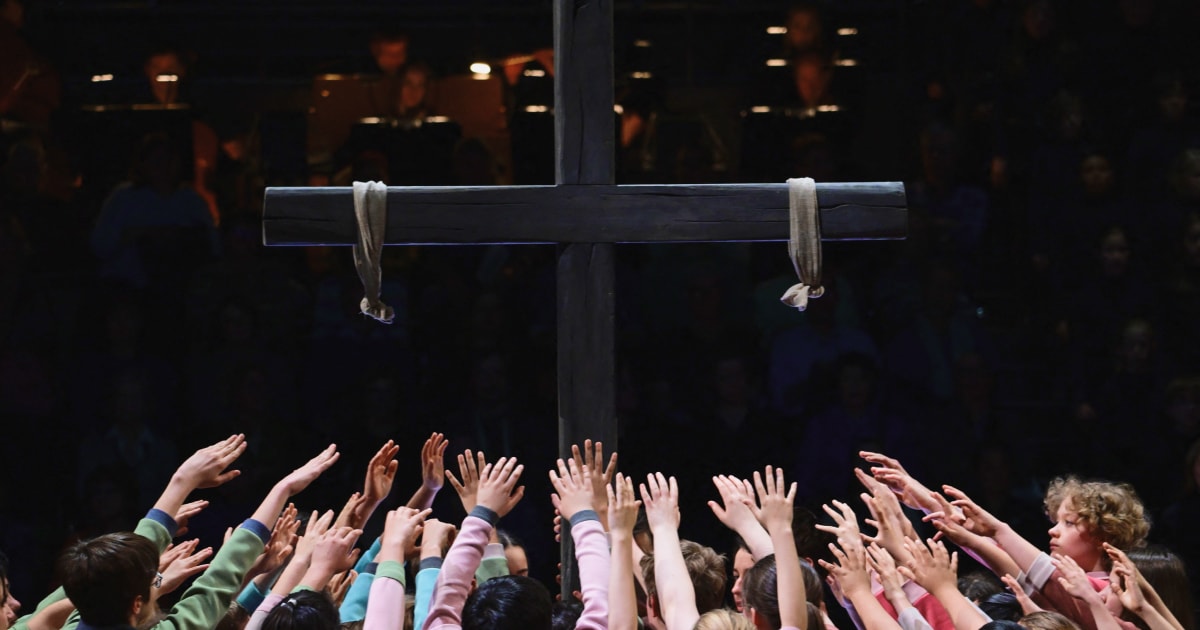
A few years ago she presented Fauré’s Requiem as the soundtrack to a rather forbidding art film about rituals of death. This time, with the Brahms, she went further. Entering the auditorium, you were confronted with the all-too-realistic stage set of a crashed plane – out of which emerged, dazed and confused, the chorus for the Requiem, singing from memory and acting out the parts of crash survivors. Except, maybe, they had not survived. Perhaps they were all dead, negotiating afterlife existences. It was not spelled out.
Either way, they were all members of Equilbey’s own professional choir Accentus who, like an opera chorus, are experienced in the business of singing on the move, with some element of theatre. Suffice it to say, they are good: among the better choirs in France, where choral tradition does not flourish so abundantly as in Britain. And quite apart from the emotional assault of the staging – which included some arresting aerial ballet from a gymnast on a wire, hanging in mid-air like the broken body on a crucifix – the musical performance was affecting: strong but supple, with distinctive soloists in soprano Eleanor Lyons and baritone John Brancy.
That it took some liberties with Brahms’s score, inserting bits of Bach cantatas into its trajectory, as well as a poignant moment when Brahms’s famous lullaby surfaced to the accompaniment of a lone accordion, was risky. But it sort of worked. And I can honestly say that I will never hear the Brahms Requiem again without that image of the wrecked plane taking over: a connection forged indelibly, for good or otherwise.
•
There was nothing so visually impressive about the English National Opera staging of Kurt Weill’s Rise and Fall of the City of Mahagonny, playing as it did at the London Coliseum on scruffily bare terms that advertised not only the problems the company is going through but the problems of the piece. Composed to words by Bertolt Brecht in 1920s Weimar Germany, Mahagonny is a sermon on the evils of Western capitalism that started life as a punchily compact cabaret score but was then enlarged by its authors into a leaden monster – maintaining the cabaret songs (which are why the piece is worth doing) but stringing them out with ideological rant so heavy-handed and long-winded that engagement flags.
As a result, the full-sized Mahagonny is a challenge to both audiences and performers. And this ENO show, done on the cheap with minimal rehearsal, did not rise to it beyond the level of heroic failure. Everyone involved worked frantically to keep its sapping energy alive, including the director Jamie Manton and conductor Andre de Ridder. And there were strong performances within the cast – though sadly not from the supposed star, Danielle de Niese, who failed to project, wasting some of Weill’s best numbers in the process.
Given ENO’s cash-strapped state, it would have been smarter to have done the leaner, little version – maybe somewhere other than the Coliseum, where it would not have been lost on such a massive, empty stage, and where the muscle of the piece might have registered more powerfully. Mahagonny’s basic message – that the world is mired in greed, lies and corruption – is worth hearing. But its presentation needs more thought and care than it got here.
•
The great unfulfilled plan of Elgar’s life was to write a trinity of oratorios on the life and legacy of Jesus; and of the two he completed, The Apostles is the one with deathless tunes beloved of choral societies, while The Kingdom is generally thought of as the also-ran, its best ideas merely reprises of the other piece.
The Kingdom, though, does have its champions. Among them is the choral conductor David Temple, who recorded it recently (to acclaim) with his own Crouch End Festival Chorus and repeated that success in a live performance at the Festival Hall, where the Chorus were joined by Temple’s other group, the Hertfordshire Chorus.
Together they produced a thrilling sound – so many large-scale choruses are woolly in the middle voices, lacking decent tenors: this was strong and clear across the range. And standing proud among a good line-up of soloists was the spectacular Francesca Chiejina: a soprano to watch out for, clearly on the rise.
It did not manage to persuade me that The Kingdom is a masterpiece to be compared with Elgar’s truly great The Dream of Gerontius. And no, it does not bear comparison with The Apostles either. But it invests the biblical narrative of Pentecost with appropriate drama; touching scenes unfold between disciples in the Upper Room; and there is a lyrically soft setting of the Lord’s Prayer that may not be Elgar at his best but steers the score effectively to its conclusion. All of which makes it a piece worth reappraisal by a wider public – not just for collectors.