April 9, 2026

Zurbarán: painting, piety and the power of stillness

Melanie McDonagh
More
Related
Min read
share

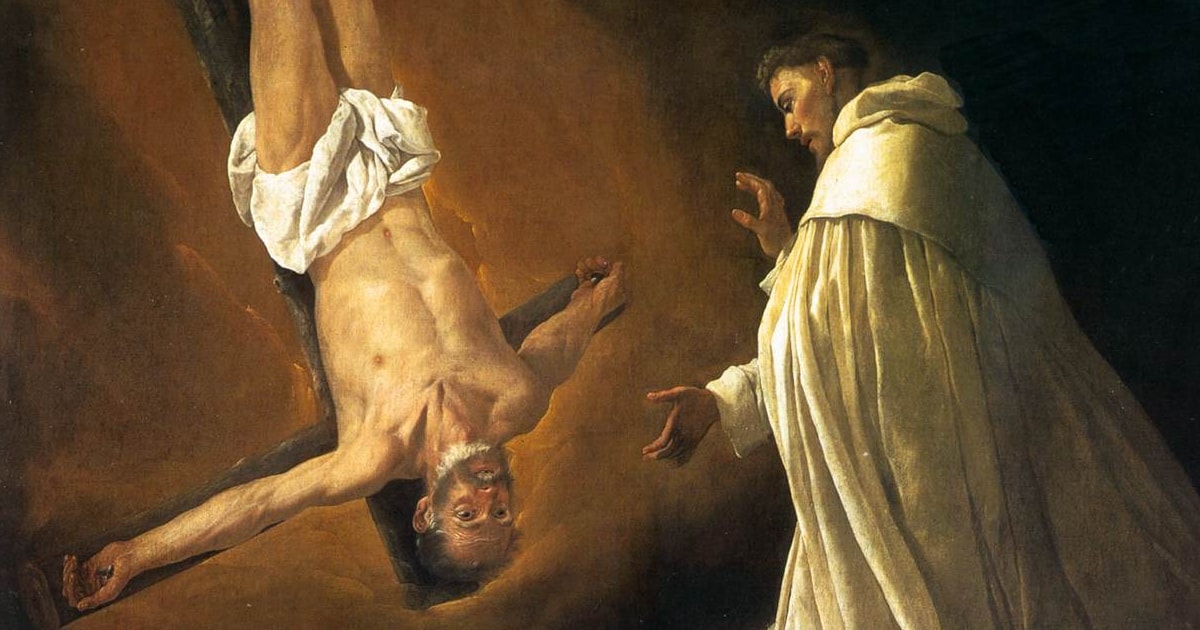
There is not much that we know about the life, let alone the personality, of Francisco de Zurbarán, the 17th-century Spanish painter who is the subject of a new exhibition at the National Gallery in London from May 2. Yet two pictures that top and tail the show from the Prado in Madrid tell us a good deal. The Apparition of Saint Peter to Saint Peter Nolasco is an astonishing, shocking work, which strikes the viewer – at least, this viewer – as extraordinarily modern. The friar saint, founder of the Mercedarian Order, kneels before another Peter, the apostle. But it is St Peter as he is being crucified upside down, slanting down the canvas in a dramatic head-first plunge, supported by rusty clouds. The saint is old, his lips drawn over his teeth and his unseeing eyes staring, his cheeks reddened – this is not a dignified death but an undignified torture. The kneeling St Peter Nolasco gestures to him in reverence. In this drama the two figures are separate and distinct, drawn together by the friar’s compassionate gesture and downward gaze.

© Photographic Archive Museo Nacional del Prado

The exhibition closes with The Crucified Christ with a Painter, which shows just that: Christ on the Cross, affixed by four nails, his head hanging down, his skin grey in death. The Cross is starkly alone against a dark and cloudy sky, the time when the sun was darkened; the hills in the background are barely visible. But below the Cross, at a little distance, there stands a man in striking soft pink, looking up at Christ with the utmost tenderness and reverence, one hand on his chest, the other gesturing towards him. It is such a striking image, those two figures, that it is only on closer inspection that we find that the gesturing hand is holding a palette and paints, with the paint distributed as for painting. It could well be Zurbarán himself, and his attitude of reverence and awe may be telling us how he saw the work of sacred art, his art: to inspire devotion, to draw the viewer in contemplation towards the suffering Christ. The attitude of the painter, gazing up at the dead Christ, is that of the viewer looking at both. It is art in the service of affective piety.

These two pictures are a concentrated version of what the exhibition curator, Francesca Whitlum-Cooper, identifies as Zurbarán’s particular genius: the capacity to make time stand still. It is heightened drama, an emotional intensity which characterises much of the Spanish art of the period but is especially evident in Zurbarán.

© Photographic Archive Museo Nacional del Prado

There are other elements of Zurbarán here. Take a look at the flowing drapery of the kneeling friar: Zurbarán gives fabric an almost sculptural quality, but also has a feel for the particular character of the textile. His father was a haberdasher and dealt in textiles.

There is also a sculptural quality to his figures. That theatricality may owe something to Zurbarán’s training in gilding and on polychrome sculptures – carved, coloured figures which were more highly regarded at the time than paintings. Some of those figures may have been taken in procession around Seville, where Zurbarán spent much of his career, and that sense of drama invests many of his paintings of individuals: the magnificent St Casilda from the Museo Nacional Thyssen-Bornemisza, for instance, with her sideways gaze, her dramatic scarlet sleeves and brocade skirt and splendid beribboned braids, for she is a sultan’s daughter. A whole room of the exhibition will be given over to these figures, and together they convey the impression of a procession, so characteristic of medieval and early modern religion. Art was on the move in the streets, not just on walls.

Among the most striking figures are those from the Carthusian house outside Jerez, now in Cádiz, depicting notable monks in their sculptural white habits; the order was an important patron of his. The habits are uniform, yet he invests the figures with remarkable individuality. They were intended, moreover, for a little curved passageway behind the altar of the monastery, which is intensely dark, and there the white of the painted habits, viewed by other monks in the same habits, would have shone in the candlelight with dramatic intensity.

© Photographic Archive Museo Nacional del Prado

But the highlight of the show is a smaller picture, intended, it would seem, for private contemplation. It is the Agnus Dei from the Prado, the finest of the paintings of the subject, of which Zurbarán did several. It is of a lamb, a male lamb, with horns; his little hooves are drawn together with cord; his eyes are open, looking down. He is unresisting, but it would seem he knows his fate. It is, in the old sense of the word, pathetic, arousing in the viewer the utmost compassion; it could make a vegetarian of me. There is no halo on this lamb as on others, and the museum is considering replacing its title with the simple description of Little Lamb; but for a 17th-century viewer it would mean one thing: the Lamb of God, the willing sacrifice. We have no record of what Zurbarán called it. The woolly fleece is intensely tactile; you could stroke the silken hair on its legs. That lamb is worth a visit alone.

This promises to be a wonderful exhibition, drawing together about 50 works, including his still lifes, from a variety of galleries, including Chicago (where the exhibition will travel after London and Paris), Philadelphia, the Louvre and several Spanish museums. It will be worth a visit if only to avoid the queues at the Prado, where you can easily wait an hour and 40 minutes to get in, where Zurbarán is juxtaposed with his friend Velázquez and Murillo and stands up to the comparison. Go, and be moved.

‘Zurbarán’, National Gallery, London, May 2 – August 23, 2026. The Musée du Louvre exhibition of Zurbarán’s works will be on view from October 7, 2026, to January 25, 2027, and the exhibition at the Art Institute of Chicago will take place from February 28 until June 20, 2027.

Continue reading with a free account

Create a free account to read up to five articles each month
Create free account

You have # free articles remaining this month.

Subscribe to get unlimited access.
Sign up

subscribe to the catholic herald today

Our best content is exclusively available to our subscribers. Subscribe today and gain instant access to expert analysis, in-depth articles, and thought-provoking insights—anytime, anywhere. Don’t miss out on the conversations that matter most.
Subscribe