


May 24, 2026

Death in Algiers

Andrew Cusack
More
Related
Min read
share

It drives you mad, the sun. Or so they tell me, but personally I can’t get enough of it. But then I don’t live in 1940s Algiers like Albert Camus did.

His novel L’Étranger – “The Stranger”, now adapted for film by François Ozon – abides in constant solar imagery and references: “the blazing sun that made the landscape shimmer”, “it was still the same bright, sun-drenched countryside”, “the day, already full of sunshine, hit me like a slap”.

Camus was a writer of brutal honesty, both about the injustices of the world around him and about the reality of himself. Brought up in French Algeria, a society of sun, sand and racial tension, he was willing to confront its injustices but was also in love with the land of his birth. As he said forthrightly when accepting the Nobel Prize for Literature in 1957: “I believe in justice, but I will defend my mother before I will defend justice.” It is perhaps just such nuanced realism that has made Camus, a man of the Left, so receivable across the literary spectrum. Indeed, a now-dead friend of mine raised in Northern Rhodesia pointed out L’Étranger was a staple of French classes in British colonial schools (although by then white schoolteachers were, in a sense, the liberal clerisy of these late colonial societies).
Ozon’s adaptation is the second French one after Visconti’s 1967 production and the director clings reasonably close to the novel but not slavishly. “To make a modern adaptation,” Ozon told the press, “I had to take into account everything that has happened since 1942, the year the book was published. There was the Algerian War, independence and also all the analyses that have been done on the book, both philosophical and literary.”

The director cites the book’s entry into popular culture beyond the Francophonie thanks to The Cure’s 1978 song “Killing an Arab” – included in the closing credits – renewed by Kamel Daoud’s acclaimed 2013 novel Meursault: contre-enquête, investigating the fictional murder from the perspective of the dead Arab’s brother.

“For me,” Ozon says, “it was impossible to ignore all of that. It had to be integrated into the film. So very quickly, I needed to contextualise the story and, in my character development, particularly in the character of the sister, to give voice to an Arab perspective.”

The film’s response is to name the victim Camus never granted a moniker, as well as adding the character of his sister. The divergences from the novel are more like respectful forms of adaptation rather than straying from the writer’s purposes.

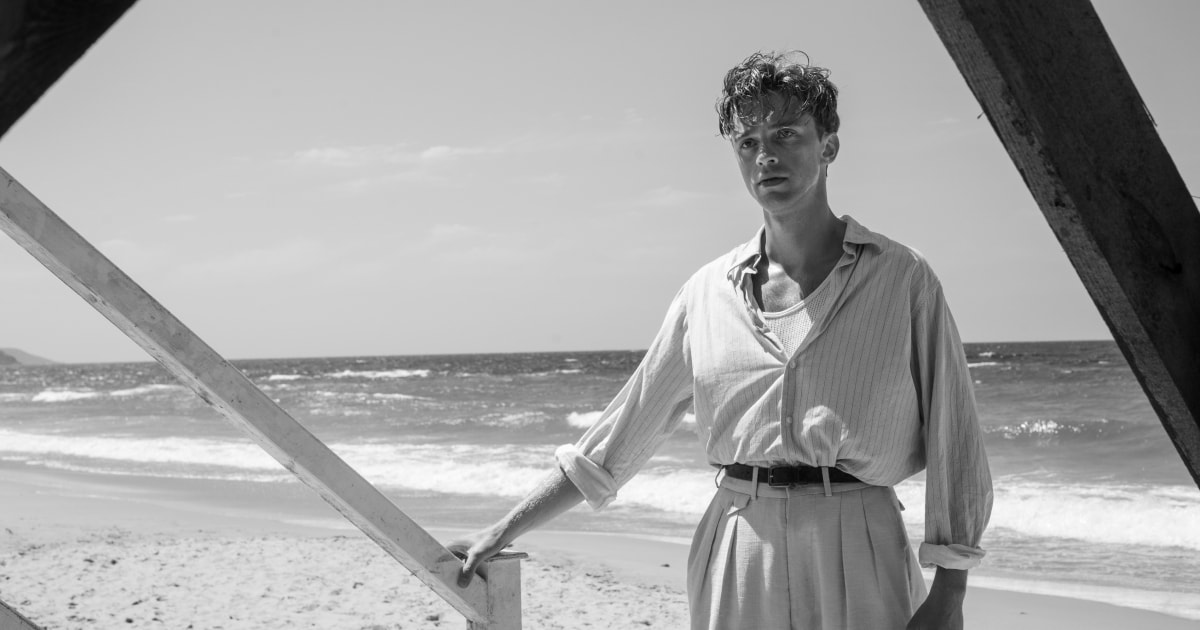
The film might be in black and white – anachronistic, but it works – but both Camus’s original novel and Ozon’s interpretation of his work avoid moral simplification or reductionism. The director skilfully reproduces Camus’s ability to depict a situation such that one forgets he is the creator of it.

In “The Stranger”, he is aided by a first-rate cast. Benjamin Voisin’s Meursault bears the weight of the film. Is he simple? Is he wicked? Is he deranged? Or is he just an insensitive young man? Blunt and undiplomatically honest? Voisin is a total cipher, brusque somehow without being rude, hurtful to his girlfriend Marie in a matter-of-fact way, unmoved by the infelicitous circumstance of human existence – the death of his mother, an old man struggling to walk in her funeral procession. His only hint of humanity is when his neighbour grieves for the missing dog he has been cruel to and Meursault invites him into his flat to commiserate.

Like every pretentious francophile plaguing South Kensington’s Ciné Lumière, I thought I was on top of French cinema but I hadn’t recognised Voisin as the protagonist from Xavier Giannoli’s excellent 2021 Balzac adaptation Illusions perdues. Voisin was capable there, but here he is a master of restraint. He is aided by the attractive and elusive Rebecca Marder as Marie. The boisterous Pierre Lottin stars as Meursault’s neighbour and nabbed the only César – for Best Supporting Actor – of the film’s four nominations. Fatima Al Qadiri’s subtly haunting score was similarly nominated but was robbed by the prize jury.

The film deals with the Catholicism of death in French North Africa in an unfussy and unbothered way – very French itself. Voisin’s unbothered Meursault is the epitome of calm all through his trial and – plot spoilers – condemnation to death. Somehow it is only the arrival of the prison chaplain – Swann Arlaud, Best Actor at the 2018 Césars – that our protagonist becomes ferociously perturbed. It’s not that Meursault hasn’t confronted the reality of death – his mother’s, the Arab he killed – but the chaplain confronts him with the reality he had failed to consider: that of eternity.

Continue reading with a free account

Create a free account to read up to five articles each month
Create free account

You have # free articles remaining this month.

Subscribe to get unlimited access.
Sign up

subscribe to the catholic herald today

Our best content is exclusively available to our subscribers. Subscribe today and gain instant access to expert analysis, in-depth articles, and thought-provoking insights—anytime, anywhere. Don’t miss out on the conversations that matter most.
Subscribe