



Pentecost ought not to pass politely. If Easter dazzles and Christmas enchants, Pentecost should unsettle. It arrives not with the stillness of a manger or in the quiet wonder of a garden, but with disruption: ‘a sound like a mighty rushing wind’, tongues loosed, barriers overturned, speech made strange and suddenly universal. It is a feast not only seen in flame, but heard – viscerally, insistently heard.
The scriptural account is saturated with sound. Before there is proclamation, there is noise; before understanding, a kind of holy confusion. The Apostles do not begin in composure but in upheaval. And it is precisely here that music finds one of its deepest theological homes. Pentecost is not tidy. It is not merely reflective. It is, at its heart, an eruption.
This has profound implications for how we approach music in the liturgy. Too often, sacred music risks becoming a vehicle for the expected, the well behaved, even the anaesthetised. But Pentecost resists that instinct. It asks something riskier: that sound might once again surprise us, even startle us into awareness. The ‘other tongues’ are not simply a miracle of communication: they are a reconfiguration of perception. Something new is breaking in, and it does not sound like what came before.
Joseph Cardinal Ratzinger (later Pope Emeritus Benedict XVI) expressed this with characteristic depth: ‘Church music comes into being as a “charism”, a gift of the Spirit. It is the true glossolalia, the new tongue that comes from the Holy Spirit. It is above all in Church music that the “sober inebriation” of faith takes place – an inebriation surpassing all the possibilities of mere rationality. But this intoxication remains sober, because Christ and the Holy Spirit belong together, because this drunken speech stays totally within the discipline of the Logos, in a new rationality that, beyond all words, serves the primordial Word, the ground of all reason.’
‘Sober inebriation’ is a striking phrase – paradoxical, even provocative. It captures something essential about the musical life of the Church. True liturgical music does not abandon order, but neither is it confined by it. It stretches language to its limits, and then goes beyond, into that realm where meaning is carried not only by words, but by sound itself – by resonance, by colour, by the shaping of breath into something that feels at once human and more than human.
To work daily with a children’s choir is to encounter this mystery in miniature, and often in unexpectedly vivid ways. Children approach the liturgical year not as a cycle to be managed, but as a series of lived experiences, each with its own emotional and sensory imprint. Pentecost, for them, is not an abstract theological concept. It is noise, excitement, energy – something almost unruly.
There is a particular privilege in guiding them through this terrain, especially in a place where tradition runs deep and expectations can be high. One begins to see how the Holy Spirit does not merely sustain what is already established, but continually renews it – often through the very voices one might least expect.
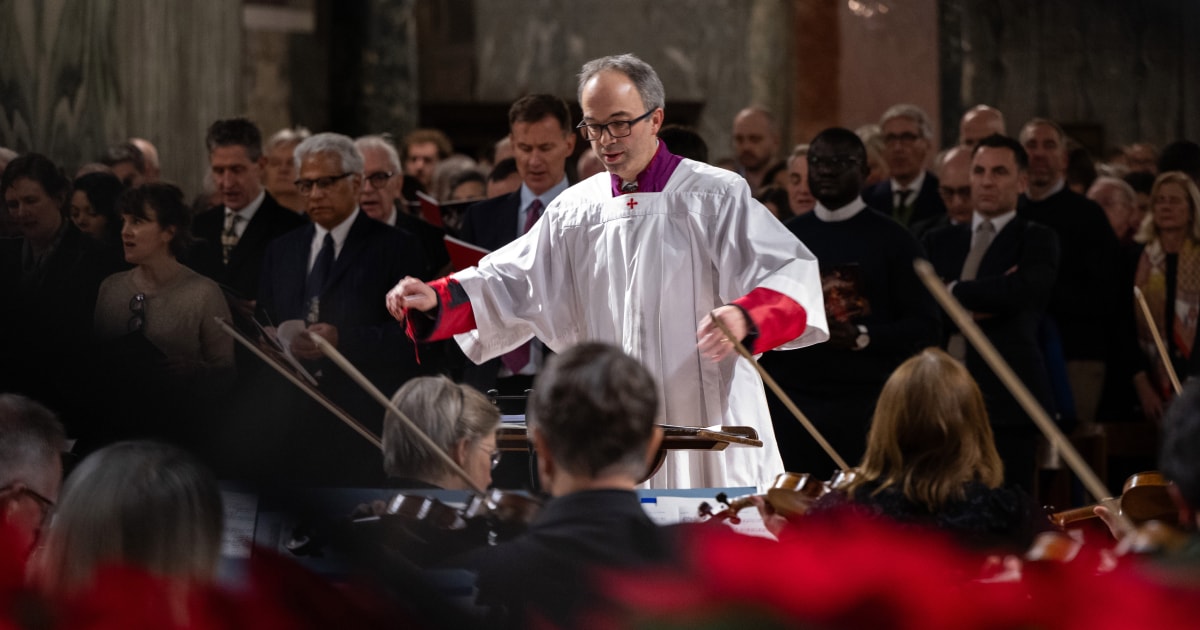
When I arrived as Master of Music at Westminster Cathedral five years ago, the choir stood at something of a crossroads. This was not through any failure of those who had gone before, but the cumulative effect of the Covid pandemic and the residue of uncertainty following changes to the choristers’ routine. The choir felt like a wounded creature – still possessing formidable instinct and power, but inexperienced, wary, unpredictable, and in need of careful, patient rebuilding. It is precisely in such circumstances that one becomes acutely aware of how fragile a choral tradition can be.
The rebuilding of a choir brings its own Pentecostal dimension. As repertoire expands and confidence grows, there is a palpable sense of horizons opening. Music that once seemed out of reach becomes possible; unfamiliar harmonic languages begin to speak; the collective sound acquires depth and character. This is not simply a matter of technical progress. It feels, at times, like the emergence of a shared voice – something given rather than constructed.
And there is, too, something quietly counter-cultural about boys singing. In an age where such a thing can seem unusual, even improbable, the sight and sound of boys committing themselves to this tradition carries a note of surprise. That surprise, in its own way, echoes Pentecost. It challenges assumptions about what has become normal, what is desirable, what is possible. It suggests that beauty, discipline and expressive freedom are not relics, but living realities.
Perhaps this is part of what it means for music to ‘shock’ us at Pentecost – not through novelty for its own sake, but through the reawakening of our capacity to hear. When a choir finds a new level of intensity, or when a familiar piece is suddenly charged with fresh meaning, something shifts. We are reminded that the liturgy is not a performance to be consumed, but an event in which we are caught up.
The ‘sober inebriation’ of which Pope Emeritus Benedict speaks is not an escape from reality, but a deeper entry into it. It is the experience of being drawn beyond the limits of ordinary speech and thought, while remaining grounded in the truth that gives those limits their meaning. In musical terms, it is that moment when sound seems to carry more than it should be able to carry – when it becomes, in some sense, transparent to something greater.
Pentecost invites us to seek out such moments, and perhaps even to risk creating the conditions in which they might occur. It asks us to trust that the Spirit is still at work – not only in the grand gestures, but in the daily discipline of rehearsal, in the gradual formation of young voices, in the patient unfolding of a tradition that is always, somehow, new.
And so the feast returns each year, not as a repetition, but as a renewal. The wind still blows; the voices still rise; the Church still sings in tongues both ancient and ever new. If we are attentive – if we are willing to be surprised – we may yet find ourselves caught up in that same ‘sober inebriation’, where sound becomes more than sound, and music becomes, unmistakably, a gift of the Spirit.