July 8, 2026

Stella Maris: the Aga Khan’s church by the sea

Andrew Cusack
More
Related
Min read
share

The Mother of God has been invoked as Stella Maris – Star of the Sea – for almost as long as she has been invoked at all. Long before the world of satellites and GPS, lighthouses and admiralty charts, those who depended upon the sea called upon her to protect them from the dangers of the waves. Stella Maris is an ancient title precisely because Christianity in its earliest days was a religion of the sea. The first Apostles were fishermen, and it was around the shores of the Mediterranean that the Gospel was first spread. The sea we so often view as a barrier today was the great highway of the ancient world, and along its waters travelled merchants, soldiers, missionaries and pilgrims. The first centuries of Christianity primarily unfolded from one port to another.

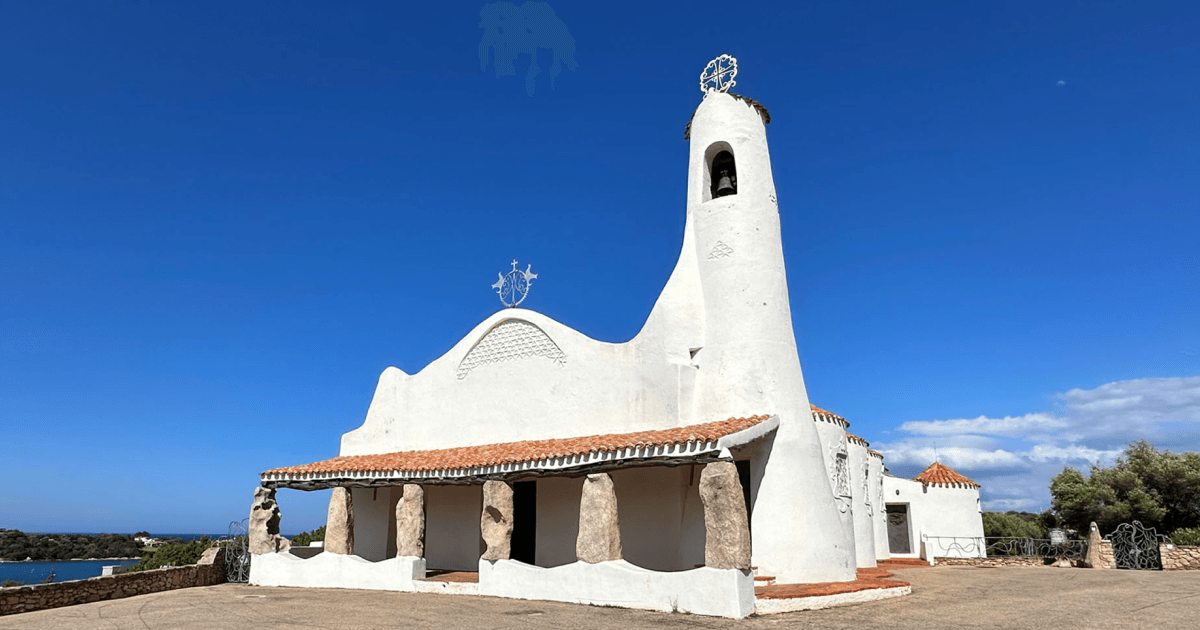
These days, seagoers broadly fall into two camps. There are those who work upon it, carrying the commerce upon which the modern world depends, and there are those who seek their pleasure upon it, sailing because they enjoy it. Since the 1960s, pleasure seekers in the Mediterranean have been able to sail into Porto Cervo in Sardinia, where the first building that greets the eye is a fine whitewashed church on a bluff raised slightly above the harbour.

Aside from its beauty, this church has an added significance. Churches have been commissioned by many over the centuries: bishops, priests, merchants, princes, confraternities, religious orders, the rich and even the poor. This church was commissioned and built by the hereditary imam of the Nizari Isma’ilis, His Highness the Aga Khan IV, Shah Karim al-Husseini. It was he who “discovered” this remote corner of the Gallura region of Sardinia in the early 1960s and decided to buy up what he could and sensitively develop it into what is now known as the Costa Smeralda – the Emerald Coast. The Aga Khan envisioned a playground of wealth where discreet villas could be accessed by sea from gleaming yachts, with marinas, hotels and streets that looked as if they had developed organically over time. He crafted a remarkable feat of placemaking with Porto Cervo, creating an ensemble of buildings that refused either slavishly to regurgitate the architecture of the past or modishly to follow the ephemeral fashion of modern styles.

Whatever his own religious views, the Aga Khan understood that a community on Sardinia – even one centred on tourism – required the spiritual heart provided by a Catholic parish. He donated the land, commissioned the building and entrusted its design to the Roman architect Michele Busiri Vici.

Busiri Vici’s own story was remarkable enough, as part of a Franco-Italian family descended from many generations of architects, beginning with Jean Beausire (1651–1743) in France and Andrea Vici (1743–1817) in Italy. His own works spanned many decades and a broad spectrum of clients. At Porto Cervo, he managed to produce a little gem of a church. Stella Maris belongs unmistakably to the 20th century while avoiding the many architectural pitfalls that plagued the period. It is neither an archaeological imitation nor – like too many 1960s places of worship – a bland conference centre in liturgical dress. It feels entirely at home in its surroundings.

The church’s whitewashed walls catch the intense Sardinian sun, while rough local stone anchors the building to the hillside. Curves and flowing, organic forms soften the building’s silhouette without sacrificing any of its dignity. Details in timber, terracotta and ceramic speak a kind of pan-Mediterranean vernacular in architectural form. It draws upon centuries of the unpretentious art of building as practised in Sardinia and across the Mediterranean world, but without directly imitating any one particular source. The building feels absolutely of its place and refreshingly original.

Approaching the church, the visitor is greeted by six dolmen-like rough stones acting as pillars holding up a lean-to, red-tiled roof, providing some shelter from the sun for worshippers emerging from Mass. Stepping inside, the visitor encounters the gentle low arch of the cool nave leading straight to a sunlit sanctuary. A smaller side aisle provides a focus of veneration for the Blessed Sacrament reserved in the tabernacle. The gentle forms feel as if they have been smoothed by centuries, though they only date from the late 1960s. There is a presaging of George Lucas’s Tatooine here, inspired as it was by the rustic architecture of North Africa across the Mediterranean.

The overall mood is one of restrained ease rather than ostentation. The late Aga Khan wanted Porto Cervo to be somewhere that people of extraordinary wealth could let their hair down while maintaining their dignity; Busiri Vici gave them a place of worship where they could do exactly that. Light enters softly across the white surfaces, while works of art reward those who linger, such as the entrance portal and nave lamps designed by the sculptor Luciano Minguzzi, or the Mater Dolorosa attributed to El Greco. Nothing feels excessive. Serenity is the vibe.

Perhaps that is why this church makes such a good impression: it reminds us that beauty does not need to announce itself loudly or boldly. The most beautiful things can be those that are simple and integrated into our daily lives, rather than acts of grandiosity. Of course, there is room for both ends of this spectrum in a well-lived life.

Continue reading with a free account

Create a free account to read up to five articles each month
Create free account

You have # free articles remaining this month.

Subscribe to get unlimited access.
Sign up

subscribe to the catholic herald today

Our best content is exclusively available to our subscribers. Subscribe today and gain instant access to expert analysis, in-depth articles, and thought-provoking insights—anytime, anywhere. Don’t miss out on the conversations that matter most.
Subscribe