


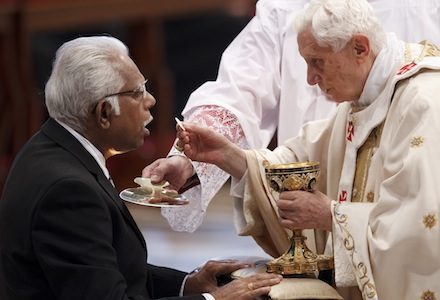
Seven years have passed since Summorum Pontificum, the motu proprio by which Benedict XVI liberated the traditional Latin Mass from all restrictions. As we contemplate this anniversary, it is interesting to ask ourselves what exactly has changed. How has the motu proprio altered the landscape of the Church? On a personal note, what changed for me was that in the wake of the motu proprio I learned how to celebrate the Extraordinary Form, as it became known. I had been to EF Masses as a child, when staying with family friends in Gozo: in those days there was a Tridentine Mass every day in the little church of Our Lady of Pompeii in Victoria. Moreover, I had been to a Tridentine Mass said privately at my school, and later on to a few in Oxford either at Blackfriars or at Campion Hall. But I cannot say that at any point the EF really ‘grabbed’ me. My preference then, and to some extent now, was for the Novus Ordo celebrated in Latin; because I knew Latin, I was quite often asked to serve these Masses for priests who celebrated in Latin; though my real joy was in a Sung High Mass, of the type I used to attend at the London Oratory with my godmother in school holidays. My father was a huge admirer of the Latin Mass of his youth: he used to say that its great advantage was that wherever you went in the world, the Mass was the same, in Latin, in the universal language, and thus accessible to all. That is a point of view I have not heard expressed for many a year. But there is something in it. The EF, I discovered as I learned it, is very formal: every gesture and every word has its place, and there is no room for variation, which is a good thing. Every Mass, in theory, is exactly like every other Mass. Why is this good? It is good because it reminds us that the Church is Catholic, universal. Of course we all have our particularities, but we need to remember that the universal aspect ought to take precedence. Why? Because the revelation of Jesus Christ is something that makes sense across space and time. It is valid for all times and places. Therefore it seems to me that the Mass ought to be celebrated in a way that emphasises the unicity of revelation and the unity of the human family. We should not be celebrating diversity, but identity; not celebrating difference, but the common heritage we all share. I think this is one thing that has changed in the last seven years, and this is one of the looked for fruits of Summorum Pontificum: the EF has ‘reminded’ the OF of the 'catholicity' of the Church. If the horizontal aspect is important, so is the vertical. The EF is clearly old, indeed very old. Codified at Trent, it is much older than Trent, going back to the time of Gregory the Great; in his time it was already old. Moreover, the OF is not ‘new’, in the sense that it is clearly in continuity with the ‘old’ Mass; the ‘new’ Mass is not ex nihilo. So, whether you celebrate one Mass or the other, or both from time to time, you are standing in a millennial tradition, going right back to the time before Pope Gregory. The ancient nature of the Church’s tradition is not something you heard much about when I was growing up, when all the talk was of the importance of ‘relevance’. So it is good that we should feel the worth and weight of tradition, and antiquity. These are useful counter-cultural correctives in this culture of ours, a culture which will one day be in the dustbin of history while the Mass, ever old, ever new, will continue. So this is the main thing that we owe to Benedict’s motu proprio: it has put us more in touch with our history and with our universality. But it goes further. In using the old Missal, one often encounters a beautiful book, more than fifty years old, yet still serviceable; this goes for both altar missals and hand missals. The bibliophile in me recognises these as beautiful survivals, things to be treasured; and like the music that accompanies a missa cantata, as well as the sheer poetry of some of the texts (one thinks in particular of the Dies Irae), these are beautiful things, and a thing of beauty is a joy forever. Modern missals are cheap and hideous: my altar missal, barely three years old, is already falling apart. Much modern liturgical music is trash, and will not survive much longer; much modern liturgical language is ugly and banal. By contrast, the words so many great composers set to music are classics: their meaning will never be exhausted, but they bear fruit in every age. Though most of the Mass is not written in a Latin that approaches the elegance of the Golden Age, much of it is lovely. Summorum Pontificum, over the last seven years, has pointed us towards the importance of beauty. Ugliness in the ecclesial setting, is, I hope, I think, in retreat. Beauty has a theological and spiritual role to play; so does ugliness, but not in a good way; the former is essential, the latter to be resisted at all costs. Summorum Pontificum has been an important weapon in the arsenal of all those who want to resist the tyranny of ugliness and banality. Seven years is a short time indeed. The task is barely begun, but the tide, I pray, is unstoppable.
1:07 PM
Summorum Pontificum has put us in touch with our history
Seven years ago Benedict XVI's motu proprio liberated the traditional Latin Mass from all restrictions
Fr Alexander Lucie-Smith

6 min read



Already a subscriber? Sign in
5freearticles every month
Continue reading with a free account. No card needed.
- Five free articles every thirty days, on any device you sign in on
- The Catholic Herald newsletter, every morning
- Subscribe whenever you like for everything: every article and the magazine
Related articles
 Newsroom
Church leaders urge Drumcree dialogue: ‘Too much is at stake’
The Catholic and Church of Ireland Archbishops of Armagh have urged a renewed commitment to peace and reconciliation amid the Drumcree stand-off
Corrie Douglas-Young Newsroom
Thousands of Irish children to join global Rosary campaign
Corrie Douglas-Young Newsroom
TikTok priest urges young people to stand with persecuted Christians
Nathalie Raffray Newsroom
Baby born at 25 weeks reunites with neonatologist two years after leaving hospital
The Catholic Herald Newsroom
Joe Biden honoured by Planned Parenthood after defending abortion rights
Christine Rousselle
subscribe to the catholic herald today
Our best content is exclusively available to our subscribers. Subscribe today and gain instant access to expert analysis, in-depth articles, and thought-provoking insights—anytime, anywhere. Don’t miss out on the conversations that matter most.
Subscribe



