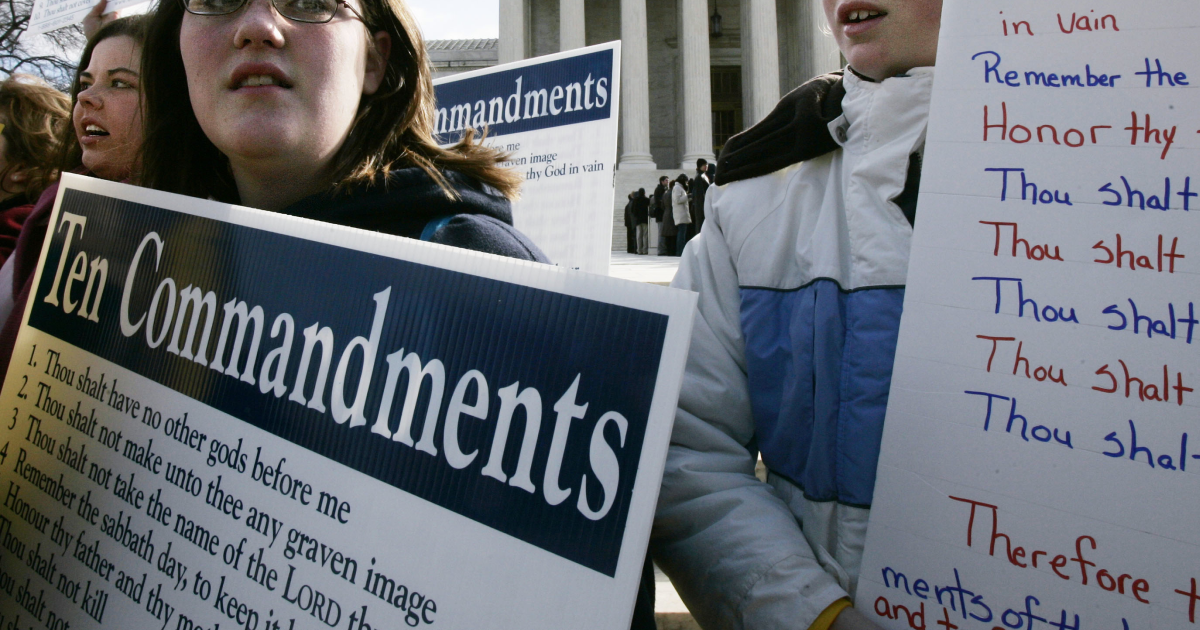


Three Texas parents have filed suit seeking to block the display of the Ten Commandments in their children’s public school classrooms.
The three mothers, identified as Audrey Nath, Sanjam Kaur Sohal and Emily Roth, have children in three school districts in the Houston area. They are suing both the state and their children’s school districts, arguing that their parental rights are being violated. They filed their lawsuit in late July, about two weeks before the start of the school year.
Under a Texas state law passed in 2025, public school classrooms must prominently display a poster of the Ten Commandments. The law was due to come into force last year, but was initially blocked. In April 2026, the Fifth Circuit Court of Appeals found that the law did not violate the US Constitution.
The law states public school classrooms must display a “durable poster” or framed copy of the Ten Commandments in a “conspicuous place”. The text must be legible throughout the classroom, and the posters must present the Ten Commandments in the order used by many Protestant denominations.
Schools are not required to purchase the posters, but they must accept any donated to them.
Unlike previous legal challenges, which argued that the law violated the First Amendment of the US Constitution, the new suit claims it breaches the Texas Religious Freedom Restoration Act as well as the state’s “Parental Rights Amendment”.
The Texas Religious Freedom Restoration Act was signed into law in 1999 by then-Governor George W. Bush. It states that “a government agency may not substantially burden a person’s free exercise of religion”.
The Parental Rights Amendment, passed by voters in a statewide referendum in November 2026, states that parents have the right to “exercise care, custody, and control of the parent’s child, including the right to make decisions concerning the child’s upbringing”.
One of the plaintiffs, Sohal, is Sikh, while another, Roth, is raising her children without religion, they told Texas media. Nath said she is giving her children a “multi-religious upbringing” in which they are learning about many different faiths.
The plaintiffs said the Ten Commandments displays would force their children to see religious messages that may conflict with their own beliefs.
“I’m not a lawyer, but what’s interesting about this is instead of addressing federal law, this addresses state law that’s on the books in Texas about our religious freedom,” Nath told Texas news station KHOU. “I’m hopeful that we have this avenue of this state law to show this is not what freedom of religion looks like in Texas.”
Texas Attorney General Ken Paxton argued that the Ten Commandments have an impact that extends beyond any religion and are historically significant.
“The Ten Commandments have had a profound impact on our nation, and it’s important that students learn from them every single day,” Texas Attorney General Ken Paxton said in a statement following the Fifth Circuit decision.