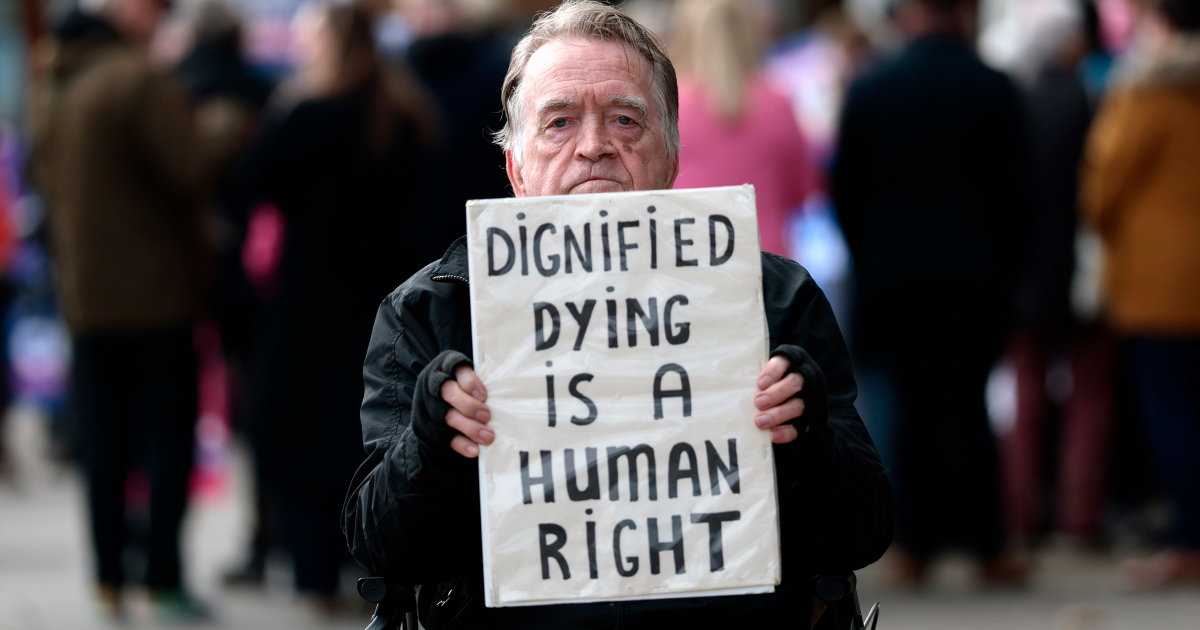


The defeat of the Assisted Dying Bill at Holyrood will be read in many ways. Some will see it as a decisive rejection of assisted dying in Scotland; others as a procedural setback in a longer journey towards legalisation. Neither interpretation is quite right. What occurred was more precise, and more politically instructive. The Scottish Parliament did not reject the principle of assisted dying – it concluded that this particular Bill could not introduce such a system safely.
That distinction matters. It should shape how we understand the campaign that led to this moment, and how we prepare for what comes next.
From the outset, the campaign against the Bill was disciplined in a way that is often overlooked in public commentary. It did not rely on noise or confrontation, but on clarity and restraint. The public messaging – ‘Don’t Risk It’, ‘Any Doubts, Vote No’ and ‘One Mistake is One Mistake too many’ – was only the visible surface of a far more sustained effort. Beneath it lay a quieter political discipline: sustained engagement with MSPs, careful argumentation and a willingness to meet supporters of assisted dying on their own terms.
Crucially, the most effective part of the campaign was not to begin with a confrontation over principle: It was to listen. Many MSPs who voted in favour at Stage 1 expressed real unease about aspects of the legislation. The campaign’s strategic decision was to focus on those points of doubt rather than to attempt an abstract philosophical refutation of assisted dying as a concept. That was not an evasion of principle, but an acknowledgment of political reality. In a parliament where a majority of members, and indeed a majority of Scots when asked in general terms, express support for assisted dying in principle, a purely principled opposition would likely have failed.
Instead, attention was directed towards the architecture of the Bill itself, and the practical consequences it would produce. What happens when the substance does not work as intended? What safeguards exist when doctors are placed in positions where they may feel implicit pressure to raise assisted dying as an option? Why was there no robust institutional opt-out for bodies and settings where participation would be structurally unavoidable? And how could conscientious objection be meaningfully protected when key elements of the system were ultimately shaped beyond Holyrood, in Westminster frameworks and professional guidance? These were not peripheral questions. They went to the heart of whether the Bill could safely carry the weight placed upon it.
We should resist describing the Bill’s defeat as a broader defeat for assisted dying itself. That reading is understandable, but it is too confident. It ignores both recent political history and the underlying public mood. It was only in May 2025 that the Scottish Parliament voted in favour of assisted dying at Stage 1.
This was not a collapse in sympathy for the idea. It was a refusal to proceed with a system that could not convincingly guarantee safety in practice. That is why it is more accurate to say that this was a defeat of a specific legislative proposal rather than a rejection of assisted dying in principle. The distinction is not semantic. It determines what happens next.
What happens next is already clear: the argument will return. Those who support assisted dying have not abandoned their objective. Nor should we expect them to. Liam McArthur himself has indicated that this is an issue that will come back before Parliament. The logic is straightforward: public support, at least at the level of principle, remains strong; therefore, the task of supporters of assisted dying is to refine the legislation until it becomes acceptable to Parliament. The danger, however, is that improvement in drafting can be mistaken for resolution of principle.
Many of the objections raised during this debate – particularly those articulated powerfully by disabled MSPs such as Jeremy Balfour and Pam Duncan-Glancy – were not simply technical criticisms. They were rooted in a deeper concern about what kind of society is being shaped when the state authorises assisted death as a medical option. These contributions pointed towards the question that will not go away: how do we protect the most vulnerable in a system where the intentional ending of life is not only permitted but professionally facilitated?
The experience of scrutinising Liam McArthur’s Bill, once described by McArthur as ‘bulletproof’, has exposed the difficulty, perhaps the impossibility, of designing an assisted dying regime that fully eliminates risk. Every safeguard introduces a pressure point. Every procedural protection relies on human judgment. Every assessment of voluntariness sits within relationships shaped by vulnerability, dependence and sometimes subtle coercion.
It may be that this experience will shift some who were previously sympathetic but cautious. When confronted with the cumulative weight of practical objections, they may come to question not merely whether this Bill was safe, but whether any such Bill can be made safe enough.
The central philosophical question that now re-emerges, because no legislative system of this kind can be made risk-free. At best, it can be made risk-managed –but the risks are not evenly distributed. They fall disproportionately on those who are elderly, disabled, isolated or otherwise vulnerable to pressure, whether explicit or implicit. The closer one examines the mechanics of assisted dying legislation, the more apparent it becomes that the aspiration of total safety is not achievable. The question then becomes whether residual risk is morally tolerable when the consequence is irreversible. That is not a procedural question. It is a question about the kind of moral architecture a society is willing to build into its healthcare system.
Now that this particular parliamentary moment has passed, the focus must shift. Those who oppose assisted dying cannot rely solely on procedural critique or legislative caution. The debate will return one day. It will likely be framed in terms of improved safeguards and refined eligibility criteria. If opposition remains confined to process, it will struggle to prevail in the long term.
What is required instead is a return to principle, but a principled argument that is politically intelligent as well as morally serious.
There is a temptation in this space to become loud, reactive or ideologically rigid. That would be a mistake. The experience of this campaign in Scotland demonstrates something different: that persuasion is most effective when it is disciplined, attentive and rooted in an understanding of the concerns of those who disagree.
This is not a call for dilution of conviction. It is a call for its refinement. In Catholic social thought, truth is not separated from charity. Caritas in veritate is not an abstract slogan; it is a method. It insists that moral argument must be both intellectually serious and genuinely attentive to the human realities it addresses. That balance is precisely what was achieved in this campaign: firm opposition to a proposed law, coupled with a refusal to caricature those who support it.
The challenge now is to carry that approach forward into the next stage of the debate. The legislative contest may be paused, but the philosophical one is not. If assisted dying returns, as it almost certainly will, it will do so in a more polished form. The response must therefore be deeper, not louder; more principled, not merely procedural; and always conscious that the question at stake is not only what the law permits, but what kind of society it quietly becomes.