



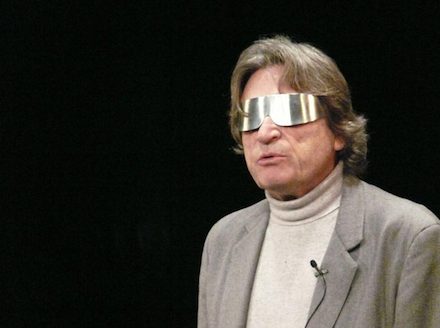
On holiday last week I picked up a book at random from the shelves of the flat I was staying in. It was titled Invisible and written by a French painter and photographer, Hugues de Montalembert. It was a bit rambling and repetitive and most likely would not have been written at all but for one horrible circumstance: the author relates that in 1978, aged 35 and living in New York, he was instantly blinded during an assault and robbery during which paint remover was thrown in his face. Montalembert’s life as a painter and photographer depended on his eyesight, so the brutal assault had enormous consequences for his life and career. But what was interesting in his memoir was that he showed no trace of either self-pity or anger at his assailants. He also makes it clear he has no time for God or for religion. His attitude is: “This has happened. What am I going to do about it?” He actually re-built his career in films, trusting to his “inner eye” or imagination to construct his vision. The passage in his account that especially pulled me up short was when he wrote: “Why, during or after what I went through, did I never contemplate suicide? I have no answers. I have the feeling that the only sin is the sin of Judas, the one who sold Jesus Christ for 30 pieces of silver and went into despair and hanged himself. Such is the absolute sin. The sin against life.” “The sin against life”: what a powerful and haunting phrase. It is what I come back to after reading all the excellent arguments against Lord Falconer’s proposed Bill to allow for assisted suicide (which is being debated in its Second Reading in the House of Lords today) with all the human and religious reasons they assemble. While having compassion for those who are tempted to despair and who want to die, for whatever reason – mental anguish or physical pain – we should always do what we can to dissuade them. I read a most touching article some years ago about a simple, poor Chinese man who lives in a little shack he has built next to a famous “suicide bridge” in China for the sole purpose of rushing out on to the bridge to dissuade those wanting to jump over into the gorge below. He is often successful. As far as I recall there was no mention of any religious faith in his attitude either; he was simply motivated by fellow-feeling, an instinctive wish to help fellow human beings see that life is worth living and not commit what de Montalembert calls “the sin against life”. Christians should exemplify this understanding of life because we know it has an extraordinary supernatural dimension – that we are alive because God has called us into existence - and for a single purpose: to love him and each other. I rather think the worst “sin” we Catholics can thus exhibit is joylessness. A recent blogpost by Taylor Marshall brings this home. He posts a comment from a reader thus: “Lifelong Catholic here (40 years). I have a hard time finding ANY impulse to share the faith. I can defend it, sure. But evangelise? Why? It’s intellectually consistent and defensible, but when the rubber meets the road, it’s a gruelling, joyless slog. Much better to let people take their chances with invincible ignorance.” Such a sad and dispiriting comment. It makes me, a cradle Catholic, realise why we need converts: to remind us yet again that faith is ultimately about love, not rules. “Love and do what you will”, as St Augustine put it. Now I am off to join others outside the peers’ entrance to the House of Lords, to give a small witness to what de Montalembert and the Chinese man understood: we must not give way to despair – which is what Lord Falconer’s proposed Bill is about.
2:10 PM
The blinded photographer, assisted suicide and 'the sin against life'
A photographer's haunting memoir sheds new light on the Assisted Dying Bill
Francis Phillips

5 min read



Already a subscriber? Sign in
5freearticles every month
Continue reading with a free account. No card needed.
- Five free articles every thirty days, on any device you sign in on
- The Catholic Herald newsletter, every morning
- Subscribe whenever you like for everything: every article and the magazine
Related articles
 Newsroom
Church leaders urge Drumcree dialogue: ‘Too much is at stake’
The Catholic and Church of Ireland Archbishops of Armagh have urged a renewed commitment to peace and reconciliation amid the Drumcree stand-off
Corrie Douglas-Young Newsroom
Thousands of Irish children to join global Rosary campaign
Corrie Douglas-Young Newsroom
TikTok priest urges young people to stand with persecuted Christians
Nathalie Raffray Newsroom
Baby born at 25 weeks reunites with neonatologist two years after leaving hospital
The Catholic Herald Newsroom
Joe Biden honoured by Planned Parenthood after defending abortion rights
Christine Rousselle
subscribe to the catholic herald today
Our best content is exclusively available to our subscribers. Subscribe today and gain instant access to expert analysis, in-depth articles, and thought-provoking insights—anytime, anywhere. Don’t miss out on the conversations that matter most.
Subscribe



