




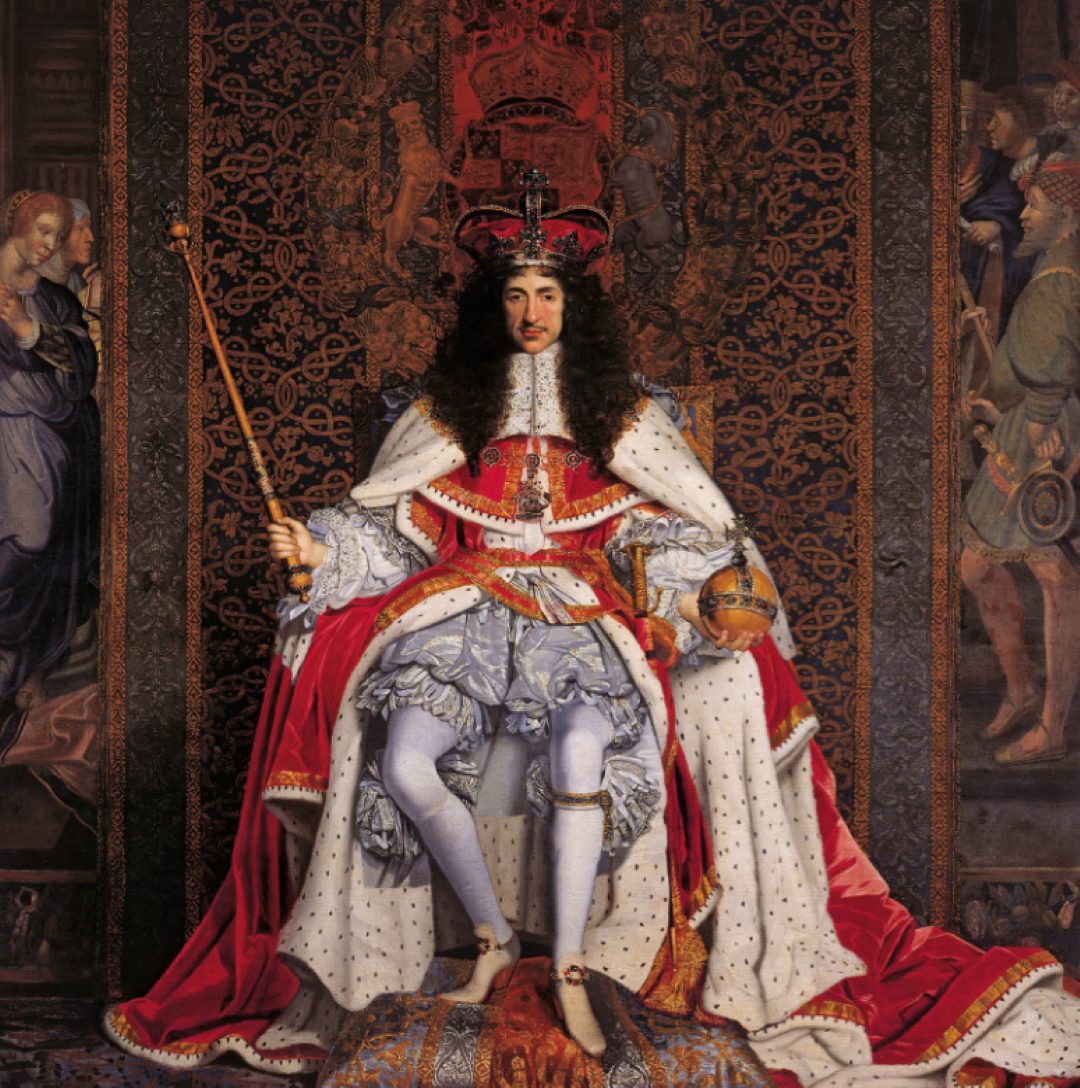
Charles II: Art and Power Queen’s Gallery, Buckingham Palace, until May 13 Charles II was fun-loving. Not only personally, with his many mistresses, but also publicly: he opened up the theatres again after the dark decade of Cromwell’s Protectorate, when even Christmas celebrations had been banned. And he loved a big spectacle. Charles knew, at the Restoration of the monarchy in 1660, that he had to make his mark, to put on a show. Royal regalia, including a medieval crown, had been sold or melted down for cash during the Protectorate; Charles replaced them – and not just the crown jewels. A large cabinet at the start of a glorious new exhibition at the Queen’s Gallery, Buckingham Palace, holds a gilded silver altar dish a yard across, a pure gold chalice and paten, and a stunningly ornate mace. Charles understood the popular mind: he became the People’s King by opening himself up to them for the King’s Touch. During his reign he touched nearly 100,000 people to heal them from the King’s Evil, or scrofula. This was highly regulated: the exhibition includes an admission token, and a gold touch-piece, hung around the sufferer’s neck. Charles’s mistresses are there aplenty. His longtime favourite, Barbara Palmer (née Villiers), features in several paintings and engravings. So does the woman who supplanted her in his affections in the 1670s, Louise de Kérouaille, whose descendants, from her son with Charles, include both wives of the present Prince of Wales. Annoyed at being mistaken for Louise, Nell Gwynne said: “Pray good people be civil, I am the Protestant whore!” There’s a lovely engraving of Gwynne, or “Madame Ellen Groinn”, with her two sons by Charles as winged cupid figures. Charles II filled his court with beautiful women, mistresses or not. Two lovely paintings come from a series known as the Windsor Beauties. On the same wall Charles’s Queen, Catherine of Braganza, is portrayed in a sumptuous silvery satin silk dress. Paintings are at the heart of the exhibition: not just of Charles’s women but also of himself and his successor, James II. The most spectacular portrays Charles in his coronation robes. One of the most touching paintings isn’t of a monarch or mistress, but a servant woman, Bridget Holmes, who lived to be 100, having served Charles I, Charles II, James II and William III. Charles II wasn’t only interested in beautiful women and gorgeous paintings. A “great encourager of arts”, he collected drawings by Leonardo and Hans Holbein the Younger. He was fascinated by the sciences, and there’s a cabinet devoted to the Royal Society, the world’s oldest and most prestigious scientific society, founded in 1660. This splendid exhibition celebrates the visual expression of Charles’s authority, the re-establishment of court culture with its life and colour that Charles embraced so enthusiastically, and his recovery and recreation of the royal collection after its scattering during the Commonwealth.
12:00 PM
The king who gave the public what it wanted
David V Barrett

3 min read



Already a subscriber? Sign in
5freearticles every month
Continue reading with a free account. No card needed.
- Five free articles every thirty days, on any device you sign in on
- The Catholic Herald newsletter, every morning
- Subscribe whenever you like for everything: every article and the magazine
Related articles
 Newsroom
Injured priest tells Poles: ‘Do not blame Ukraine’ for convent attack
Fr Adrian Mantykiewicz, who was injured in the attack that killed a fellow priest, has urged Catholics to pray for the assailant and not blame Ukrainians for his actions
Corrie Douglas-Young Newsroom
Church leaders urge Drumcree dialogue: ‘Too much is at stake’
Corrie Douglas-Young Newsroom
Thousands of Irish children to join global Rosary campaign
Corrie Douglas-Young Newsroom
TikTok priest urges young people to stand with persecuted Christians
Nathalie Raffray Newsroom
Baby born at 25 weeks reunites with neonatologist two years after leaving hospital
The Catholic Herald
subscribe to the catholic herald today
Our best content is exclusively available to our subscribers. Subscribe today and gain instant access to expert analysis, in-depth articles, and thought-provoking insights—anytime, anywhere. Don’t miss out on the conversations that matter most.
Subscribe



