





THEATRE
Kidman works her chemistry on DNA
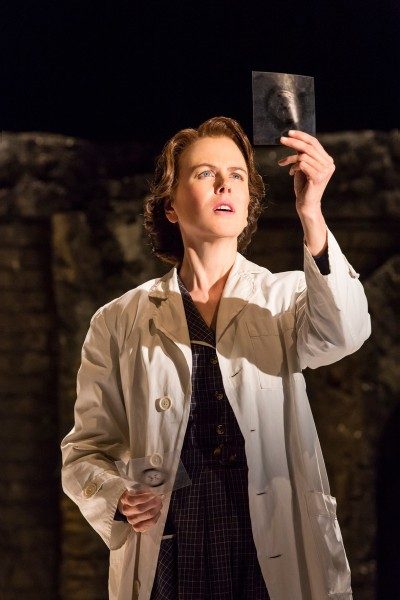
Nicole Kidman, who was last seen on the London stage 17 years ago in David Hare’s adaptation of Arthur Schnitzler’s notoriously erotic La Ronde, returns to act in Anna Ziegler’s Photograph 51 at Noël Coward Theatre. Kidman pays tribute to the English chemist and crystallographer Rosalind Franklin, the woman who cracked DNA and didn’t get the Nobel Prize she deserved. Franklin was always convinced that she was right. She was not, to put it mildly, an easy person to work with. She was her own worst enemy. Her froideur kept everybody at a distance and led to clashes when people trespassed on her territory. Maurice Wilkins (Stephen Campbell Moore), with whom she was meant to work on equal terms at King’s College, had a particularly hard time. Her only close friend was an American admirer (Patrick Kennedy). Kidman’s performance of a brusque, no-nonsense, fiercely intelligent loner in a male-dominated world, who didn’t suffer patronising males gladly, is highly accomplished. Michael Grandage’s clever production shows a firm grasp of the loose script. The supporting actors are well chosen and the designer, Christopher Oram, has provided an arresting setting – in a bombed-out King’s College with the rubble still there. Matthew Warchus is the new artistic director at The Old Vic and his tenure gets off to a good start with Tamsin Oglesby’s Future Conditional, a debate about what sort of education we want for our children and how can we make it fairer for all. The debate has three separate strands: one features the frustrated parents, another a research committee, and a third, in a series of monologues, shows a comprehensive-school teacher in the classroom. The play is held together by a student refugee who is grateful for an education which would have been denied to her in Pakistan because she is a woman in the wrong class and caste. Warchus has turned the whole debate into a lively theatrical experience. Nikki Patel, making her stage debut, is impressive as the refugee. Rob Brydon plays the teacher and has a fine speech when he is at his laptop, typing an apology to a parent. Lucy Briggs-Owen is very funny as a pushy middle-class mum. The scenes with the committee are among the most entertaining: when Joshua McGuire (Eton-educated) and Brian Vernel (state school) are at loggerheads and liable to behave like naughty children. Dusty at Charing Cross Theatre tells the life of Dusty Springfield. The English pop singer and icon of the Swinging Sixties appears on screen in archival filmed footage and as a hologram. It’s good to see and hear her sing; but there is something absurd about applauding a photograph and a 3D model. Alison Arnopp, who is playing Dusty and singing her songs, has to compete with the footage and the hologram – it’s an impossible task. As the production stands now, the show only works when Dusty is singing; and this could well be enough for Springfield’s nostalgic fans. But for those of us wanting to see a good musical, the poor script, poor staging and distracting choreography are a severe hindrance. Robert Tanitch