




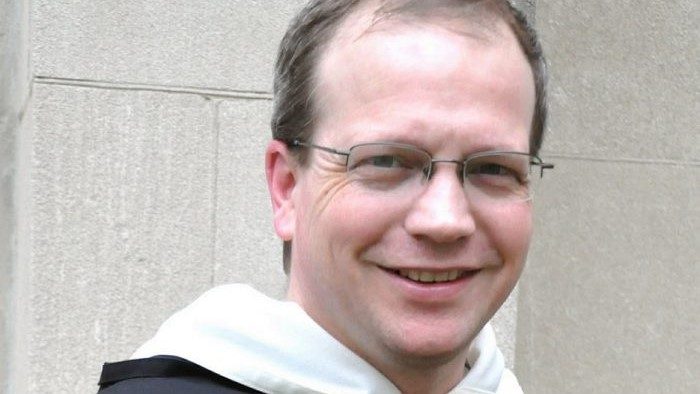
In the first of a series of interviews with leading minds, the philosopher Fr Thomas White OP discusses apologetics, the coronavirus and the need for deeper conversations. Fr Thomas Joseph White OP seems tired. When I Skype-call his office in the Pontifical University of the Angelicum in Rome, I ask how he is finding the lockdown. He pauses. “Well, it’s been going on a long time.” Eight weeks at the time of our conversation. Fr White, though, has not been clamouring for normal service to resume. One of those people who speaks in fully formed sentences with subordinate clauses, White is generally known for being one of the world’s foremost popularisers of the philosophy of St Thomas Aquinas, as well as being a theologian of substance in his own right. Until recently, the controversies Fr White was most likely to be involved in were about the extent of Jesus’s human knowledge or whether God can suffer. Recently however, Fr White joined the debate over Covid-19 lockdown measures with an article for First Things defending the decision made by many Catholic bishops to suspend public masses – an article that sharply disagreed with the journal’s editor, RR Reno. He’s received a lot of responses. In our conversation, White is consistently charitable, giving different perspectives their due and making clear that it is important to have a “rich political debate” about the measures taken to address the virus. In a second article for First Things, he wrote that the Church should resist pressure from public officials to “maintain closure for excessively prolonged periods”. But I detect a certain frustration with some of his interlocutors. What’s driving it? “There is a way,” he says, “of ignoring the current moment in its gravity, both in terms of health and economics, by changing the subject to previously existing topics – of public rivalries or ecclesiastical divisions. And in this context, that has the likelihood of intensifying and exacerbating those divisions for no obvious productive reason.” He pauses. “It seems to me that that is not the appropriate Christian response when in fact what we are facing is a situation in which many vulnerable people are dying, many people are ill, many people are unemployed and economically compromised.” He’s also keen to rebut narratives that cast the Church’s response to the virus as weak or timid. “I’ve heard of priests in a very busy parish in California with 4,000 families, where the pastor divided up the telephone listing of every family and the priests are now going through the roster and calling and speaking to every family individually, something they’ve never done before.” The Salesians in India, he tells me, have opened up their parishes and schools as food pantries and are feeding thousands. White acknowledges that people are right to be frustrated about the lack of access to their loved ones and to the sacraments. “But I think we have to avoid the misguided notion that this is easy for the clergy and that they enjoy this time as a kind of vacation – because that’s quite the opposite of how we feel.” Is the Church doing enough? “We know that the answer is no because we’re never going to be doing enough to be adequate to the calling of Christ. But a lot is being done in many different ways.”
12:22 PM
‘We can’t simply say the truths’: An interview with Fr Thomas Joseph White
Ben Conroy

10 min read



Already a subscriber? Sign in
5freearticles every month
Continue reading with a free account. No card needed.
- Five free articles every thirty days, on any device you sign in on
- The Catholic Herald newsletter, every morning
- Subscribe whenever you like for everything: every article and the magazine
Related articles
 Newsroom
Church leaders urge Drumcree dialogue: ‘Too much is at stake’
The Catholic and Church of Ireland Archbishops of Armagh have urged a renewed commitment to peace and reconciliation amid the Drumcree stand-off
Corrie Douglas-Young Newsroom
Thousands of Irish children to join global Rosary campaign
Corrie Douglas-Young Newsroom
TikTok priest urges young people to stand with persecuted Christians
Nathalie Raffray Newsroom
Baby born at 25 weeks reunites with neonatologist two years after leaving hospital
The Catholic Herald Newsroom
Joe Biden honoured by Planned Parenthood after defending abortion rights
Christine Rousselle
subscribe to the catholic herald today
Our best content is exclusively available to our subscribers. Subscribe today and gain instant access to expert analysis, in-depth articles, and thought-provoking insights—anytime, anywhere. Don’t miss out on the conversations that matter most.
Subscribe



