




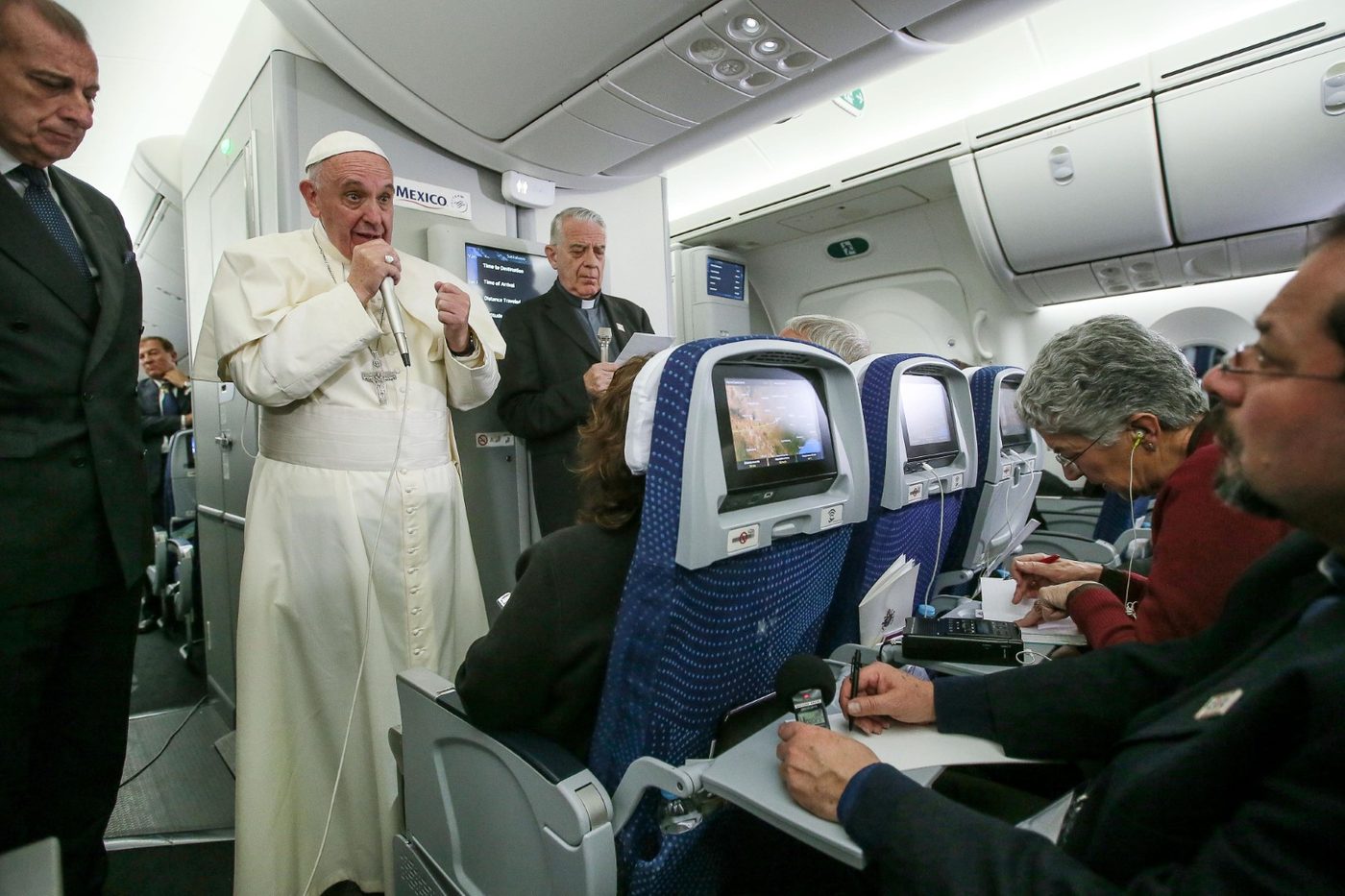
Pope francis’s in-flight press conferences have become the stuff of legend, a source of delight for journalists, confusion for the faithful and headaches for Vatican spokesman Fr Federico Lombardi. The Pope’s remarks last week on his return from Mexico did not let us down, in that sense. As well as wading into the US presidential election the Holy Father also seemed to suggest that it was acceptable for women in Latin America to use contraception in response to the Zika virus, which has been linked to microcephaly, or shrunken heads, in children. Asked about the virus, and what steps Catholics could take to prevent infection, he said abortion was a cribut that “avoiding pregnancy” was in a different moral category. The Pope explained: “We are speaking in terms of the conflict between the fifth and sixth commandment. Paul VI, a great man, in a difficult situation in Africa, permitted nuns to use contraceptives in cases of rape. “Don’t confuse the evil of avoiding pregnancy by itself with abortion,” he said, for while abortion is an evil, avoiding pregnancy is not an absolute evil. “In certain cases, as in this one, or in the one I mentioned of Blessed Paul VI, it was clear,” he said. Pope Francis’s comments were interpreted by the media to mean it was acceptable for women to use contraception to avoid the risk of a Zika-infected child. It was yet another case of Catholics opening their secular newspapers to find the Pope suggesting something radically new. But was he? Initially Catholic commentators suggested that Francis may have only been referring to natural family planning rather than contraception. This was quickly corrected by Fr Lombardi, who told Vatican Radio that what Francis was referring to was “the possibility of taking recourse to contraception or condoms in cases of emergency or special situations”. Such action could only be taken “in cases of special urgency” and with discernment, the Vatican spokesman explained. Yet what constitutes a case of “special urgency”? Is it, for instance, if a woman fears her violent, Zika-infected husband will force her to have sex? Or can such a justification be invoked if neighbours have been infected by the virus? Fr Lombardi has left great big blanks in the picture. Other commentators seized on the reference to Paul VI approving the use of contraception for nuns in the Congo. This is said to have taken place in the 1960s during a civil war where large numbers of nuns were raped. Yet it didn’t quite happen that way. The approval actually came from an Italian journal Studi Cattolici (“Catholic Studies”), which published the arguments of three moral theologians who believed that in the Congo contraception could be justified. Cardinal Montini of Milan, the future Paul VI, was close to the magazine’s editors and it was assumed he had given his assent to its line, a belief reinforced when he later made one of the article’s authors, Pietro Palazzini, a cardinal. Leaving the Congolese nuns aside, the substance of Pope Francis’s remarks divided the Catholic blogosphere. Vatican-watcher John Allen, for instance, argued at Crux that the Pope’s comments were “not terribly different from the way the Vatican has approached condom use in the context of a married couple where one partner is HIV-positive and the other isn’t, and the aim is to prevent the other partner from becoming infected”. Benedict XVI, for instance, argued in the book Light of the World that “there may be a basis in the case of some individuals, as perhaps when a male prostitute uses a condom, where this can be a first step in the direction of a moralisation, a first assumption of responsibility, on the way toward recovering an awareness that not everything is allowed and that one cannot do whatever one wants.” Yet Janet E Smith, a professor of moral theology writing for Crisis Magazine, said that Pope Francis’s reasoning did not quite add up. With the Zika virus, she argued, there was no conflict between the fifth commandment (“thou shalt not kill”) and the sixth (“thou shalt not commit adultery”) as the Zika virus is not fatal. The Pope’s foray into the ethics of contraception was always going to be risky. The general public is so poorly informed about the reasoning behind the Catholic position that any improvised comments are likely to be taken the wrong way. It’s good for Francis to offer guidance to Catholics struggling with the Zika virus. But a better approach might have been through an interview with a sympathetic journal such as La Civiltà Cattolica, with more time to choose his words and convey his point clearly.
12:00 PM
What Francis really said about condoms
Ed West

4 min read



Already a subscriber? Sign in
5freearticles every month
Continue reading with a free account. No card needed.
- Five free articles every thirty days, on any device you sign in on
- The Catholic Herald newsletter, every morning
- Subscribe whenever you like for everything: every article and the magazine
Related articles
 Newsroom
Church leaders urge Drumcree dialogue: ‘Too much is at stake’
The Catholic and Church of Ireland Archbishops of Armagh have urged a renewed commitment to peace and reconciliation amid the Drumcree stand-off
Corrie Douglas-Young Newsroom
Thousands of Irish children to join global Rosary campaign
Corrie Douglas-Young Newsroom
TikTok priest urges young people to stand with persecuted Christians
Nathalie Raffray Newsroom
Baby born at 25 weeks reunites with neonatologist two years after leaving hospital
The Catholic Herald Newsroom
Joe Biden honoured by Planned Parenthood after defending abortion rights
Christine Rousselle
subscribe to the catholic herald today
Our best content is exclusively available to our subscribers. Subscribe today and gain instant access to expert analysis, in-depth articles, and thought-provoking insights—anytime, anywhere. Don’t miss out on the conversations that matter most.
Subscribe



