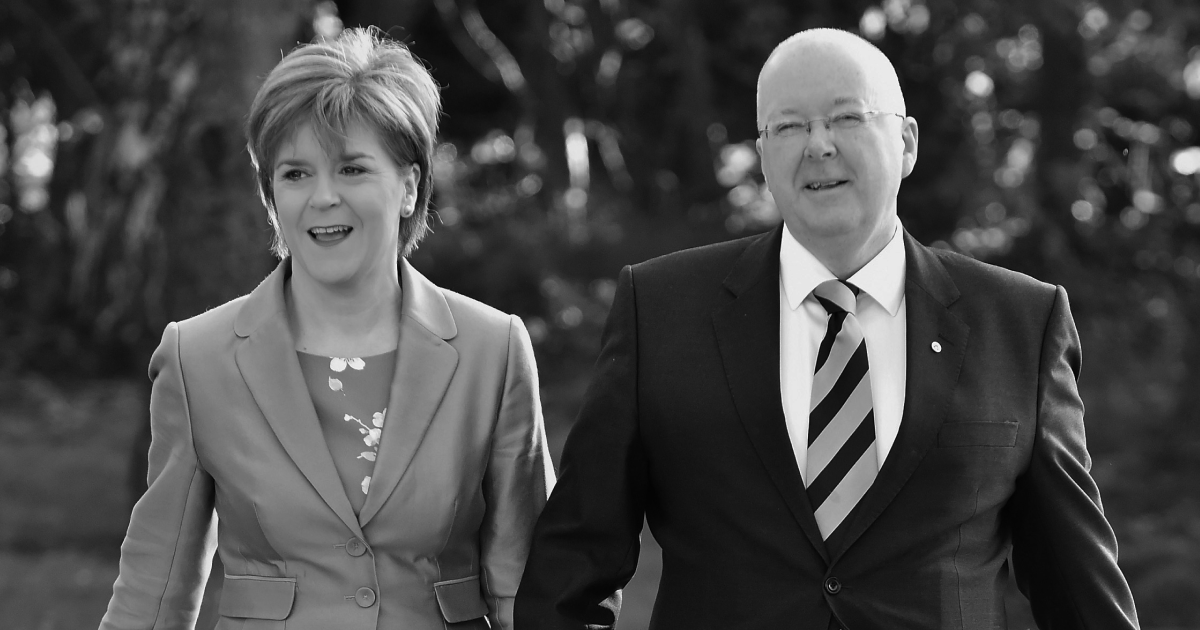


The guilty plea entered by Peter Murrell on May 25 has naturally generated intense political debate. Questions will continue to be asked about money, accountability and who knew what within the upper ranks of the Scottish National Party.
Yet beyond the politics lies another question, one that has captured the public imagination precisely because it touches something much deeper.
How can something of this magnitude happen within a marriage? Nicola Sturgeon and Peter Murrell were not simply colleagues. They were husband and wife. They shared a home, a life, a cause and, for many years, a position as Scotland’s most influential political couple. To many observers, the most startling aspect of the story is not merely the wrongdoing itself but the apparent disconnect between what occurred and what was known within the marriage.
We should be careful before rushing to judgement. History is full of examples of spouses discovering painful truths about one another only after many years. Deception works because it deceives. None of us can know what private conversations did or did not take place behind closed doors.
Nevertheless, the public fascination with this story reveals something important about our understanding of marriage.
Most people instinctively believe that a husband and wife should know one another deeply. We expect marriage to involve a level of intimacy, trust and transparency unlike any other human relationship. When we hear of serious secrets being concealed within a marriage, it strikes us as a violation of something fundamental. The irony is that while many still hold this expectation, modern culture increasingly undermines the very conditions that make such intimacy possible.
For decades, we have been encouraged to view marriage less as a union and more as a partnership between autonomous individuals. Separate finances, separate ambitions, separate social lives and separate identities are often presented as marks of healthy independence. The highest good is no longer unity but personal fulfilment.
This represents a profound departure from the Christian understanding of marriage. The Catholic tradition does not see marriage as a contract between two self-interested individuals. It sees it as a covenant in which two people freely give themselves to one another. The language of Christian marriage is not autonomy but self-gift. It is not about preserving independence but about forming a genuine communion of life. This is why marriage has always involved sacrifice. The husband sacrifices for his wife. The wife sacrifices for her husband. Both sacrifice for their children. They share not only their successes but also their burdens, weaknesses and vulnerabilities. In doing so, they create the conditions for trust to flourish. When sacrifice disappears, trust often weakens alongside it.
A culture that constantly asks, “What do I want?” eventually struggles to sustain relationships that require us to ask, “What is best for us?” The result is not merely more marital breakdown. It is a growing inability to share life at a genuinely profound level.
The lesson of the Sturgeon-Murrell story is not that one spouse must always know everything the other does. Human beings are fallible, and even good marriages can be tested by deception. Rather, the lesson is that truth matters.
Every marriage is built upon thousands of acts of trust. Those acts require honesty, accountability and a willingness to live not as isolated individuals but as a genuine union. Where truth is absent, relationships become fragile. Where truth is present, even difficult realities can be faced together.
Political scandals come and go. Public figures rise and fall. But the questions raised by this story point beyond politics altogether.
They point towards a deeper crisis in our culture: a crisis of commitment, sacrifice and truth.
And those are questions that concern every marriage, not merely those that happen to make the headlines.