
April 20, 2026

Why Catholicism no longer feels uncool in New York

Aubrey Strobel
More
Related
Min read
share

A few weeks ago, I called my local parish in the West Village the hottest club in town in a tweet. I was talking about St Joseph’s Church. On one recent Sunday, there were lines out of the door on the streets of New York City. Standing room only. The tweet went viral. I thought I should explain a little further what I meant.

A bit of my journey: I grew up Catholic – my parents met at a Newman Center. I was baptised, confirmed, became a Eucharistic minister, spoke at college retreats, went on mission to Port-au-Prince with the Sisters of Charity and have hardly ever missed a Sunday Mass. And yet, for many years, I spoke as little of my Catholic faith as possible.

Living in New York City over the past 10 years and working in the tech industry, when friends asked what I was doing on Sunday, I would answer quietly that I was going to Mass. The response was often surprise, as though I had confessed to holding a belief from the 1800s. I do not think the fault was entirely theirs; I had shielded my faith so as not to offend anyone, to appear open-minded and to avoid the questions that would follow. Because being a Catholic for many years had been unpopular.

For a long time, it was chic to speak of the absence of one’s faith rather than of its presence. More commonly I would hear acquaintances call themselves lapsed Catholics, joke about Catholic guilt or point to the failures of the Church as sufficient reason to leave it behind. And this was taken, in many circles, as a sign of intelligence, sophistication and open-mindedness.

But then one day a few years ago, I noticed a shift. Not just culturally, but spiritually and perhaps existentially. It felt as though one day we lived in a world where Christianity was something to keep quiet about, and the next it felt like I did not have to whisper any more.

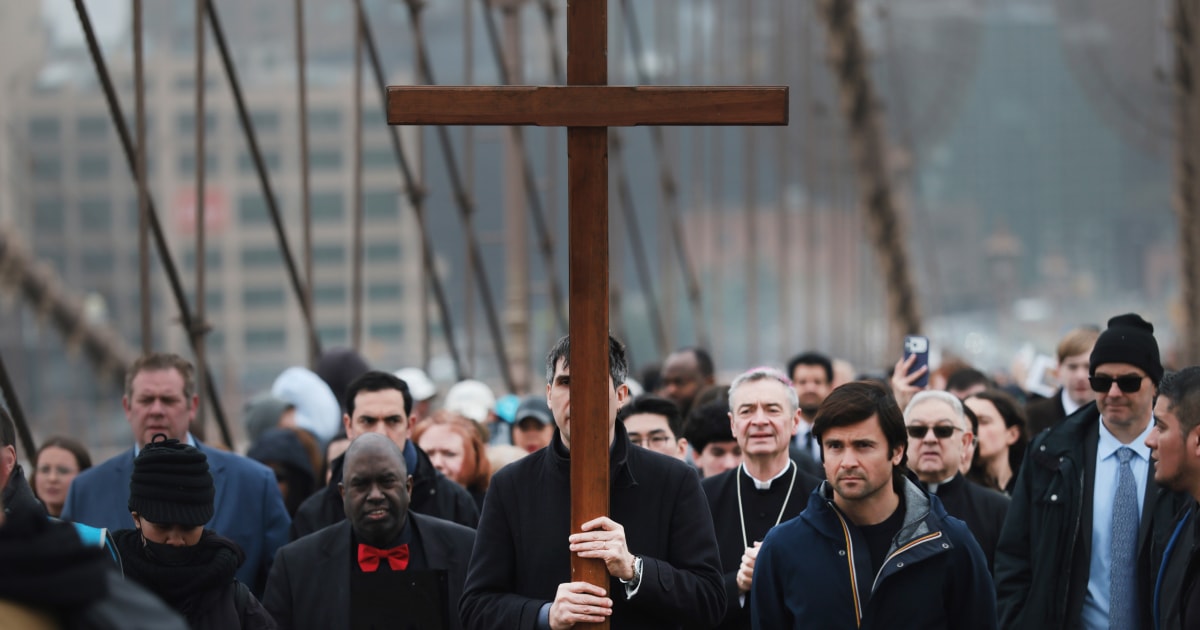
Over the past few years, the Church has received a remarkable number of new converts, specifically in New York. A reawakening was ignited with Pope Leo XIV in the United States. Dioceses across the country report rising numbers. In France, where belief has long been thought to be in retreat, adult baptisms have increased significantly. These facts are striking, but they do not, by themselves, explain what is happening.

They point to something deeper – that several things have been moving in the same direction for some time.

For years, many Christian sects adjusted themselves to the changing winds. This has been especially visible in many mainline Protestant churches: Lutheran, Methodist, Presbyterian – which bent towards cultural pressure, softening doctrine, reshaping liturgy, meeting the crowds where they were. But in doing so, they often became indistinguishable from the culture itself, no different at times from the media or the endless stream of content one could scroll through on a phone. And people grew tired of it.

Now we live at a time when knowledge is abundant and easily obtained thanks to AI and the internet. There is very little we cannot access, and yet this has not made us more certain of ourselves, nor more at peace. We are, in many ways, less so.

These tools we have built often affirm us, no matter how wrong we are, and that is not good. They are optimised for our approval. And somewhere, quietly, we know this.

The machines can assist us in almost anything, but they cannot tell us what is true. So it makes sense that people have begun to look beyond silicon for meaning.

The Catholic Church does not change with the moment. It does not bend. It asks things of you that cost something. It offers not comfort but truth. In a moment defined by endless optimisation and ease, that refusal has stopped looking like rigidity and started looking like integrity. The young especially seem to know this. They have grown up with infinite options and no weight. They are now walking into cathedrals, kneeling on hard floors and finding that the weight is the point.

It would be easy to suppose that faith must diminish as knowledge increases. But it may be that knowledge, pursued far enough, reveals its own limits.

Not everyone receives these developments with uncomplicated joy. Those who remained, who continued in the Church when it was less admired, have found this shift unsettling. There is, at times, a sense that what was once deeply held is now, in some cases, lightly worn. There has been a rise of influencers, content and clickbait articles that have entered the scene.

But we know that is not the Christian story.

In the parable of the prodigal son, the father does not question the one who returns. He does not ask for an account of where he has been. He sees him at a distance and runs to meet him. He receives him fully and without hesitation.

It is the older son, who faithfully remained, who finds this difficult. And who could blame him?

But the father says to him only this: your brother was dead, and is alive; he was lost, and is found.

If you are among those who have remained, who kept your faith when it seemed uncool, fringe or even embarrassing, then you may be tempted to look with suspicion on those who arrive now. But the parable suggests another response.

They have come home.

The manner of their arrival may differ from your own. It may be louder, less certain, more public. But this does not alter the fact itself.

Here in New York, the prodigal son has returned.

It would be a mistake to meet him with hesitation.

We should run.

Continue reading with a free account

Create a free account to read up to five articles each month
Create free account

You have # free articles remaining this month.

Subscribe to get unlimited access.
Sign up

subscribe to the catholic herald today

Our best content is exclusively available to our subscribers. Subscribe today and gain instant access to expert analysis, in-depth articles, and thought-provoking insights—anytime, anywhere. Don’t miss out on the conversations that matter most.
Subscribe