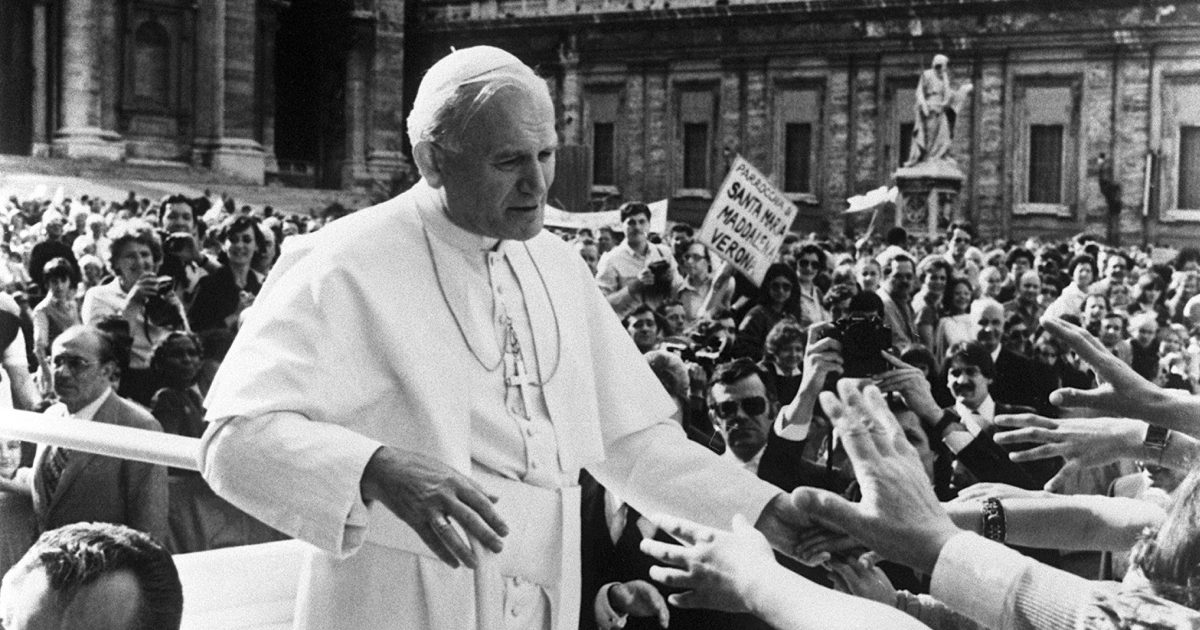


In 1978, Pope Saint John Paul II came onto the loggia of St Peter’s Square. The third Pope of the year, it is difficult to overstate how consequential and providential his papacy would become.
Thirteen years on from the close of the Second Vatican Council, the Church was still finding its direction in the Council’s ripples. The Novus Ordo Missae, the Mass of Paul VI, had been in parish churches for less than a decade, having been introduced on the First Sunday of Advent in 1969, and a progressive theological mood had taken hold in the Church. Hans Küng rejected papal infallibility in that same year, and just a few years earlier Edward Schillebeeckx OP had, in Jesus: An Experiment in Christology (1974), attempted to explain away Christ’s bodily resurrection.
South of the equator, liberation theology had taken hold of the Church with remarkable speed. Leonardo Boff was writing Church: Charism and Power, which explicitly acknowledged the use of Marxist analysis as a methodological tool for theology and proved so controversial upon its release in 1981 that Cardinal Ratzinger, then head of the Congregation for the Doctrine of the Faith, asked Boff not to write for a year. Boff responded with accusations of “religious terrorism”.
Priests ordained in this era are perhaps the most liberal the Church has seen, or will see. A 2022 study by the Catholic Project at the Catholic University of America found that just 20 per cent of priests ordained before 1980 described themselves as “orthodox” or “conservative”.
It is also true that cardinals of liberal disposition could plausibly have been chosen as the 264th Roman Pontiff. Cardinal Léon-Joseph Suenens, a Belgian prelate, was 74 years old and therefore eligible both to vote and to be elected. In 1964, when the Council was in full swing, he had urged Paul VI not to maintain the Church’s traditional teaching on contraception, even imploring his brother bishops to “avoid another Galileo affair”.
Similarly, Austrian Cardinal Franz König, who had been created a cardinal by John XXIII and was an elector in three conclaves, could have assumed the papal office, being 73 in 1978. He had described Humanae vitae, Pope Saint Paul VI’s encyclical outlawing contraception, as a “tragic event”.
It could also have fallen to one of the two Dutch cardinals, Johannes Gerardus Willebrands or Bernardus Alfrink. Whilst their compliance is not known, the Netherlands had been in the grip of “liturgical experimentation” since the 1960s, where extreme interpretations of the Second Vatican Council were being relied upon to rewrite the liturgy.
Instead, the world was presented with a pontiff who, despite change being in the air, resolutely did not succumb to the spirit of the age. Cardinal Karol Wojtyła, who had lived through Nazism and was living under a communist regime in Poland, did not bend easily to passing ideologies. Rooted in Thomistic philosophy, he was also influenced by Max Scheler, the German philosopher who advocated for ethics grounded in objective, hierarchical values and who, through the prism of phenomenology, argued that values are given in experience, not merely in law. This influence shaped Wojtyła’s major philosophical work, Person and Act (1969).
Unlike some of his brother cardinals, he was remarkably orthodox on matters of faith and morals. He fully supported Humanae vitae and had himself argued against contraception in Love and Responsibility eight years before its publication. As Pope, he tightened doctrinal oversight, most notably through his close partnership with Cardinal Joseph Ratzinger at the Congregation for the Doctrine of the Faith.
It is difficult to overstate how imperative this papacy was for the fate of the Catholic Church. John Paul II led the Church out of the turbulence caused by the revolutionary attitudes of the 1970s into the modern era, a time defined by cultural decadence. His papacy offered a viable alternative to secularism precisely because, under his leadership, the Church did not mirror it.
He also oversaw significant growth in the developing world. Under his leadership, the Catholic Church in Africa more than doubled, while the Church in Asia grew by 70 per cent. His efforts at evangelisation went hand in hand with his support for Mother Teresa’s equally prolific work among the poor. By the time of her death in 1997, the Missionaries of Charity had around 4,000 sisters serving in approximately 610 missions across 123 countries. Overall, during his pontificate, the global Catholic population grew by 47.3 per cent.
But it is not only John Paul II’s immediate impact that has proved beneficial. His legacy has left the Catholic Church in an undeniably stronger position than many other Christian denominations through his stringent adherence to inherited dogma.
In 1994, when the Church of England first introduced female clergy, John Paul II declared in his apostolic letter Ordinatio sacerdotalis that “the Church has in no way the faculty to confer priestly ordination on women, and that this judgment must be considered definitive by all the faithful of the Church.” More than 30 years on, figures released by Bible Society show that in the UK Catholics have increased from 23 per cent of churchgoers in 2018 to 31 per cent today. The Catholic Church in the United States appears to be entering a similar period of renewed growth, with the latest data showing that more people are now joining than leaving. Figures compiled last year by Shane Schaetzel, using research from the Center for Applied Research in the Apostolate (CARA), the Pew Research Center, the National Catholic Register, and Vatican statistics, suggest that adult conversions are on the rise.
By contrast, Anglican Church attendance in the UK has declined from 41 per cent of the Church going population in 2018, to 34 per cent today. Similar trends can be seen in other liberal denominations. In 1980, Methodist Church attendance in the UK stood at over 600,000; today it sits at around 150,000. When the United Reformed Church was founded in 1972, it had 192,136 members; by 2021 that figure had fallen to 40,024. The denomination, which now has more retired ministers than active ones, was also the first major UK church to conduct same-sex marriages.
While church attendance, practice, and belief are undeniably complex matters that cannot be reduced to a single explanation, it seems likely that had the leaders of the Catholic Church adopted the liberalising reforms of their counterparts, it would have experienced a similar decline. John Paul II remained resolute in adherence to truth even when the prevailing cultural winds pointed in the opposite direction.
No one comes to the Church looking for a mirror of secular society. No one comes seeking a Church that conforms and capitulates to its surroundings. The Church is only as appealing as it is a viable alternative to its absence.
Much can be said about the many failings of the Catholic Church in recent decades, but it has also been served by exceptional leaders who made the right decisions when it would have seemed easier to move in the other direction. Pope Saint John Paul II is one such example. May his life continue to be an example to many.