
July 10, 2026

Why the Church institutionalises joy

Ruadhan Jones
More
Related
Min read
share

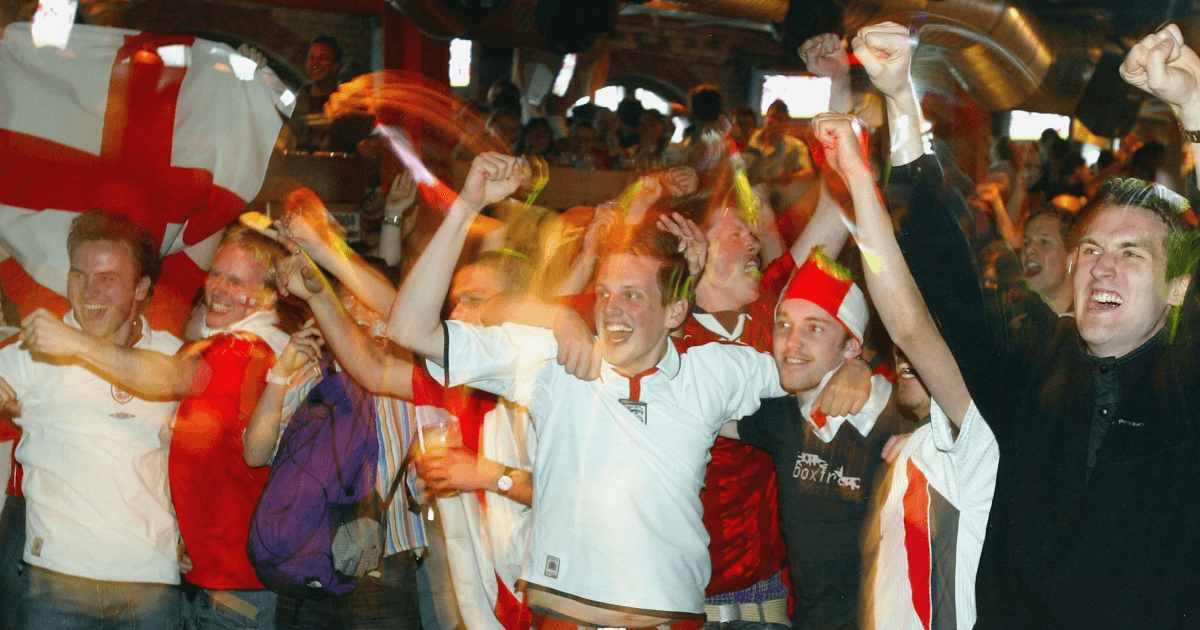
One man stepped forward to lead the singing and dancing of the uniform crowd, dressed in red and white, their faces daubed in paint. They were chanting and shouting, arm in arm, forgetting for a moment any grievances or differences as they lost themselves in ecstatic union. Then they found their way back to the bar for the next round, as the English fans continued to pour out libations in celebration of an impressive World Cup win over Mexico. It was a moment in which the advertisers, organisers and fans were proven right – the beautiful game has the power to transcend divides, shifting the course of daily life down a different route for a moment.

It’s not just football that does this. The New York Times noted a similar feeling around the Big Apple after the Knicks won the NBA championship. Even a city known for its attitude of indifference was bowled over by a communal experience of joy that offered a rare pathway to intimacy. The New York Times appealed to the work of British anthropologist Victor Turner to explain the feeling of ecstatic kinship.

Turner defined this experience as “communitas”, when strict social structures are stripped away and replaced by an unstructured state in which all members of a community are equal and share a common experience. According to the New York Times, he warns against institutionalising this feeling, arguing that the return to normal social life is necessary. That is, so long as people “return to structure revitalised by their experience of communitas”.

But it is likely that the New York Times is misunderstanding what Turner means by institutionalisation. What he was responding to was the hippie counterculture of the 1960s that sought to introduce a radical egalitarian vision, stripping away structures and hierarchies in its bid for authenticity. But Turner was no doubt influenced by an organisation that has successfully “institutionalised” ecstatic communion, wherein stratified social experiences are set aside in favour of our common brotherhood.

The British anthropologist formed his theories while observing initiation and coming-of-age rituals among an African tribe in Zambia, but it is likely he discovered communitas much closer to home. Turner and his wife Edith were adult converts to the Catholic Faith, and in attending church at Easter or Christmas or any number of the great feast days – even a daily Mass would have done the trick – they no doubt came to know the power of communitas intimately. For through its rituals and liturgical cycle, the Church embeds ecstatic communion in our lives.

To those of us who grew up within the seasons of Church life, this may not be obvious. But then consider how the Church’s liturgies unite us in praise and in sorrow, regret and joy. Even the most beleaguered Christian community comes together at Easter and celebrates the Resurrection. Just as the wealthiest and most comfortable parishioners must bow their heads to receive ashes and follow a cycle of repentance and atonement during Lent, culminating in the great sorrow of Good Friday.

We might not feel the emotions of the Liturgy, but as Turner noted, something deeper is being embedded in this cycle that is vital to our lives, individually and as a community. We are being asked to step back for a moment and see our bosses and employees, our children and spouses, our friends and our enemies, in the light of Christ. Our rituals and traditions root us in this fact, regardless of our subjective experience of the events.

But the world – although perhaps I really mean the village magazine of an influential global elite – pours scorn on the rituals of the Church, or ritual as such. Its vision is still skewed by the ideals of the 1960s, the idea that only by ridding the world of rigid structures and rituals can we reveal our true, authentic selves.

Yet it is the Church’s rituals and rigidity that pave the way to authentic selfhood, offering a toughness that confronts mystery head on, rather than searching for it in endless freedom. As Fr Louis Bouyer describes in his book Life and Liturgy, the Church’s mysteries are open for all to come and see. Its rituals do not conceal with cloak and dagger to create a mystique – they confront us with truths we simply cannot comprehend and are forced to live with and explore.

Joy is one of those mysteries, as is sorrow. By requiring us to experience these together in a recurring cycle, to be drawn out of our earthly lives into the life of Christ, the Church makes manifest transcendent realities before releasing us back into daily life, renewed. Knicks fans know what it feels like, as do English football supporters for now; but while their grasp is tenuous and subject to human whims, the Christian’s is firm.

It is through our rituals that we come to know our communion in the Mystical Body, signified by and consummated in our reception of the Eucharist. Ours is not a participation in earthly joy, but in the heavenly one, made known through the Church’s requirement that we weep with those who weep and rejoice with those who rejoice – even when we don’t feel like it.

Continue reading with a free account

Create a free account to read up to five articles each month
Create free account

You have # free articles remaining this month.

Subscribe to get unlimited access.
Sign up

subscribe to the catholic herald today

Our best content is exclusively available to our subscribers. Subscribe today and gain instant access to expert analysis, in-depth articles, and thought-provoking insights—anytime, anywhere. Don’t miss out on the conversations that matter most.
Subscribe