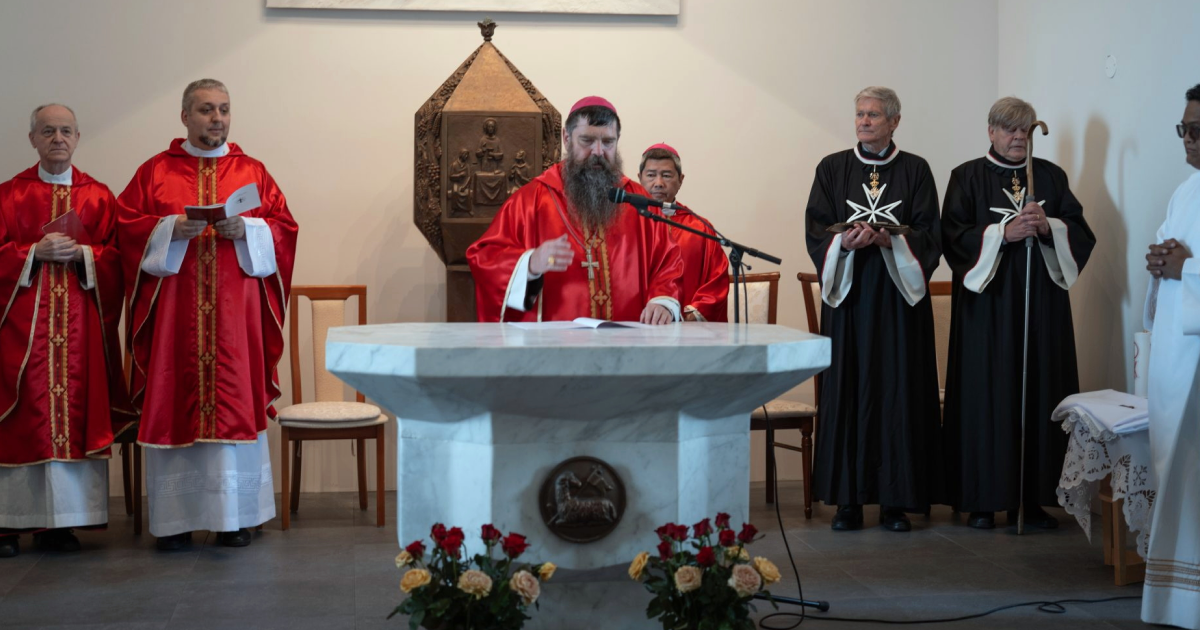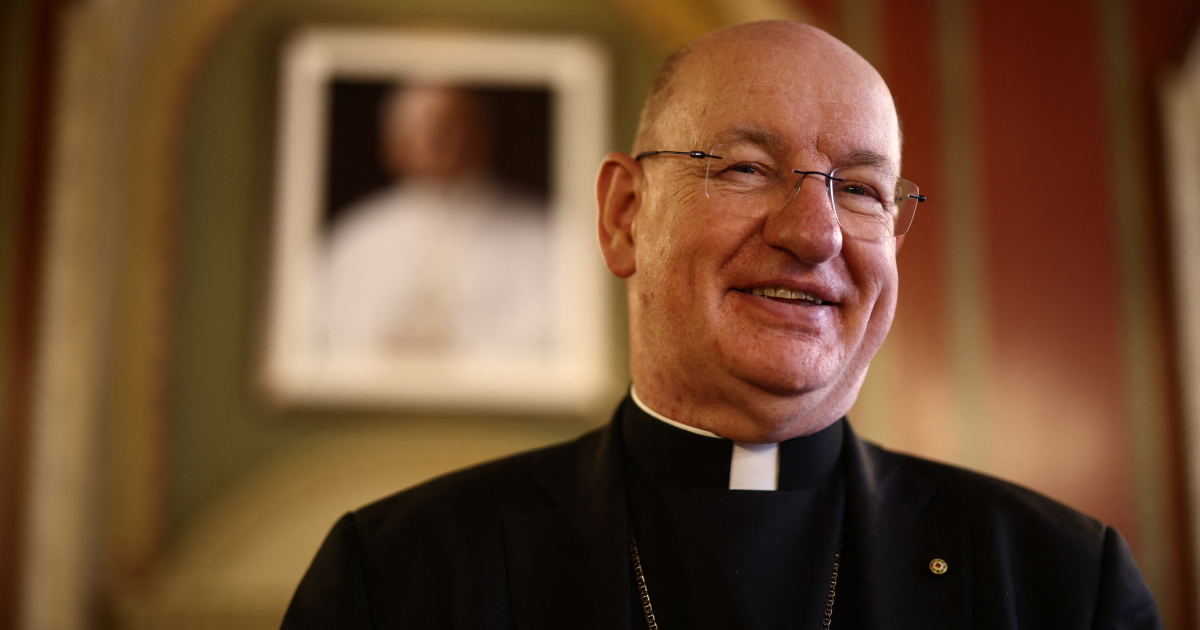


On December 19, 2025, more than five years after Cardinal Vincent Nichols offered his resignation to Pope Francis upon turning 75, Pope Leo appointed Bishop Richard Moth, Bishop of Arundel and Brighton, to take over as Archbishop of Westminster, the Ordinary of England’s most important see, and by custom the President of the Bishops’ Conference of England and Wales.
Ordained a priest for the Archdiocese of Southwark on June 3, 1982, after studying at the now closed St John’s Seminary, Wonersh, he has almost 45 years of experience in the priesthood. His first appointment was as curate at St Bede’s, Clapham Park, a church which has in recent years become a beacon of revival, with an average parishioner age just of 22. He was then sent to Ottawa, where he studied for a Licentiate and then a Master’s in canon law before returning to be curate at St Saviour’s, Lewisham. It was at this time that he had his first experience of military chaplaincy, becoming a Territorial Army chaplain and then being commissioned in the Royal Army Chaplains’ Department as Chaplain to the Forces 4th Class.
He held a variety of positions within the Southwark diocese, including bishop’s secretary and master of ceremonies, vocations director and vice-chancellor, before becoming vicar-general in 2001.
In 2009, Pope Benedict XVI appointed Moth as Bishop of the Forces, and he was consecrated a bishop on September 29, 2009, in Westminster Cathedral, before being appointed Bishop of Arundel and Brighton in March 2015.
His considerable pastoral experience and extensive travels, together with his membership of the Equestrian Order of the Holy Sepulchre of Jerusalem and his many visits to the Holy Land, place him well to serve the cosmopolitan community of the Archdiocese of Westminster.
With his installation set for tomorrow, February 14, at Westminster Cathedral, the Catholic Herald sat down with His Grace to reflect on the experiences that have led him to this point and his plans for the future of his diocese.
CH: As you prepare to assume the role of Archbishop of Westminster, could you share some reflections on your personal journey of faith, from your upbringing in Zambia and Kent to your ordination in 1982?
BM: I wasn’t quite three when we came to England, so I don’t remember Zambia at all. The family settled in Kent, and as you do, I became an altar server in the little local parish, a small West Kent parish church. When I was about 12, I began to think – we had a very good parish priest, a lovely man: I wonder what it would be like to do what he does? That was the initial thought. It was not well thought out; I just said, at only 12, I wonder what it would be like to do what he does. The thought didn’t go away, and then I began to think about it, pray about it and pursue it more. So I went on retreat. When I was 17, I put in an application and was accepted. So I left school in July and went to the seminary in August.
CH: Having served as Bishop of the Forces and then Bishop of Arundel and Brighton, what key lessons from those roles do you plan to bring to Westminster?
BM: Some people assume that leading a military diocese must be profoundly different from heading a territorial one. There are, of course, major differences. Yet at its core, the role remains essentially the same. An ordinariate like this has no fixed geographical boundaries: the bishopric of the forces exists wherever British military personnel are deployed at any given time. In all those places, the task is to bring the faith and the life of the Gospel, whether to service members or, for example, to families in garrisons in Cyprus, Germany or elsewhere. You confirm individuals, celebrate sacraments and carry out the same pastoral duties you would in any ordinary diocese. The essentials are quite similar; only the circumstances change.
What I bring from my time in Arundel and Brighton is the experience of developing our diocesan pastoral plan. That process relied heavily on extensive conversations and meetings with people across the diocese. I don’t yet know this diocese. I have never served north of the Thames, I know very few Westminster priests. So my immediate priority is clear: to get to know the place, to begin those conversations and to build the necessary relationships.
CH: What advice would you give your successor in Arundel and Brighton?
BM: The advice I would give to him – and I’m not sure I will even need to give it, to whoever is appointed – is this: one thing I can say with confidence is that he will inherit a very fine presbyterate here, a very united presbyterate, working very well with the lay faithful in the mission of the Gospel. It’s a lovely diocese, just as Westminster is. I know he will receive a very warm welcome there, because 10 years ago I myself received a very warm welcome in the diocese.
I would never sit down and say, “This is what you’ve got to do next,” because after Saturday, I won’t be the bishop there any more. So I think I would simply say to him: You have a very united presbyterate and people in this diocese. You will be very warmly welcomed. And there are great people here whom you can rely on to build the mission of the Church. I don’t think I need to say very much more than that.
CH: In your view, what are the most pressing challenges facing Catholics in England and Wales today, such as declining Mass attendance, secularisation or interfaith relations, and what initial policies or initiatives do you envision implementing as the de facto leader of the Church here?
BM: We do live in a secular world, but we also live in a world that is thirsting for God. There is an innate, built-in search in every human being for the divine. This creates a real opportunity for the Church. It comes back to conversations and dialogue. In 2010, Pope Benedict XVI spoke about the need for dialogue between the secular world and the world of faith, between secular rationality and religious belief, working together for the common good.
We have a genuine opportunity at this moment in history, when so many people are searching for the divine and seeking God’s presence in their lives.
We’re seeing this in small but encouraging ways, especially among young people turning to faith. Most dioceses report increased adult baptisms and a gradual rise in people coming to church. Numbers are picking up again after Covid, though not yet back to pre-pandemic levels. There is also growing interest from young adults exploring or entering the Church.
So there is a great opportunity here. How will these initiatives be implemented in Westminster? There is already a great deal happening, much of which I have not yet discovered. My task is to learn what is going on, to support existing efforts and then to discern the next steps together.
CH: The synodal process under Popes Francis and now Pope Leo XIV has emphasised listening and inclusivity, but critics argue it sometimes risks compromising immutable doctrines. From your background, how do you propose balancing synodality’s call for dialogue with the imperative to safeguard unchanging truths?
BM: Well, the two are not mutually exclusive. There is no conflict here. Synodality is not about going down a path that denies the truth of the faith. What we did in Arundel and Brighton – the work that went into our pastoral plan – relied on conversations and a great deal of listening. Altogether, I had just over 50 meetings myself with lay faithful and priests around the diocese. At no point did anybody say to me that Jesus is not present in the Eucharist.
CH: Where do you see the archdiocese and yourself in the next five years?
BM: The key thing for me is the mission the Lord has given us: to bring the Gospel into the world in which we live. The diocese must continue to do this, and I know it will. That mission has to be rooted in prayer. If we do not pray, we can do absolutely nothing. So that rootedness in prayer, especially in our celebration of the Eucharist, must be the foundation of everything we do. A growing understanding of our faith will enable us to carry out this mission effectively.
This is already happening in the diocese, and the task now is to continue building on it, strengthening it and responding to the changing world around us. The approach we take does not involve changing doctrine in any sense, but it does mean adapting the way we present and communicate the faith to meet the circumstances of today.
A very simple example: you are interviewing me right now using a mobile phone. That is a change in circumstance that would not have existed 10 years ago. The Church has always recognised this need to adapt to new means of communication. Vatican II’s decree on social communication was addressing something entirely new at the time. We communicate in a very different way now than we did in 1965. So we must continually ask ourselves: What is the world we live in today? How do we bring this wonderful message of the Gospel and the rich life of the Catholic Church into that world?
CH: Lastly, what is one key policy or tone that you will take away from Cardinal Vincent, your predecessor?
BM: The thing that has always struck me about Cardinal Vincent is how personally approachable I have found him, and how consistently supportive he has been of me and my episcopal ministry, right from the beginning and continuing right up to now. I think he has been a very good pastor and a very fine preacher.
The key takeaways from that, for me, are his sense of approachability and his closeness to people. That kind of genuine conversation – I know it can sound quite soft – is not soft at all. Continuing those conversations and building those relationships, not only within the community of the Church but beyond it, is demanding work. Yet that is precisely what we must do if we are to bring the light of faith into our world.