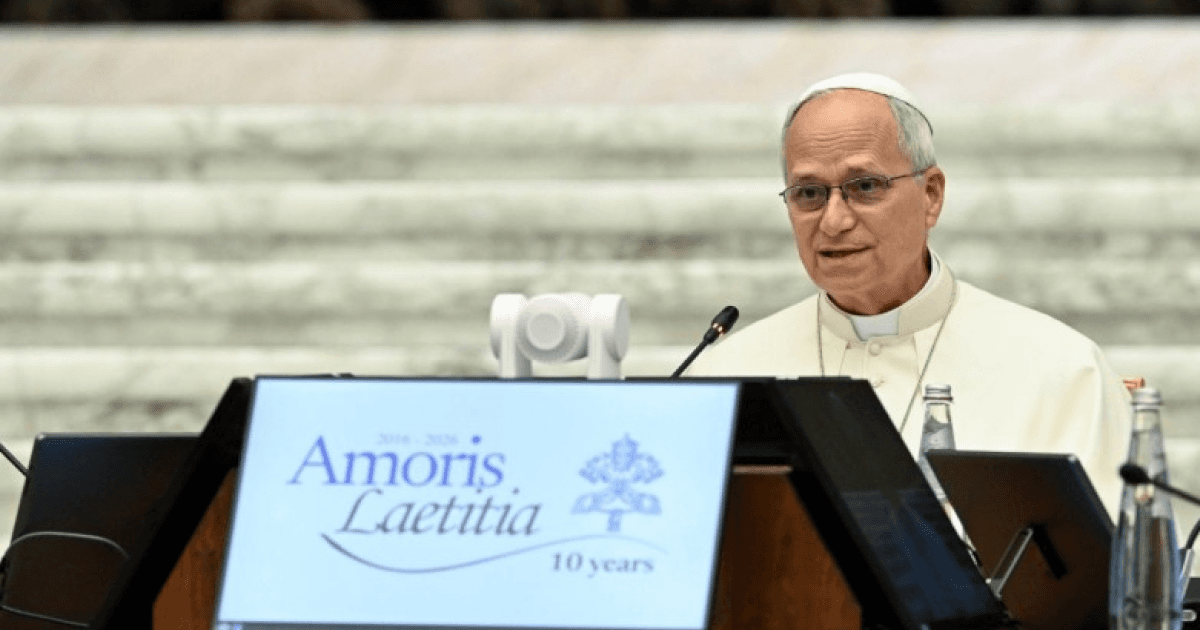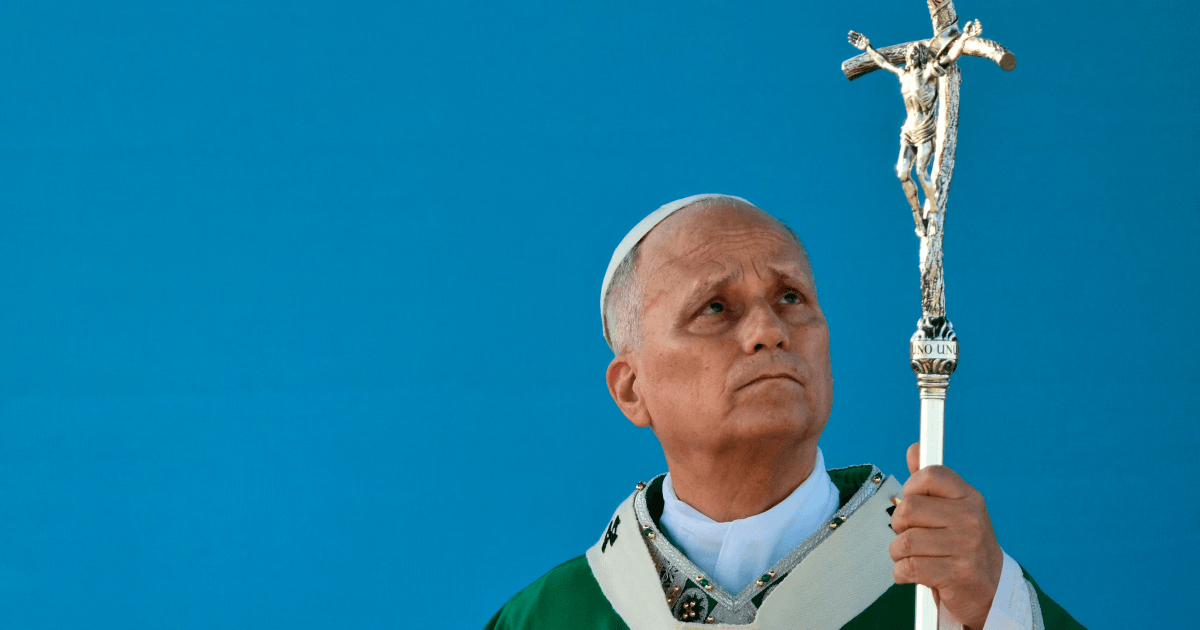
Pope Leo sought to deliver a message of “peace”, “unity” and “love” in Rimini this weekend, as he attended the annual meeting for “Friendship among peoples” organised by the Communion and Liberation organisation.
It was a highly anticipated papal visit to Rimini on Saturday, as Leo XIV briefly visited Communion and Liberation’s flagship event on the north-eastern Italian coastal town. Begun in the 1980’s, the annual event sees Rimini become the “capital of international culture” as individuals from every sphere of society gather to discuss friendship and happiness.
“The fundamental value of reference is the recognition of an objective factor that unites all men: the desire for happiness, goodness, truth, and justice that resides in everyone’s heart and therefore founds the appreciation of every diversity,” write Communion and Liberation.
Leo’s message fitted that description very nicely. The American Pope delivered a strong charge to the attendees to build a better world, in a speech which mixed the sociological with the ecclesial. He urged peace and an escape from the rearmament of nations, while also calling on young people to “open yourselves to a truly Catholic spirit, broadening your networks beyond every overly narrow sense of belonging.”
“Resist whatever would separate you from brothers and sisters of different cultures, sensibilities and backgrounds, especially the poorest among them,” Leo said.
Catholic culture must “counter the false realism that rearms minds, words and nations, with the realism of mercy which recognises that there can be no enemies, and that everyone, even those who oppose us, is a brother or sister to be looked in the eye and encountered in truth,” added the Pope.
Let us, he urged, “free our lives from suspicion, culture from arrogance, education from ideology, work from the idolatry of profit, and technology and finance from the business of death.”
Such lines very much embodied the tone of the Pope’s address at the Rimini meeting, as he issued an appeal for an improved society based on Christian values, though appeared to stop short of leaning into promoting Catholicism for its own sake.
But Leo did highlight the increased pull to Christianity which is taking place in many places around the world. Secular society, he said, “seems surprised by your commitment to Christ, by the attraction you feel toward him and his word, and by your sense of belonging to the Church.” The reason for this resurgence of faith is “a matter of freedom because the truth can be encountered only in freedom,” he noted.
Addressing the young people in the crowd, Leo called on them to utilise this international longing for “meaning, justice and peace” in order to promote Gospel values at the foundation of society. “Dear friends, always love the Church! Love and safeguard unity.”
The Pontiff turned also to synodality and linked his perception of the term and process to the appeal he had already made for a re-Christianisation of society. The “synodal” aspect of the Church “calls us, first and foremost, to learn to listen to one another”, he said.
Leo has appeared to consistently promote a different understanding of synodality than that pushed by the Vatican under Pope Francis’ reign. While Francis’ synodality involved constant questioning of established teaching, Leo’s involves “listening” over questioning. This, he said, is something which should be a part of Communion and Liberation’s style and of his vision for a newly religious world: “Synodality is not the name of a process, but the very nature of a people who, through friendship and encounter with others, come to recognise that they belong to God alone. In this way, authority is transformed into service, one that honours differences and fosters their harmony.”
The Pope’s day had begun in the micro-republic of San Marino, where he visited the Basilica of San Marino, venerated the saint’s relics and greeted the enthusiastic crowds. Being a very brief stop in the majority-Catholic state, the visit’s main takeaways came during Leo’s speech before the civil authorities.
Leo linked the protection of life “from conception to natural death” to a flourishing society, in a message which was carefully crafted to convey the Vatican’s pro-life stance in the wake of many bids for countries to legalise euthanasia. “A community like yours, in fact, both rich in traditional values and technologically up-to-date, can effectively pursue this goal [of care of the human], through care that translates into the protection of every life, at every stage, from conception to natural death.”
Echoing themes of his speeches in the small, Catholic nation of Monaco, Leo posited San Marino as an example for the international sphere. The nation, he said, “can be a laboratory’ of good politics, where, without derogating from the secular nature of the State, one can draw on the principles of Catholic social doctrine.”
To this end, Leo also emphasised a link between freedom and human dignity, saying that “in the Christian view, freedom and communion stand or fall together,” and that “there is no true civil liberty without personal freedom.”
The morning’s visit was predictably overshadowed by Leo’s afternoon engagements in Rimini, both in addressing the Rimini meeting itself and then in his port-side Mass. The Pope’s key messages of the day had already been delivered by the time of his homily, but it was a controversy over Holy Communion which has become an especially notable element of the Mass.
Scandal has erupted among some Italian Catholics since, despite the presence of hundreds of concelebrating clergy, lay-women were seen distributing Holy Communion from kitchen bowls, while wearing quasi-clerical garb. To make matters worse, the Vatican News livestream captured such women handing out Communion to boys who appeared shirtless, a style of dress which Messa in Latino notes is not even allowed in the town itself but somehow was no issue for Mass.
Despite Leo’s campaign against liturgical abuses, it is often large-scale attendance events like papal Masses which lead to abuses, especially when held outside the Vatican. The office of papal ceremonies has, on this front, been visibly lacking in recent years.
Michael Haynes is an English journalist in the Holy See Press Corps. He serves as Vatican Correspondent for the Catholic Herald, while readers can follow him at Per Mariam and on X @MLJHaynes.