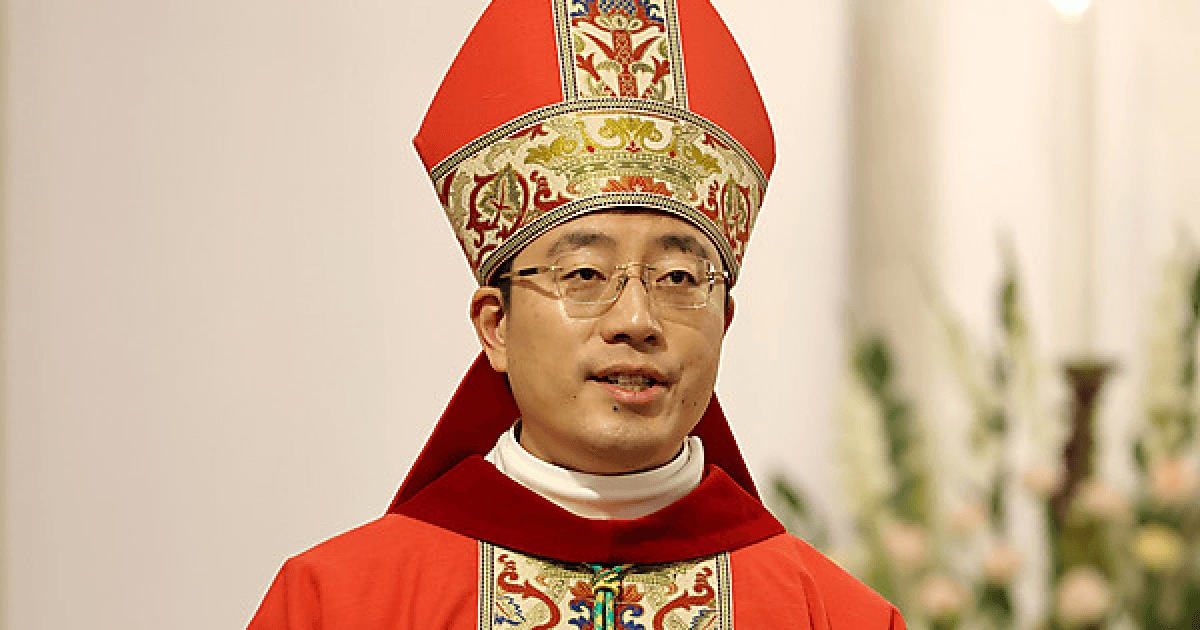
In line with the Vatican’s secret deal with China, a new bishop of Chongqing was consecrated for the see today, after having been elected by the state-church in April.
As announced by the Holy See Press Office on September 8, Andrea Ding Yang was consecrated as ordinary of the see of Chongqing. He had been elected by the Chinese Catholic Patriotic Association (CCPA) – the state church loyal to Beijing and Communist ideology – on April 15, and appointed by Pope Leo XIV on July 28.
The Vatican’s announcement noted that the new bishop had been approved by the Pope under the terms of the Vatican’s deal with China regarding the selection of bishops. As ever, the details shared by the CCPA made no mention of Pope Leo’s appointment of Yang, since the state church does not recognise the authority of the Holy See.
Another constant is the differing versions of information given by the Vatican and by Beijing regarding the new bishop. Turning 45 next week, Yang was ordained in May 2007 after studying at Beijing’s national seminary.
According to the Vatican, he spent one year studying in Rome’s Pontifical University of the Holy Cross from March 2014 – something the CCPA did not mention.
What the Vatican failed to mention was Yang’s particularly close involvement with the state-church which does not recognise the Pope. The CCPA noted that Yang serves as the deputy Secretary-General of the state-approved bishops conference, as well as being vice chairman of the Chongqing Catholic “Two Sessions” and secretary-general of the Academic Affairs Committee.
The new bishop is thus a man who will be very well versed in the policy of Sinicization mandated by Beijing and enforced by the CCPA. China experts warn that this involves having “all religious communities be led by the Party, controlled by the Party, and support the Party” – hence at its core, Sinicization ultimately leads to a rejection of Catholicism and an acceptance of Communist ideologies.
Another discrepancy in detail is regarding the see itself. China does not recognise metropolitan archdioceses, and thus only acknowledges Chongqing only as a diocese. In contrast, the Holy See noted it as an archdiocese in its own press release.
The see of Chongqing has a complicated history and has been vacant for many years. There have also been a series of bishops loyal only to the state, and whose consecration was not approved by Rome. Its recent episcopal history points to the strained nature of the state-approved church exerting its power while the Underground Church battles for existence.
Bishop Shi Mingliang held the see from 1963 until 1978, having been consecrated without the Vatican’s approval. He was succeeded by Bishop Simon Liu Zongyu, consecrated in 1981 also without papal approval. Then came Bishop Peter Luo Beizhan who was consecrated in 1993 and died in 2001. Another bishop is also recorded, Bishop Joseph Hou Guoyang, who was consecrated in 1989 but then the Holy See reportedly ruled it to be invalid since he was married.
Proponents of the 2018 Sino-Vatican deal will thus be viewing today’s consecration as a positive step, since it fills a long-standing vacant see to the satisfaction of both Rome and Beijing. Filling such vacant sees was one of the reported aims of the deal, although it has officially remained secret.
Yang’s consecration comes just days after the consecration of Father Paul Liu Honggang as bishop of the Diocese of Datong, after having been confirmed by Pope Leo under the terms of the Sino-Vatican deal.
Indeed, Leo XIV has appeared to be particularly active in approving bishops under the terms of the deal. With the next review not due until 2028, when the deal will be ten years old, this trend looks set to continue.
But as the Catholic Herald reported recently, the Underground Church has given a notable sign about the failure of the Sino-Vatican deal. Bishops are being consecrated in secret for the Underground community, with at least 10 bishops consecrated in Fuijan province alone since the deal was first signed. This correspondent has been informed that many of that number have taken place in the last year.
The reason for such a move is to protect the faith, according to the Underground bishop who revealed news of the secret consecrations. It was thanks to concerns that the integrity of the Catholic faith will suffer” due to the increasing influence of the Communist officials, that the secret consecrations occurred in order to “assure the survival of China’s Church”.
Since that news broke at the end of August, the Vatican has not provided public comment nor responded to the Catholic Herald’s request for comment on the matter.
The Underground bishop warned that the Holy See risks losing its moral authority in the Underground Church as Catholics no longer trust the Vatican to act in their best interest: “They wonder, who is the pope in China? Xi Jinping or Pope Leo XIV?”
China experts have warned ever since the deal was first signed in 2018 that it was flawed, and human rights groups have documented that Christian persecution has increased as a direct result of it. Notwithstanding this, the Vatican has continued in its firm support for the agreement.
Michael Haynes is an English journalist in the Holy See Press Corps. He serves as Vatican Correspondent for the Catholic Herald, while readers can follow him at Per Mariam and on X @MLJHaynes.