A prominent cardinal expert on Church history has warned that the current style of synod being promoted in the Church is partly inspired by Protestantism and is part of the “growing secularization of the understanding of the Church.”
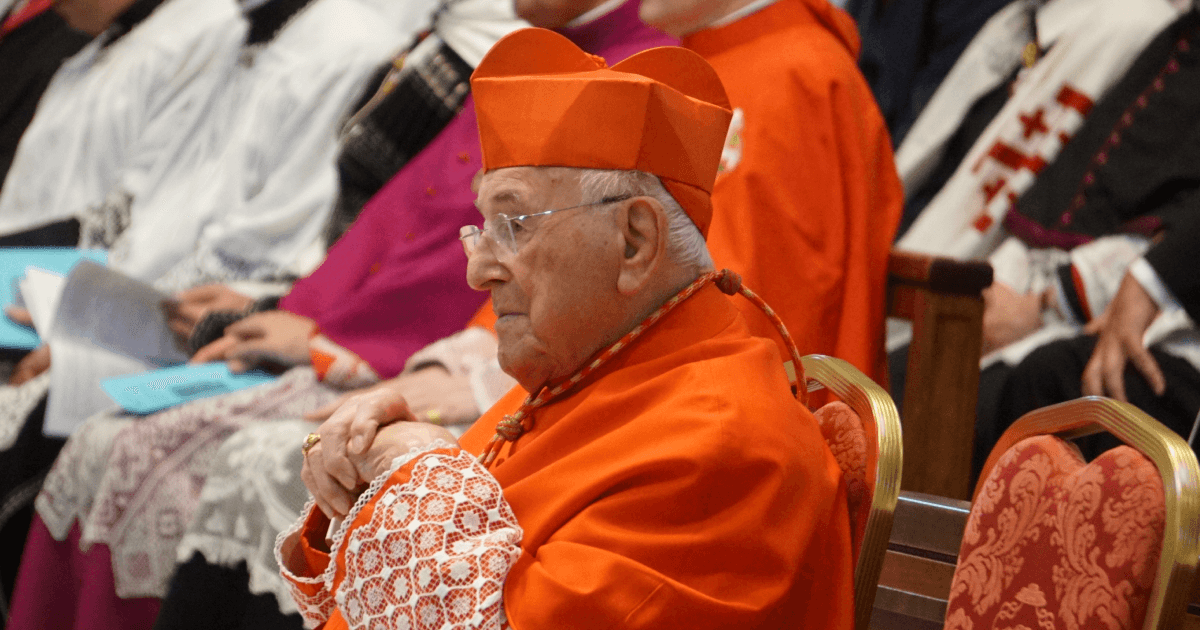
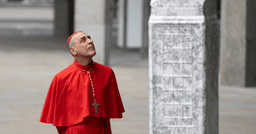
Cardinal Walter Brandmüller has issued a new critique of the Synod on Synodality and the current structure of ecclesial governance. In an analysis published by veteran Vaticanist Sandro Magister, the 97-year-old German prelate outlined an authentic notion of a synod and warned about how easily the meeting can be corrupted.
He noted, as many analysts have done, that “a clear and unambiguous definition of this word [synodality] is still lacking.” Consequently, Brandmüller outlined that the Church’s traditional understanding of a synod is as “a meeting of bishops for the purpose of jointly exercising their magisterial and pastoral service.”
Created cardinal by Pope Benedict XVI in 2010, Brandmüller is a respected Church historian, having served an 11-year term as president of the Vatican’s Pontifical Committee for Historical Sciences.
Referencing the organisational style of the Synod on Synodality, which comprised both lay and clerical voters, Brandmüller stated that this could not be described as a synod. The reason being that “neither priests nor lay people can exercise the magisterial and pastoral ministry conferred only on bishops with the sacrament of orders.”
As a result, he warned that the proliferation of this kind of meeting in the Church – which has spread especially thanks to the multi-year Synod on Synodality – risks desacralising the Church. Such meetings stem “from the effort to more or less a-critically adopt secular structures and democratic procedures in ecclesial life, in order to stay in step with the times,” said the cardinal.
Brandmüller added that with the rise of this kind of meeting and organisation, the Church was straying from its own, well-established method of holding a synod and drawing from the Protestant style.
“A type of synod is being proposed in the Catholic sphere, inspired in part by the Protestant model, whose members are democratically elected from among pastors, men and women of various professional expertise and cultural contexts, all with an equal say.”
The cardinal likened this development to the Protestant revolution and Martin Luther, noting how Luther advocated for this kind of lay involvement when he “asserted that baptism alone is sufficient to make a man or woman priest, bishop, and pope.”
“It is clear that such a concept of synodality is incompatible with Catholic ecclesiology,” said Brandmüller.
He warned also that “negative” consequences have been documented in the Church when it has adopted secular styles of decision making or meetings. In Brandmüller’s assessment, included in this was the development of episcopal conferences.
“Their frame of reference was not the hierarchical structure of the Church but rather the respective state,” he said. “Therefore the consultative and decisional activity of the conference was limited to questions concerning the position and action of the Church in the modern secular state.”
But since this was the original scope of the episcopal conferences, Brandmüller lamented that Pope Francis emboldened them with his 2013 apostolic exhortation Evangelii Gaudium. Francis noted his sorrow that “a juridical status of episcopal conferences which would see them as subjects of specific attributions, including genuine doctrinal authority, has not yet been sufficiently elaborated.” This move risked undermining the primacy of doctrinal authority reserved to the papacy, warned Brandmüller.
As episcopal conferences have grown in both size and status, they have replaced synods and become more political, he said. “It is difficult to ignore the fact that this is an expression of the growing secularization of the understanding of the Church.”
Brandmüller went so far as to argue that in the modern, political episcopal conference style, “one recognises an ecclesiological neo-Arianism which, while not expressly denying the supernatural character of the Church, more or less ignores it : the Church as social entity.”
Instead of this growing trend, he urged that synods should be restored to the particular churches and in so doing reinstate “their original importance.” This, Brandmüller opined, would assist to “effectively counteract the process of secularisation of the Church and take a decisive step toward its “de-secularisation.”
Though advanced in years, Brandmüller has not chosen a quiet retirement. He has twice joined brother cardinals in issuing dubium to Pope Francis: first in 2016 regarding Amoris Laetitia and then in 2023 regarding the Synod on Synodality.
Signing the 2023 dubia, the five cardinals warned that the Synod was an event “which many want to use to deny Catholic doctrine on the very issues which our dubia concern.” The detailed dubia questions had to be resent to the Pope, after his original answers only “deepened” the concerns the cardinals’ expressed.
Alongside Brandmüller, the 2023 dubia signatories were Raymond Leo Burke, former prefect of the Apostolic Signatura; Juan Sandoval Íñiguez, former Archbishop of Guadalajara; Robert Sarah, the former prefect of the Dicastery for Divine Worship and the Discipline of the Sacraments; and Joseph Zen, the former bishop of Hong Kong.
Michael Haynes is an English journalist in the Holy See Press Corps. He serves as Vatican Correspondent for the Catholic Herald, while readers can follow him at Per Mariam and on X @MLJHaynes.