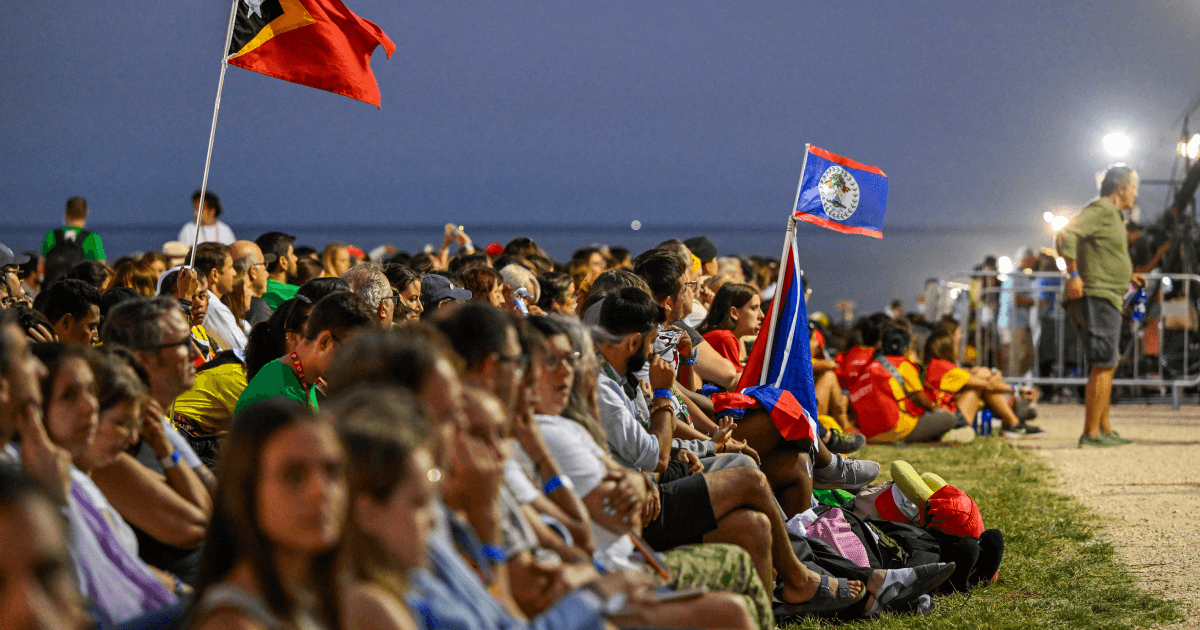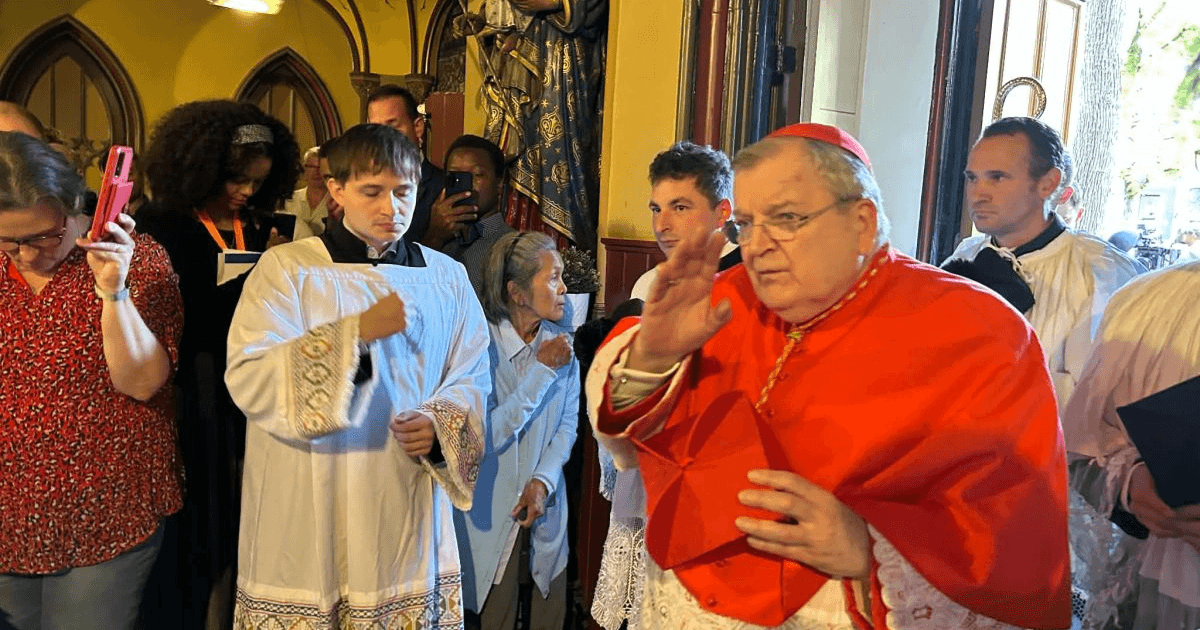
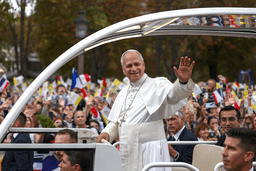
Hundreds gathered in Amsterdam at the weekend to participate in an international Rosary rally and traditional Mass celebrated by Cardinal Raymond Burke, with organisers hailing it as the most successful iteration of the event to date.
On Saturday, Burke offered a pontifical Mass in the traditional rite in Amsterdam’s church of Our Lady on Keizersgracht. The pews were packed out with some 700 people estimated to be in the congregation and spilling out onto the street. A small counter-protest gathered outside, but dissipated when they were informed how long the Mass would be.
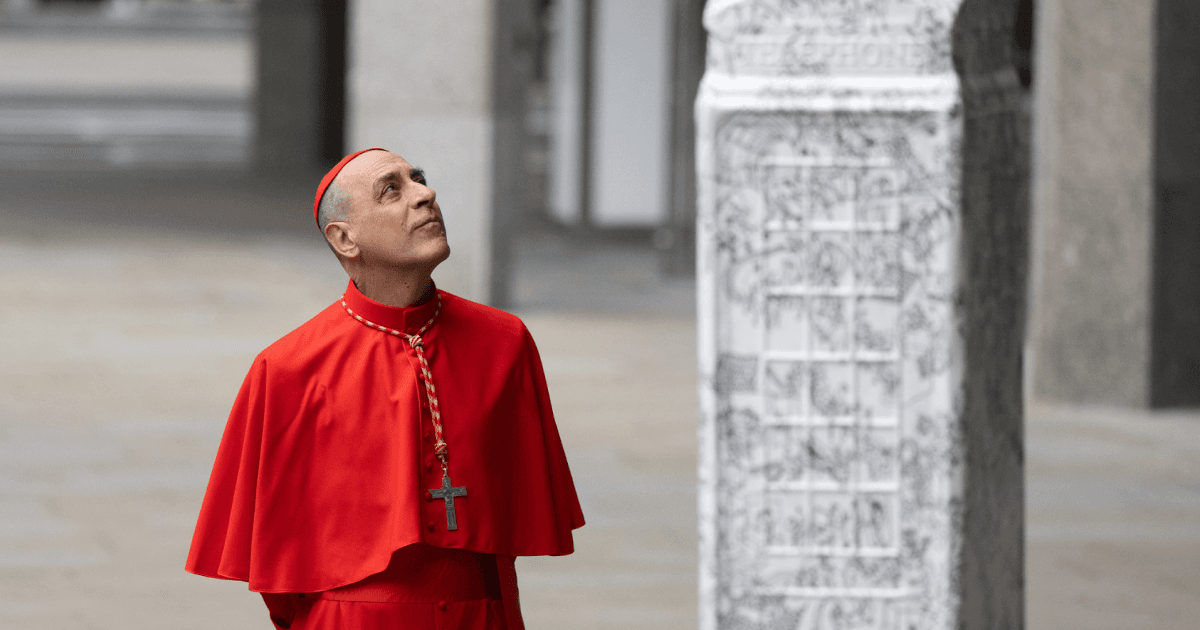
Welcoming Burke warmly to the diocese of Haarlem-Amsterdam, Bishop Johannes Hendriks spoke about “a longing in the hearts” of locals for “eternal values”. “May our prayer and our gathering on this day be a spiritual support to them all; may many find the joy of living, thinking and speaking ‘secundum Cor tuum’, according to Your heart, O Lord,” he added.
As the Catholic Herald reported, Burke’s weekend in Amsterdam featured Masses on both Saturday and Sunday, before then leading the Rosary rally on Saturday organised by Radio Maria Netherlands which has become a feature on the Catholic calendar in recent years.
It comes as part of his renewed personal campaign to promote devotion to the First Saturdays, as requested by Our Lady of Fatima, a cause he has championed for many years. Burke has also been a supporter of the local diocesan seminary life, something which Bishop Hendriks thanked the cardinal for at the weekend.
Homilising on Saturday to the packed out congregation, Burke commented that “the beauty of the Sacred Liturgy manifests to us the reality of the descent of the glorious Christ from His place at the right hand of Mary, said Burke, “teaches us that nothing can be more important to us than the gift of God’s love, immeasurable and unceasing, which destines us for eternal life with Him, in the company of the angels and of all the saints.”
Following the Mass, the procession made its way to Vondelpark in the centre of the city, a location used just weeks ago for the two-week long LGBT “Worldpride” event. Highlighting this aspect prior to the Rosary rally, Fr Pieter Zimmermann – the priest-director of Radio Maria Netherlands – opined that there was no “better place to bring reparation to the Immaculate Heart of Mary than this park.”
Here Burke delivered a detailed explanation of the First Saturdays and the Rosary devotion, and posited the Rosary as a key answer to the spiritual crisis present in the Church. “The Rosary,” said Burke, “sustains our participation in the Sacred Liturgy and helps us to realise the fruits of that participation in the holiness of daily living.”
“In our day, there is widespread confusion about the teaching of the faith,” he added. “The Rosary is a powerful tool for combating such confusion and proclaiming the truth about Christ and the Church.”
Drawing from the writings of Saints Louis Marie de Montfort and Pio de Pietrelcina, Burke defended the Rosary against critics, presenting it as “a most effective tool of evangelisation and catechesis,” as well as being a “prayer for peace” by its very nature.
The American prelate was joined by Cardinal Willem Eijk and, over the course of the weekend, some six bishops accompanied the various liturgies. Radio Maria praised the assistance of local police in ensuring safety and security of the Mass and procession, noting that just a single protestor attempted to interfere with the procession but was swiftly informed about the benefits of the Rosary.
Offering Sunday Mass in Haarlem Cathedral, Burke expounded on the benefits of fraternal correction, a topic which he is well known for given his own public interventions during the course of Pope Francis’ pontificate.
Catholics must be unafraid to speak the truth in an age when the state is legalising “moral evils” against life, such as abortion and euthanasia. But a particular challenge is when a fellow Catholic proposes some position which contradicts the faith, especially when done in public.
“The moral relativism of our society tends to accept as right whatever a person thinks about any given moral question,” he lamented. “As a result, we often find ourselves in social conversations or in discussions with others, in which statements are made, which are contrary to the moral law and, therefore, to Church teaching. If we remain silent, we give the impression that we agree with what is wrong, and we fail to call our neighbour to examine what he or she is stating in the light of the moral law and the Church’s teaching.”
Faced with such confusion even within the Church, Burke defended fraternal correction as a charitable act performed out of love of the faith, rather than being “some prideful act”. “Christ teaches fraternal correction as a fundamental responsibility of charity, from which we may not excuse ourselves because it is difficult to fulfil,” he said.
Expanding on this theme later in the day during a separate presentation, the cardinal outlined the practical forms which apostasy takes. “It is clear,” he said, “that apostasy, either explicit or implicit, leads hearts away from the Immaculate Heart of Mary and, thus, from the Sacred Heart of Jesus, the only font of our salvation. In that regard, as the Message of Fatima makes (sic), the pastors of the Church, who in some way cooperate with apostasy, also by their silence, bear a most heavy burden of responsibility.”
As reported elsewhere on the Catholic Herald, Burke also defended the Marian title of Mary as “Co-Redemptrix”, a term which has come under attack from the Dicastery for the Doctrine of the Faith in recent months after the publication of Mater Populi Fidelis. The highly controversial text argued that it was “always inappropriate to use the title ‘Co-redemptrix’ to define Mary’s cooperation.” However, the DDF’s prefect Cardinal Fernández later backtracked, saying that if a Catholic wishes “to express precisely that within your prayer group or among friends, you may use the title – but it will not be used officially, that is, either in liturgical texts or in official documents.”
The American cardinal’s defence of the term is notable, and marks one of the first public instances of a cardinal doing so since the publication of Mater Populi Fidelis.
In Burke’s assessment, devotion to the Rosary, first Saturdays, and the Immaculate Heart are intimately connected with viewing Mary as Co-Redemptrix.
Michael Haynes is an English journalist in the Holy See Press Corps. He serves as Vatican Correspondent for the Catholic Herald, while readers can follow him at Per Mariam and on X @MLJHaynes.