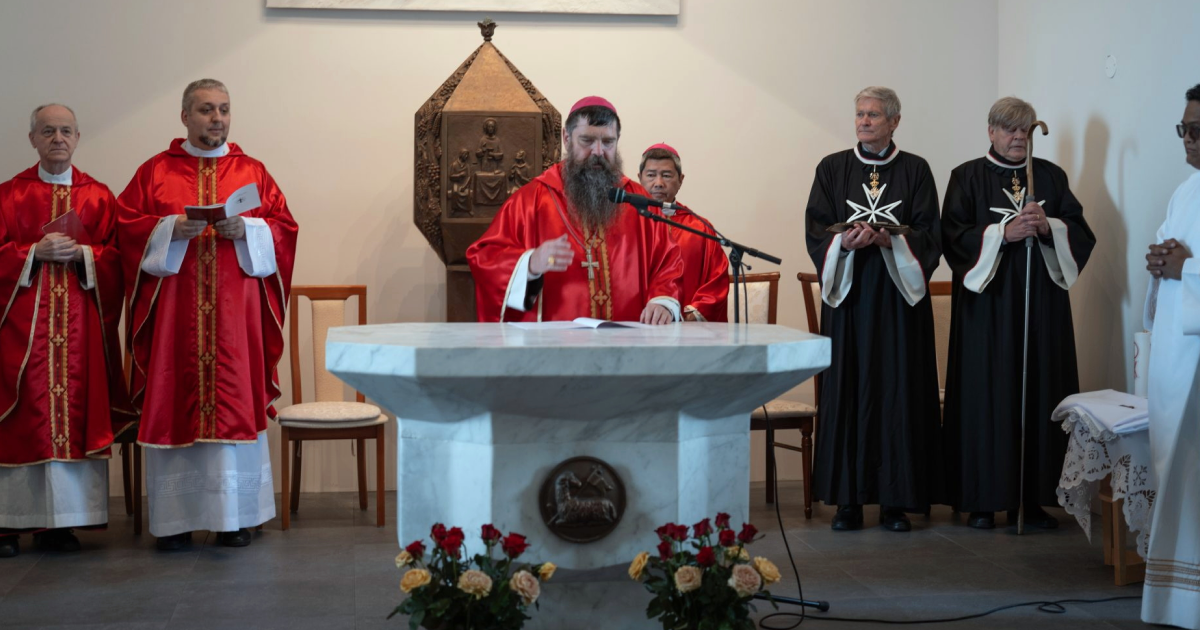


At the end of the extraordinary consistory, senior Church figures addressed questions on synodality and the role of the laity during a Holy See press conference.
The briefing included Cardinal Luis José Rueda Aparicio, Cardinal Stephen Brislin, and Cardinal Pablo David, offering their insights into how the synodal process is being understood as it develops. The Catholic Herald asked the cardinals how synodality, described by some as being in its infancy, can be ensured to remain rooted in doctrine and tradition, and what distinctions are being drawn between legitimate lay participation and the functions reserved to the priesthood and episcopate.
Cardinal David responded first, choosing to begin with the question of lay participation and the priesthood. “I’d like to start with the second, which is about legitimate lay participation, the central function of the priesthood,” he said. He placed synodality firmly within the framework of mission, adding: “Synodality is founded on the concept of co-responsibility in mission. We used to think of mission as the job of missionary congregations. Now, when we speak of mission, we’re speaking about the mission of the whole Church. We’re not Church if we are not in mission.”
He continued by linking mission to apostolic responsibility rather than passive discipleship. “Christianity isn’t just about discipleship or following. It’s also about apostolicity, about apostleship, which is engaging in mission,” he said. Referring to Evangelii Gaudium, Cardinal David defined mission as “proclaiming the comforting joy of the Gospel, especially to people most in need of good news, people who are struggling with despair, people who are wounded, people who are broken.”
Addressing directly the question of lay participation, Cardinal David identified what he described as a structural problem within the Church. “I think it’s been made clear that one of the obstacles in the Church is clericalism,” he said. He warned that speaking about co responsibility becomes meaningless if attitudes remain unchanged. “We love to speak about co-responsibility in mission, but the laity would find it difficult to really participate in the life and mission of the Church if there is a prevalent attitude that says, ‘I am the one in control.’”
He linked this mentality to an exaggerated understanding of ordination. “Because we’re ordained, we’re supposed to be the ones to give the direction of the Church,” he said, before adding: “Through synodality, we’re allowing the other sectors of the Church, aside from the ordained, to be heard as well, that their voices are heard, the laity and the religious.”
Turning to the concern about ambiguity, Cardinal David rejected the idea that synodality represents a novelty. “As far as I’m concerned, synodality has always been there since the beginning of Church history. We’re just sort of retrieving the vocabulary,” he said. He explained that the reality of synodality can be expressed without the term itself: “Speak about communion, speak about participation, speak about mission, about co-responsibility. That’s synodality.”
On disagreement within the process, he was frank. “Disagreements are about to come out,” he said, adding that this was precisely why “we engage in conversations in the Spirit”. He continued: “While we identify points of convergence, we will also identify points of divergence among ourselves.” Such divergence, he argued, should prompt deeper engagement rather than alarm. “When there are points of divergence, that probably only means we need more conversations.”
He stressed that listening is central to the process. “The listening is not just listening to one another, but listening most of all to the Holy Spirit speaking through one another,” he said, noting that communal discernment remains a developing discipline. “The rules of discernment, or communal discernment, are still being refined in the process itself of experiencing synodality.”
Cardinal Rueda Aparicio responded with a more measured tone, emphasising patience and diversity within the global Church. “Synodality and participation, communion, participation, mission of the baptised, men and women, of the laity, of the bulk of the Church, who are not the ordained ministers but the lay faithful, is on the way,” he said.
Reflecting on the discussions of the consistory, he observed uneven progress. “From what one can hear in the interventions of these days, in some countries more progress has been made, more presence, more maturity, more availability of the laity has been achieved. In others it is still lacking,” he said. This diversity, he suggested, should shape expectations. “The issues of the Church’s mission, of renewed evangelisation, take time.”
Later, when pressed further by Diana Montagna on clericalism and what she described as the divinely constituted hierarchy of the Church, Cardinal David replied: “What you were referring to as the divinely constituted hierarchy, there is no doubt about the hierarchy in the Church.” He added that “in the theology of the ordained ministry, we speak of the ministerial priesthood.”
He continued that the ministerial priesthood “will not make sense without putting it in the context of the common priesthood of the faithful, which is a very specific theological principle of the Second Vatican Council.” Expanding on this point, he said that when the Church speaks of the ordained “acting in persona Christi, or in the person of Christ, the head of His body, the Church,” this must be understood in its fullness. “Christ is not just the head; Christ includes the body,” he said, explaining that the whole Church is the body of Christ and that all the baptised are members of that body. On that basis, he concluded that “the ordained do not have a monopoly on acting in persona Christi,” adding that the laity also share in this reality “by virtue of the same dignity of baptism that they have received.”
The question of whether the Church can widen participation without weakening the divinely instituted nature of her hierarchy and sacramental life matters not only because it was contested during the consistory, but because it bears directly on the nature of priesthood, authority, and the meaning of baptism, and therefore on how Catholics understand the Body of Christ itself.
The comments made at the press conference by Cardinal Pablo David during the extraordinary consistory illuminate why these questions are becoming unavoidable. In presenting synodality as something retrieved rather than invented, and in framing clericalism as a principal obstacle to mission, His Eminence articulated a view widely shared among those driving the synodal process. Yet when synodality is expressed in ways that appear to blur the theological distinction between the common priesthood of the faithful and the ministerial priesthood, the discussion moves from pastoral emphasis into doctrinal risk.
This is not a marginal issue. The Church has faced similar tensions before, particularly in the period following the Second Vatican Council, when legitimate calls for renewal were sometimes accompanied by confusion about authority, sacramentality, and obedience.
Furthermore, the modern use of the term clericalism deserves closer scrutiny. Often deployed as a catch all term, it has become a word that condemns attitudes without defining them. Its popularity in ecclesial discourse owes much to cultural currents of the late twentieth century, and it entered Catholic debate largely through Enlightenment sociological critique rather than precise theological definition, notably in the writings of figures such as James Carroll. While it is obvious that genuine abuses of power must be confronted, the routine use of clericalism as a pejorative risks portraying hierarchy itself as suspect.
The synodality now being advanced often speaks the language of listening, co-responsibility, and conversation in the Spirit. These are not in themselves foreign to Christianity. Yet there is a difference between consultation and co governance, between listening and redefining who acts in the name of Christ. When it is suggested that the ordained do not possess a unique sacramental character in acting in persona Christi, this raises immediate concerns.
What is at stake is not resistance to reform but clarity about continuity. The Second Vatican Council did not dissolve hierarchy into participation, nor did it set the laity against the priesthood. The Church does not require a synodality that is radical in a political sense, but one that is faithful in a theological sense.