Calling for renewed attention to the “grave global ecological crisis” and a change in mindset across the board regarding “ecological conversion”, the Vatican’s theological advisory body has published a lengthy text positing ecological actions as a response to loving God as the Trinity.
Released without warning on the morning of September 2, the International Theological Commission’s (ITC) new document “Caring for Our Common Home: A Responsible and Fraternal Response to the Triune God”, posits climate activism against the backdrop of faith.
“A faith-filled perspective on the ecological crisis in which we live helps us decisively to understand both the theological roots that lie at its origin and the extraordinary theological potential that serves as the resource for confronting it and emerging from it in a positive way,” the Commission writes.
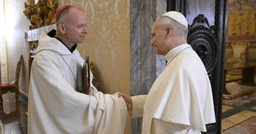
The text is a fruit of the work carried out by ten members of an ITC subcommittee, between 2022 and 2025. Approved by majority in an online vote by the ITC members in July, it was presented to Pope Leo on July 28 by Cardinal Victor Manuel Fernández. (The ITC operates under the auspices of the Dicastery for the Doctrine of the Faith, led by Fernández).
Divided into five chapters, the text begins by examining the writings of Saints Augustine of Hippo, Hildegard of Bingen, Bonaventure and Thomas Aquinas, using the saints to form the basis of the ITC’s theological arguments regarding the climate and the interconnected nature of creation. In addressing creation from the point of view of faith, the four saints – said the ITC – highlight “if the Creator is one and triune, creation in some way manifests this origin and destination.”
Since man is formed in the image and likeness of God and given the responsibility of stewardship, the ITC outlined in chapter 2 that the concept of the Sunday rest is part of a wider Divine plan involving “care for our common home, together with respect for the rhythms that generate a fundamental harmony in the garden: between the earth, its plants, animals, human beings, and the praise of God.” It also argued that “social differences – whatever they may be: of ethnicity, gender, culture, social or economic status – in no way imply a hierarchical ranking.”
The Commission drew heavily from Pope Francis’ regularly proposed concept of an “ecological sin”, and lamented the widespread temptation for humanity “to regard human beings and their unlimited desire for power over creation as the ultimate source of every criterion for defining good and evil.” This, the ITC wrote, leads to “sin against the Creator and creation” as environmental damage is “first and foremost the refusal to follow God’s intended plan for creation”.
“Ecological sin” needed to be clarified, the ITC said, so that people understand it as a term that “simultaneously implies both the harm inflicted on nature and the failure to recognise, or even the rejection, of the Creator’s plan, which includes the entrusting to human beings the stewardship and care of our Common Home.”
The document is a product of the recent Vatican emphasis on ecological issues, which was particularly pushed to the fore by Pope Francis. His encyclical Laudato si’ and follow up exhortation Laudate Deum presented the foundation for the Vatican to weigh into the climate discussion in a more direct manner.
Such rhetoric has increasingly seen faith put at the service of climate issues, and ecumenical endeavours have also become oriented to this end.
Demonstrating this growing trend, the ITC posited the Eucharist as an “ecological school” from which emanates “a spirituality capable of sustaining and encouraging the ecological conversion that we so urgently need to undertake as the human family.”
Employing the more modern theological understanding of the Eucharist as a table, the ITC wrote that since the Eucharist “is a banquet of communion, a common table to be shared” it teaches the Church about ecology.
“In it we learn to contemplate and praise God both through our work of transforming nature and through our interpersonal relationships,” wrote the Commission.
The ITC also advocated for increased ecumenical collaboration in order to change hearts and minds and effect an “ecological conversion”. Pointing to the “the driving role of the religions in favour of the common good” the ITC outlined various aspects from Judaism, Hinduism, Buddhism, Islam, Confucianism and Indigenous beliefs which could be drawn on to further the ecumenical ecological efforts.
Fundamentally, this boiled down to creeds that acknowledged a “creative principle” behind creation, which thus opened the possibility of “interreligious collaboration in the common task of respectfully caring for all creation, in service to the flourishing of life and communion with the Transcendent, who is the origin and foundation of all life.”
The Commission was keen to point out that it was not simply searching for “a lowest common denominator among religions” but instead for areas affording the opportunity to “promote collaboration in sharing certain fundamental convictions.”
Indeed, despite the great diversity of premises and approaches, we share with other great spiritual and religious traditions the legacy of love and care for our Common Home.
As a purely advisory body, the ITC’s standing and weight are somewhat limited. So too is the import of its newly published text.
Released without fanfare and with such length, the ITC’s text risks being overlooked by many in the Church. Passionate climate activists and sceptics of such measures will respond in proper kind to the text, but acting in essence as a policy advisory paper the ITC’s document will ultimately only have real import for a handful of clerics at the Vatican.
“An honest acknowledgment of sin against the Creator and creation opens us to accepting the urgent call to ecological conversion,” it reads. Such a phrase points to the emerging concept of two differing concepts of morality within the Church today, and which the new document is an example of.
Those eagerly consumed with climate issues will welcome the Church’s continued intervention into the sphere as an important step, while Catholics more focussed on the concerns of traditional morality will question the import and value of the nearly 30,000 word text.
Michael Haynes is an English journalist in the Holy See Press Corps. He serves as Vatican Correspondent for the Catholic Herald, while readers can follow him at Per Mariam and on X @MLJHaynes.