
Hamnet, directed by Chloé Zhao, is a visually beautiful film and a moving portrait of marriage and grief. But the film is let down by its ahistorical treatment of religion.
First, the absence of Christianity: not once in Hamnet do any of the characters mention God – let alone invoke the name of a saint. This omission is not surprising. We have come to expect period dramas to present a past in which Christianity seems never to have existed. If it is shown at all, it tends to be portrayed as the sole province of cruel and sadistic characters, like The White Princess’s Margaret Beaufort and Wolf Hall’s Thomas More. Perhaps the fact that Hamnet ignores Christianity is hardly worth commenting on. Of slightly more concern is the fact that Shakespeare’s wife appears to be a neo-pagan.
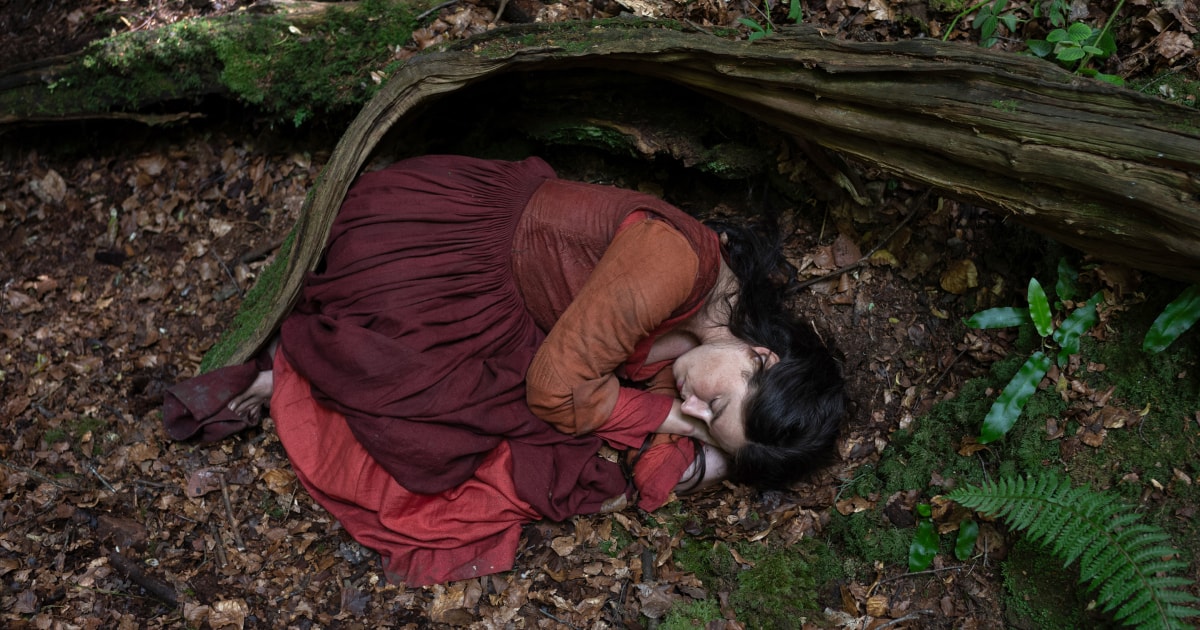
We learn very early in the film that Agnes (known to history as Anne Hathaway) is the daughter of a “forest witch”. The other characters whisper it behind her back, and she concedes it to Will, saying: “My mother taught me many things,” and later: “The women in my family see things.” Possessed of this “sight” – much like Philippa Gregory’s version of historical women in her novels, who do magic and can also “see” – Agnes knows some of what will happen in her future and can read people by holding their hands. The audience is given several flashbacks of Agnes’s childhood with her mother, learning a song about the herb mugwort, which she later teaches her own children, and that she should always trust what her dreams tell her. Agnes has a deep connection with the forest and wanders the woods with her hawk. She gives birth to her first child cradled in the womb-like hollow of a great tree and is devastated when prevented from returning there for her second birth.
So Agnes is definitely “witchy”, to use the contemporary idiom. The film is clearly trying to imply that Agnes has held on to her mother’s wise, sylvan faith, which is contrasted with the institutional stuffiness of her contemporaries. The fact that the word “witchy” exists today speaks to the widespread longing for such a faith and, had I seen Hamnet a few years ago, I might have been swept up by Agnes’s appeal. But watching the film as a convert to Catholicism, I was left wondering: what does Agnes actually believe?
The one scene in Hamnet in which faith is acknowledged explicitly is during an exchange between Agnes and her mother-in-law after the apparent stillbirth of Agnes’s second daughter. The older woman says: “She is gone to Heaven.” Agnes replies: “She is not gone to Heaven. I go to your church but I do not say a word.” Were it not for the first sentence, this line could have come from the mouth of a bold recusant Catholic scorning Cranmer’s new religion, and would have made more sense as such in a film depicting this period of English history (although the conversation would have needed to have taken place between two different characters: Shakespeare’s family remained faithful Catholics).
Is the film suggesting a kind of enlightened agnosticism for Agnes, perhaps omitting mention of God throughout in sympathy with her position? Not quite. Agnes clearly believes in some kind of afterlife. She will not let her dying daughter “cross over” – where to? – and, when her hawk dies, she buries him with stones and flowers, telling her children that he will watch over them and grant them wishes. Agnes is not a materialist or an atheist, but she still firmly rejects religion, espousing instead the vague spirituality acceptable to post-modern, sceptical, liberal man: one that goes so far as to believe people might go somewhere when they die, but would never claim to know where.
It is not only in her spirituality that Agnes is thoroughly modern, but also in the whole notion of the witch as a nature-worshipper, communing with trees, disclosing the secrets of herbs and reading the landscape. This is a 19th- and 20th-century invention. The conception of witchcraft in Shakespeare’s time was one of black Sabbaths and general diabolism. It reached its height in the 1600s under the Puritans, when it often took on an anti-Catholic flavour, with the ritual and ceremony of Catholicism being seen as magic – and therefore demonic – and priests accused of priestcraft just as “witches” were accused of witchcraft. The Catholic Church was seen as overly feminised and as having been given over to women’s strange rites and customs, such as the ceremony of churching, when a newly delivered mother would rejoin her community, veiled at first and then unveiling after her lying-in period. Misogyny certainly mingled with the spectre of popery in Puritan witch trials.
But the figure of the nature-witch, the woman feared because she was too close to the natural world and suspected of nature-based paganism, did not exist in the Puritan imagination. She is the fictitious creation of Gerald Gardner and Margaret Murray, who did such a thorough job promoting their pseudo-histories that by the time they were disproved they had taken such powerful root in the popular imagination that it did not matter any more. Evidently, the medieval and early modern pagan nature-witch does not look set to go anywhere soon.
Margaret Murray based her idea of witchcraft as a pre-Christian fertility religion in part on the theses of 19th-century folklorists like Sir James Frazer, author of The Golden Bough, who posited the existence of a European nature-based paganism preserved by the peasant class throughout the ages. As evidence, they took folk rituals and customs in rural communities and worked backwards to imagine the kind of pagan cults to which these might once have belonged, coming up with the folk religion of fertility rites and sun gods with which we are now so familiar. But it never existed. Those folk rituals and customs were remnants not of a lost pagan past but of medieval Catholicism.
The same goes for herbal medicine. For the filmmakers of Hamnet, a woman who knows about herbs can only be a witch. But it was once the duty of all women to know which herbs healed which ailments. Before the advent of the so-called Enlightenment, medieval men and women saw the world as a divine emanation of God. Thus plants were no less sacred than the rest of Creation, and medieval herb-women made “simples” of them – medicines that kept the plants whole rather than cutting them up to mix with others. Protestant iconoclasts were so suspicious of any sense of the divine in the natural or material world that they razed the ancient monastic orchards known as “paradise gardens”. If a Puritan suspected a woman of witchcraft because of her knowledge of herbs, it would not have been because of connotations of paganism, but of Catholicism.
A Catholic woman of Agnes’s day believed in something. She knew who her Creator, her Saviour and her Redeemer were; she knew whose Body and Blood were in the tabernacle. She knew what her duty was: to get her husband and children into Heaven. She knew she deserved Hell, but that her sins had been paid for and she could be forgiven. She prayed to her Mother, Mary, in her labour; she prayed to the saints as she worked – perhaps, as she prepared her simples, to St Hildegard of Bingen, who wrote extensively about the uses of herbs.
Most historical dramas are all drama and no history – or, in Hamnet’s case, melodrama: the use of Max Richter’s “On the Nature of Daylight” at the end felt a little like an instruction to “cry, now!” It is unsurprising, therefore, that Hamnet should both omit Shakespeare’s faith and concoct an imagined paganism for his wife. Unsurprising – but still disappointing. Is it too much to ask of a script, a director or indeed a novelist that historical characters speak, act and pray like real historical people? How refreshing it would be to see characters grapple with love and loss through their faith, which, far from being the preserve of sadists and simpletons, was the lens through which the world was understood by the greatest writer in human history. And his wife.