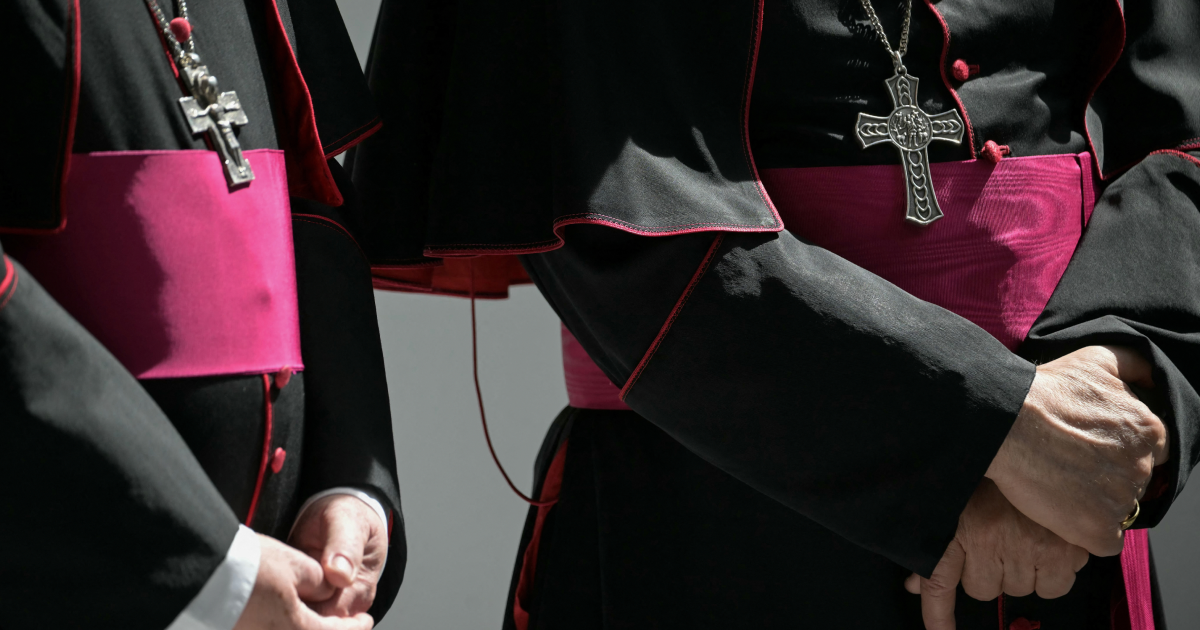


Last week, German Bishop Peter Kohlgraf of Mainz rejected claims that he and other members of his country’s episcopate have ceased to be Catholic, insisting that such accusations misunderstand both his position and the nature of Catholic identity today.
Preaching in Mainz Cathedral on the Feast of the Immaculate Conception, Bishop Kohlgraf said he repeatedly encounters assertions that German bishops are no longer Catholic.
Referring to the German Synodal Way and its proposals for reform, the bishop said: “Time and again, I read that myself and other bishops in Germany are no longer Catholic,” before dismissing the charge as unfounded.
He used the Marian feast of the Immaculate Conception to reflect on what it means to be Catholic, suggesting that the faith is often reduced to a narrow set of disputed questions. Arguing that Catholic identity should not be framed primarily in terms of boundaries and exclusion, the bishop said he rejected Catholicism defined as “an unchanging truth that must be proclaimed at all times, regardless of current issues and developments”.
The bishop further explained: “For me, being Catholic also means reckoning with the possibility that I may be wrong.”
During the homily, the bishop did not directly address specific points of criticism levelled at the German Synodal Way. Nor did he refer to repeated interventions from Rome warning that national synodal bodies do not have the authority to alter teachings held to be irreformable. Instead, his focus remained on what he sees as a distorted portrayal of the German bishops’ intentions.
Since its launch in 2019, the Synodal Way has passed a series of resolutions calling for radical changes to Church teaching and governance. Among the most contentious are texts supporting blessings for same sex couples, the ordination of women, a revision of sexual morality, and the creation of a permanent governing synodal council of bishops and laity.
On the question of same sex unions, the Synodal Assembly voted in favour of allowing Church blessings for same sex couples. The resolution declared that “same sex partnerships who want to take the risk of an unbreakable common life should be able to see themselves placed under the blessing of God”.
This contradicts a 2021 Vatican declaration that the Church cannot bless same sex unions, as such blessings would endorse sinful acts. The Synodal documents express appreciation for “different sexual orientations and gender identities” and call for a re evaluation of homosexuality in Catholic teaching.
In September 2022, 83 per cent of the German bishops voted to support a draft text proposing revisions to Church teaching on homosexuality. These texts promote a liberalised sexual morality, including greater acceptance of contraception and masturbation, in direct conflict with the Catechism. Bishop Georg Bätzing, president of the German Bishops’ Conference, has openly criticised the Vatican’s position as outdated and not reflective of a “freedom loving society”.
The Synodal Way also endorsed calls for women to be admitted to ordained ministry. In February 2022, the assembly passed a document titled Women in Ministries and Offices in the Church, with 174 votes in favour and 30 against. The text challenges Pope John Paul II’s 1994 apostolic letter Ordinatio Sacerdotalis, which affirmed that the Church has no authority to ordain women. The German document argued that it is the exclusion of women from ordination that requires justification. It further recommended renewing the theology of ministry to open the diaconate to women.
In a session vote, 92 per cent of Synodal delegates and 82 per cent of bishops supported exploring women’s access to ordination. Bishop Franz Josef Bode of the Diocese of Osnabrück suggested that doctrines such as the male only priesthood are historically conditioned and could develop over time, challenging the notion of definitively held Church teachings.
Reforms to priestly life were also approved. Delegates endorsed a text calling for the Latin Church to make celibacy optional and to consider ordaining married men, viri probati. This resolution was supported by 79 per cent of bishops present. While celibacy is a discipline rather than dogma, critics argue that Germany’s unilateral move disregards Church unity. The bishops of Scandinavia noted the decision as a capitulation to modern cultural expectations.
Sexual ethics formed a major focus of Synodal reforms. One resolution argued that Catholic sexual morality must be rewritten, stating that “almost nothing can be saved” from the current doctrine. The Synodal Way proposed that the Catechism be changed to affirm consensual sexual relations outside marriage and to remove language labelling homosexual acts as sinful. Cardinal Luis Ladaria, then prefect of the Dicastery for the Doctrine of the Faith, warned that the Synodal texts risked confusing the faithful and undermining the Church’s moral teaching.
On governance, the Synodal Way passed a resolution with 93 per cent approval to create a permanent Synodal Council, a national body of bishops and lay people to oversee Church life in Germany. The Vatican has formally rejected this plan. Pope Francis wrote to German Catholics in 2023 stating that the proposed council “is not in alignment with the sacramental structure of the Catholic Church”. He later reiterated a January 2023 directive forbidding the council’s creation, warning that it threatened the Church’s unity. Nonetheless, German leaders have indicated plans to proceed by 2026.
Since its inception, the German Synodal Way has drawn mounting criticism. The Polish bishops cautioned that the Synodal Path risks moral and spiritual harm by conforming to secular ideologies, while the Nordic bishops warned against surrendering to the prevailing cultural climate. In an open letter, 74 bishops from across the world expressed deep concern that the initiative undermines unity and confuses the faithful. Cardinals Ladaria and Ouellet, speaking on behalf of the Holy See, issued direct warnings to the German bishops, with Cardinal Müller going further in describing some of the Synodal texts as heretical.
These assessments, issued from multiple quarters and factions of the Church, point to a growing consensus that the Synodal Way has moved beyond legitimate reform into a trajectory widely viewed as heterodox. Some have already argued that consistent deviations from the catechism have already placed the dissenting bishops outside of Catholic teaching, and the further condemnation from various members of the hierarchy simply confirms that reality. Others would appreciate further clarification, wanting the Vatican to give their own binding ruling and even to impose sanctions on those promoting teachings contrary to the Catholic faith.
The future of the German Synodal Way remains unclear and the movement appears to be dissipating, certainly in terms of its public presence. However, what is apparent is that the movement has directly challenged Church teaching, and in doing so could certainly be within the realms of heterodoxy.