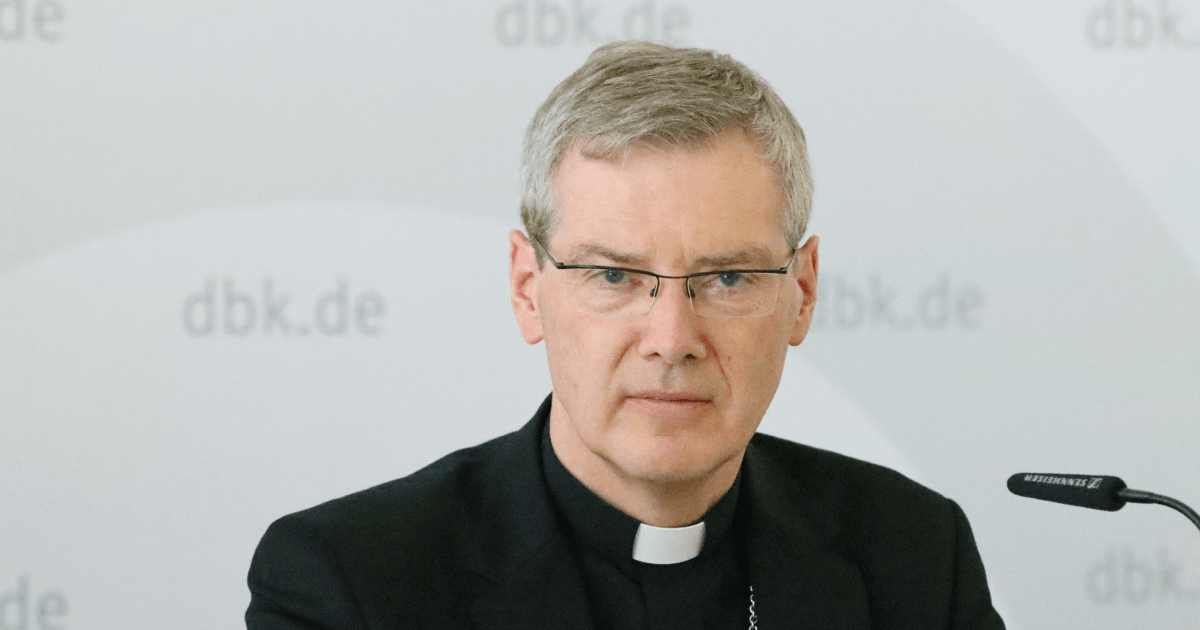
Fresh on the back of the Holy See’s firm prohibition of lay preaching in Germany, the head of the German bishops conference has praised the practice as a “long-standing tradition”.
Bishop Heiner Wilmer was elected as chairman of the German bishops’ conference (DBK) in February 2026, after having been one of the more vocal proponents of the Synodal Way’s more controversial discussion points. This included the proposal for lay preaching, something which the DBK voted for two days after Wilmer was named as chairman.
A request for a German indult for lay preaching was submitted to Rome on March 30, and the reply from the Vatican was released in June. The Holy See’s answer was a firm rejection of the request, noting that a priest may entrust the homily to a “concelebrating Priest or occasionally, according to circumstances, to a Deacon, but never to a layperson.”
In the face of the Vatican’s detailed response, Germany’s response has been somewhat forthright. Bishop Peter Kohlgraf of the Diocese of Mainz stated that lay preaching had become “common practice”, and that while he could not support it after the Vatican’s letter, he also would not penalise the practice.
A few days prior, the auxiliary bishop of the Archdiocese of Munich and Freising delivered a joint “dialogue sermon” on the feast of St Mary Magdalen with a lay-woman. Neither instance has garnered any public response from the Holy See so far.
This is the backdrop against which Wilmer’s latest interview is presented. Asked about the topic, along with Bishop Kohlgraf’s comments, Wilmer expressed great praise for the lay preachers in his own Diocese of Munster.
“I know that for years in our diocese, many baptised women and men have engaged with this issue and cultivated a culture around it,” he said. “I have great respect for this long-standing tradition and feel deep gratitude.”
Like Kohlgraf he sought to portray some public adherence to Rome’s decree, adding that “I also respect the feedback from Rome.”
“At the same time,” he continued, “I am firmly convinced that the wonderful pastoral workers in our diocese will find a good way to handle the situation effectively. I have great confidence in them and am very grateful to them for their outstanding work and their witness.”
The Dicastery for Divine Worship and the Discipline of the Sacraments’ response to the DBK’s request came in June, but in itself it offered nothing new. The teaching it presented has been a constant in the Church. Even more recently, Redemptionis Sacramentum outlawed any lay preaching and Canon Law has clearly noted the impossibility of the practice for many decades.
“Among the forms of preaching, the homily, which is part of the liturgy itself and is reserved to a priest or deacon, is preeminent,” reads Canon 767 §1.
Wilmer’s comments appear to express his official alignment with the Holy See’s latest statement on the matter, but do not point to a deeper change of spirit when it comes to his personal stance on the nature of lay preaching. The fact that it is already “common practice” in a number of German dioceses reveals that Canon Law has been long disregarded, and with growing resistance from German bishops the Vatican’s June letter is likely to have little actual effect.
The DBK chairman also commented about other elements of the Synodal Way, urging advocates of the more controversial issues not to be discouraged by a lack of Vatican action. “These issues haven’t been “put aside”; they’re still being addressed. They’re part of the world synod,” he said.
Numerous action items had been voted on in the Synodal Way, including calls for a change in Church teaching regarding clerical celibacy, admitting transsexuals to the priesthood, allowing female deacons and establishing a Synodal Council which would undermine the ordained, hierarchical nature of the Church.
Debate on these issues between the DBK and the Vatican has led to a series of meetings between both parties, with the Holy See pushing back firmly. However, in practice little regard appears to be given to Rome from the DBK.
As for the Synodal Council, Wilmer declared himself “confident that we will make progress on this”. The Vatican has firmly opposed the measure from day one, making Wilmer’s assertion surprising and somewhat unlikely. As proposed, the Synodal Council has drawn robust criticism from former Vatican doctrine chief Cardinal Gerhard Müller. “The Synodal Committee contradicts absolutely the sacramental constitution of the Catholic Church, [with a] form of Protestant ideas or more Anglican ideas where the Church is governed by the king or directly by a committee of bishops, priests and lay people,” he told this correspondent in 2024.
Seemingly unfazed by the vocal pushback from numerous fronts, Wilmer stated this week that he intended to highlight some of the Synodal Way’s points during the upcoming meeting on Amoris Laetitia in early October.
He also aligned himself with the argument that the Catholic Church must be “synodal” in order to survive. “For me the Church is synodal,” stated Wilmer. “I associate synodality with deep respect and great appreciation. We can only move forward if we journey together.”
Michael Haynes is an English journalist in the Holy See Press Corps. He serves as Vatican Correspondent for the Catholic Herald, while readers can follow him at Per Mariam and on X @MLJHaynes.