



I thank him who has given me strength, Christ Jesus our Lord, because he judged me faithful, appointing me to his service, though formerly I was a blasphemer, persecutor and insolent opponent. But I received mercy because I had acted ignorantly in unbelief, and the grace of our Lord overflowed for me with the faith and love that are in Christ Jesus. The saying is trustworthy and deserving of full acceptance, that Christ Jesus came into the world to save sinners, of whom I am the foremost.
1 Timothy 1:12–15

Near Allawa, Ethiopia, October 2005
The nickname “Haji” is a term of respect in the Muslim world, bestowed on those who have completed their hajj pilgrimage to Mecca, one of Islam’s Five Pillars. It is not commonly combined with the title pastor.
We met “Pastor Haji” at his grass-roofed house in the southern part of Ethiopia, an area where a rising tide of radical Islam was threatening the Church and Christian believers. Outside the house there was a burn mark on the wall. One week earlier, radical Muslims had tried to set fire to Haji’s house. Thankfully, he put out the fire.
As we sat drinking orange sodas Haji graciously offered us, we could look up to see sunlight streaming through holes in the tightly packed grass roof. The holes were the result of neighbourhood Muslims throwing stones onto the house, trying to pressure Haji and his family to leave the area or return to Islam. Thankfully, none of his family was injured by the falling stones.
Haji understood the hatred of radical Muslims. He used to be one of them. He was so devout that he was sent to Saudi Arabia for special training.
As we stood outside the hut, Haji had his arm around the evangelist who had brought us to meet him. Nodding his head towards the evangelist, he said five words I will never forget.
“I used to beat him.”
What?
“I used to beat him.”
Haji went on to tell us that he had been the leader of a radical Islamic group of young men, and that part of their holy duty to Muhammad the Prophet was attacking and harassing Christians. One of those they attacked was this very evangelist, the man now smiling with Haji’s arm draped loosely across his shoulders.
In spite of the beatings, the evangelist refused to hate his attackers. Instead, he showed them love and offered them blessings and the Good News. Haji had no explanation for such a response. How could a man you were beating show love to you? How could he not grow angry and fight back?
Eventually, Haji’s heart was won by the Gospel message and the love of the Christian man he was attacking. He left the vitriol and violence of Islam for a peace beyond his understanding.
His Muslim friends were not happy with his decision. Haji would spend a year in jail. He would face some of the same tactics he had once used against Christians. Now he was facing rocks through his roof and attempts to burn down his house. But he would not give up his faith in Jesus.
Once again, I was struck by the joy the men and women of our persecuted Christian family possessed. Haji was a happy man. His smile was huge. His laugh came easily and often. This was not a man who lived in constant fear, though the threats against him were real and constant. This was a man enjoying an adventure and serving a great King.
Haji was having Kingdom impact. Who better to talk to Muslims about Jesus than a former Muslim, one who had completed the hajj, one so devout that he had been sent to Saudi Arabia for special training? Who better to spell out the differences between a god who would weigh your good deeds against your bad deeds to determine whether you had earned the right to enter paradise, and a God who knows our good deeds can never outweigh our sinfulness, and so sent His own Son to pay the price for our sins and purchase our entrance to heaven with His own blood?
Haji’s story is not unique. One of the Church’s first great missionaries was a man so zealous for his religion that he sought permission to hunt down men and women who did not follow its teachings.
Then that man encountered the very One he was persecuting and was changed for ever.
One of our Voice of the Martyrs contacts in Colombia has a saying: “A racehorse can run just as fast in either direction.” One who is zealous for sin will often become zealous for Christ. One who beat Christians might eventually accept beatings with joy in service to his King.
It is easy for us to look at someone with holier-than-thou religious eyes and write them off spiritually. He is so hard-hearted that nothing could reach him. She is so trapped in sin that she can never get out. But the testimony of Pastor Haji – and the Apostle Paul – is that none of us is beyond the reach of God’s grace and mercy. Those saved from much are often the racehorses that run fastest for Christ and furthest to reach others for Him.
“I used to beat him,” said the pastor. Said the persecuted Christian. Said the Kingdom worker. With a smile.
For reflection
Are there people you have written off spiritually, people you have decided God should give up on reaching? Who, in your circle, is “a blasphemer, persecutor and insolent opponent” of Jesus and His Good News? Perhaps that is the very person God is calling you to love and reach. Perhaps God has plans for them to become a Paul – or a Haji – who will do great work for His Kingdom. How can you respond to them in such a way that Christ’s love shines through you? Write down that person’s name and the steps you will take this week to begin establishing a bridge by which to share the Gospel.
Prayer
Father, in my own strength I cannot love this person. Sometimes I cannot even stand to be in the same room as them. Please give me Your love for them. Help me see them as You see them, and send the Holy Spirit to soften the soil of their heart.
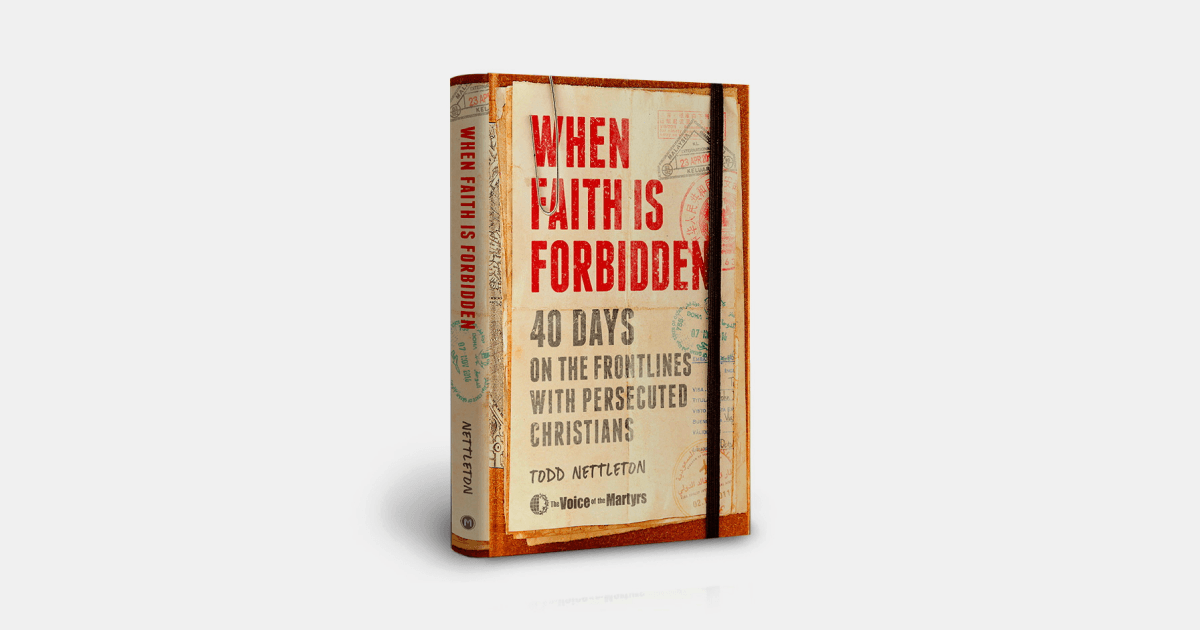
Excerpted from When Faith Is Forbidden: 40 Days on the Frontlines With Persecuted Christians, by Todd Nettleton with The Voice of the Martyrs, published by Moody Publishers.


.png)
.png)
.png)
.png)
.png)
.png)