
A concerned Catholic: ‘I became a Catholic last Easter. I have no regrets, but I sometimes feel that I have joined a club where everyone else knows the rules and procedures in church except me. For example, why does the priest read out a name at the beginning of every Mass? Those names also appear in the newsletter; on Sunday the name is pro populo. What is that all about?’
Chaplain: Congratulations on becoming a Catholic. You probably covered the fundamental Catholic beliefs and practices in preparation for that, but you are correct: there are many details which can seem strange at first. Be assured, most rapidly become familiar. The Church can, however, be much better at explaining. Never be afraid to ask questions. If you are uncertain, there will be many lifelong Catholics who are also.
The Mass is at the centre of the life of the Church and of our own spiritual lives because it is the perfect prayer of Our Lord offered on the Cross on our behalf to His heavenly Father. That prayer is answered in the Resurrection. The fruits of that prayer are made available to us in Holy Communion, Jesus Himself. At Mass we are not simply commemorating a past event. Through the power of the Holy Spirit, that one sacrifice of Christ, and what it won for us, is made present here and now.
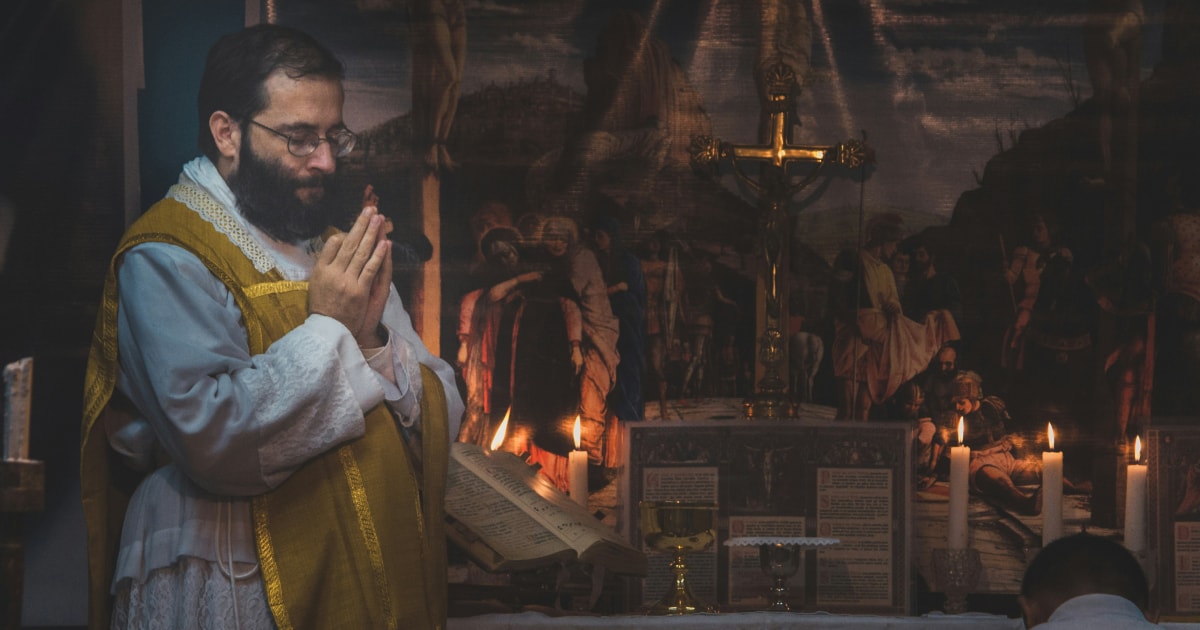
Every priest is ordained primarily to celebrate the Mass, to ensure that Jesus remains present to us in the Eucharist, that we can receive Him in Holy Communion. Each Mass is offered for all Christ’s faithful, living and dead, in the sense that the benefits of Christ’s perfect sacrifice are applied for their benefit. The priest also offers each Mass for a specific intention. Mass may be offered for an individual or individuals (living or dead), for a general need, such as world peace or vocations to the priesthood, or for personal circumstances of thanksgiving or trial.
Generally, that intention is announced at the beginning of Mass: the names you hear the priest read out. The congregation is being invited to join in the prayer for that person. (This does not prevent them coming from Mass with their own personal intentions which they wish to offer God in union with the sacrifice of Christ. Indeed, they should.) Sometimes people request that the intention is not announced. In that case, the priest may simply say that the Mass is being offered for ‘a private intention’.
The parish priest is responsible for the spiritual wellbeing of his people. There is no better way in which he fulfils this than offering the Mass on their behalf. Indeed, the Church’s canon law requires him to do so every Sunday. When the Mass is pro populo, it is being offered for the people of the parish.
When the Mass is for all the faithful departed, this is generally announced as being for the ‘Holy Souls’. This most commonly occurs in November, the month when the whole Church prays for the dead. Many Catholics have Mass offered for their loved ones on the date of the anniversary of their death. This is the ancient tradition of the Church. When St Monica was dying, she told her sons that she was not concerned as to the place of her burial, but she did want to be remembered at the Lord’s altar.
The process of arranging for a Mass to be said is very simple. Tell the priest or the parish office that you would like to have Mass offered. They will ask for the intention, normally the name of the person, and give you a date and time for the Mass, should you wish to attend. (Do check nearer the date, as Mass intentions do have to be changed if, for example, the priest has to take a funeral Mass.) If it is important that Mass is celebrated on a particular date, arrange this well in advance. In larger parishes, Mass intentions can be booked up for several weeks or months. Parishes sell ‘Mass cards’, a form of greeting card giving the details of the Mass, which the priest signs and which you can give either to the person for whom the Mass is being offered or to their family.
It is customary to make an offering to the Church when requesting a Mass to be said. In the past this constituted one of the main sources of income for a priest. In the UK, most priests now opt for a fixed salary instead, and the offering goes to the parish. It is a donation, so you may give as much or as little as you wish. The average offering would probably be £10 or £20.
I hope that removes some of the mystery from the practice of Mass intentions. The most important thing to remember is that, as the prayer of Christ Himself, there is no higher form of prayer offered for someone. This is why it is always good to have Mass said for someone, or some situation, in moments of both adversity and joy.