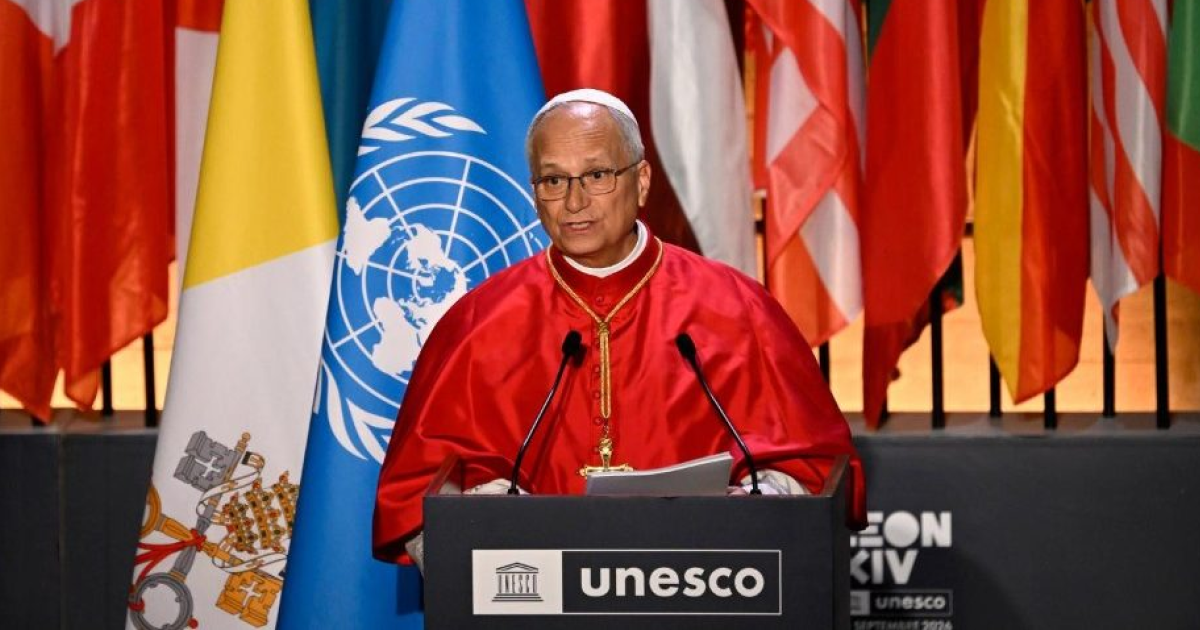


Leo XIV delivered strong calls for the defence of human life at every age during his visit to UNESCO on Friday, before encouraging French Catholics to renew their Catholic life and evangelisation while celebrating Vespers at Notre-Dame Cathedral.
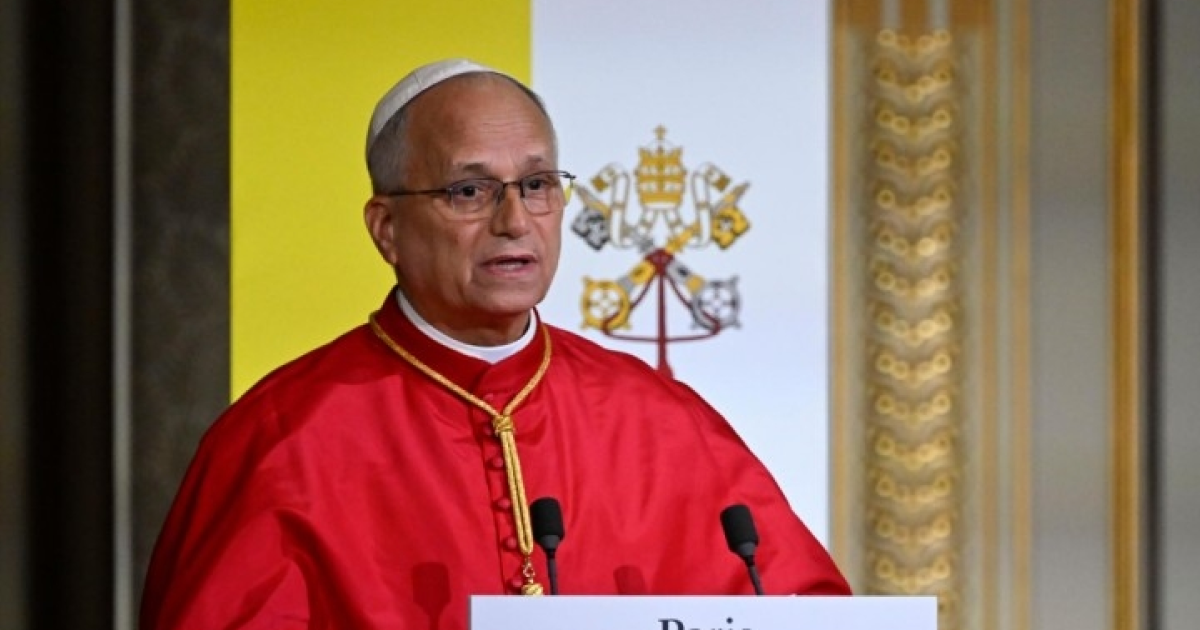
Building on themes contained within his encyclical Magnifica Humanitas, Pope Leo continued his focus on the meaning of humanity, during the first day of his apostolic voyage to France. Having already met with President Emmanuel Macron and the assembled politicians, Leo was transferred to UNESCO headquarters to deliver his address, before then presiding over pontifical Vespers at Notre-Dame.
In each stop of his first day, the pontiff focussed on themes relating to the human person. Addressing parliament, he defended the sanctity of life to Macro’s face. At UNESCO he emphasised the importance of working from the Christian teaching regarding the sanctity of life and all that this entails. This necessarily involved Leo decrying any attempts to end life via abortion or euthanasia. Then in Notre-Dame the Pope pointed to the spiritual aspect of man, urging those present to redouble their efforts of evangelisation, leading people to Baptism and worshipping God in rightly ordered liturgies.
Lengthy and wide-ranging, Leo’s speech at UNESCO walked through the stages of human life, emphasising the importance of various care needs at each stage. “Forgetting the circumstances of our birth obscures the very idea of human life, because it detaches life from the history common to us all,” he said. “Thus, life is no longer understood as a gift, but as a commodity.”
“Before all else, the human person is someone who is conceived and born,” he stated, urging respect for unborn life, adding that freedom is “disfigured when it descends into arbitrariness, violence or the thirst for power”.
Leo also pointed to the moves now being made to promote euthanasia and assisted suicide – both of which were legalised in France over the summer. As humanity collectively risks forgetting its humble origins, the rise of artificial intelligence is linked to the concern that “ideas and relationships risk being impoverished by a process of dehumanisation.”
“The human being is certainly one who is born, but also one who dies,” said Leo. “Our dignity is not destroyed by illness or suffering, nor is it dependent upon our abilities. Rather, it calls for loving care at every stage of life.”
He called on UNESCO members to “cooperate unremittingly in the name of our common history”, commenting that the organisation finds its true mission in giving a “symphonic voice to the highest aspirations for the good and the care of humanity”.
The Pontiff warned about the dangers of emulating the Tower of Babel – which was “a unity imposed through domination” – and instead called on the UN to learn from the day of Pentecost. “The corruption of culture which we are considering finds its redemption in the public square of Pentecost,” he said.
Drawing on UNESCO’s self-described key interests, Leo declared that culture only “realises its highest wisdom when it seeks peace and the good of all, bearing witness to the authentic meaning of our humanity.” As such, he warned that culture only flourishes when society cares for humanity and the world around it.
Society is measured by the value on which it places on those who need its help the most, said the Pope:
“The touchstone by which we can assess our commitment is the care we show for the littlest and for the poor: children in their mothers’ wombs and in the various theatres of war, persons with physical and intellectual disabilities, the elderly, migrants, refugees, and all those arrogantly excluded as unproductive. They are the true test of our claims to respect human dignity, and their protection and promotion extend also to creation.”
Having concluded his speech, Leo was driven straight to the Cathedral of Notre-Dame, restored and reopened with such splendour in December 2024 after the devastating fire of April 2019. Here his entrance was welcomed by the crowds gathered both outside and in, with Leo having already eschewed Macron’s offer of a private tour of the cathedral.
Leo’s visit to the cathedral was more than the sum of its parts: in many ways it was the visit which French Catholics had hoped for at the grand re-opening, when Pope Francis declined the invite. As Leo stepped foot into the heart of the cathedral the resounding peal of the organ demonstrated the widespread joy at the long-awaited papal visit.
As expected, the Pope’s homily was centred around the story of restoration which Notre-Dame now embodies. Leo praised the manner in which the cathedral’s re-opening has been used to renew Catholic evangelisation.
“Let yourselves be inspired by what has happened here,” he encouraged the clergy and religious present. “It is from the Incarnation that the identity of the Church flows, for she is called always to be a Church ‘going forth’.”
But this must be grounded in the remembrance that the cathedral “was built for the purpose of prayer and the worship of God” – evangelisation must be oriented to growing the Church.
In an age that “seems deprived of fullness, depth and promise”, Leo called on Catholics to perform the liturgical rites with reverence, since it is “the greatest gift we can share”.
Leo is always careful to encourage the priests he meets in such encounters, rather than seeking to criticise them, as had been more commonplace in previous years during papal trips. Thanking the clergy present in Notre-Dame, he called on them to redouble their own life of prayer in order to be effective in spreading the faith. “This Cathedral has been reborn so that you too may be reborn with it in a new impetus towards holiness and daily mission,” he said.
Pope Leo’s first day in France closes with a prayer vigil for young people at the Stade de France, before visiting a diocesan rehabilitation centre to start the second day of the four-day trip.
Michael Haynes is an English journalist in the Holy See Press Corps. He serves as Vatican Correspondent for the Catholic Herald, while readers can follow him at Per Mariam and on X @MLJHaynes.