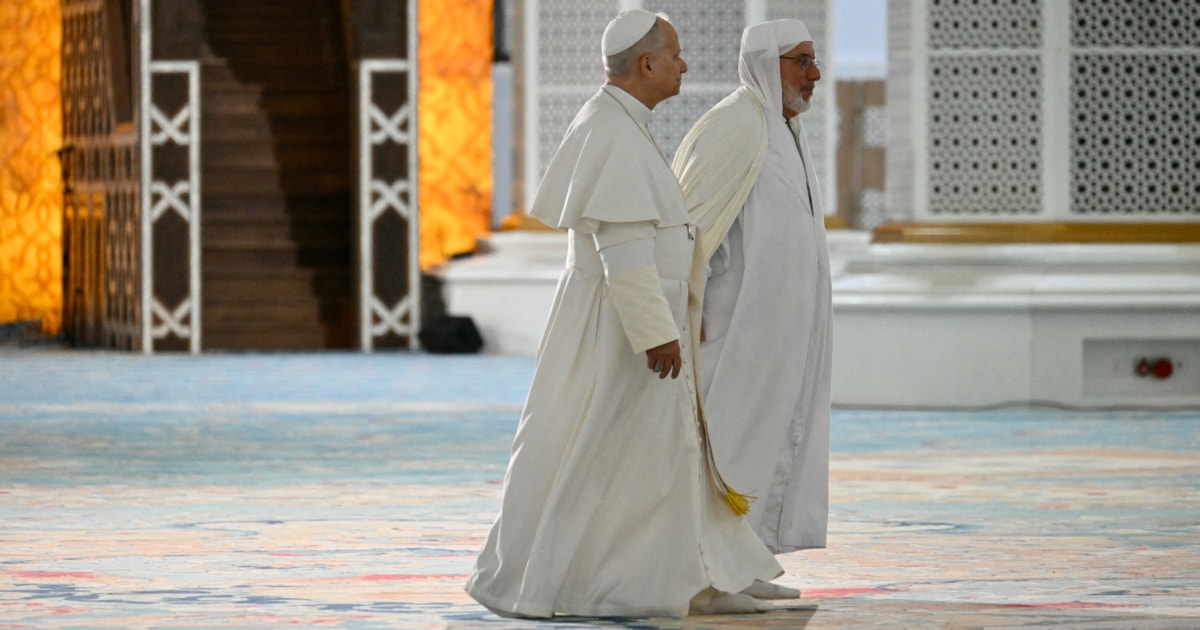
Pope Leo XIV has visited Algeria’s Grand Mosque, standing in silent reflection beside its imam.
The visit to the Mosque of Algiers, the third largest mosque in the world after those in Mecca and Medina, took place on April 13 at the start of the Pope’s African itinerary. According to Vatican News, the Pontiff removed his shoes in accordance with protocol before entering and remained inside for just under 10 minutes, several of which were spent in “silent reflection” beside Imam Mohamed Mamoun al Qasimi and before the mihrab.
The mihrab, a niche in the wall indicating the direction of Mecca, is a central element of Islamic worship, marking the direction towards which Muslims pray. The Pope stood alongside the imam before it in silence, in a gesture that has drawn attention in light of his conduct during a previous visit to Istanbul in November 2025.
During that earlier journey to Turkey, the Pope visited the Blue Mosque, where he also removed his shoes and observed the visit in silence, but declined an invitation from the imam to join in prayer. The Holy See Press Office had initially indicated there would be a “brief moment of silent prayer” during that visit, before later clarifying that the Pope had chosen instead to approach the occasion as one of “listening and learning”.
Following that journey, the Pope explained that his decision was not intended as a slight but reflected his preference for prayer in a Catholic setting, stating that he preferred to pray in a church before the Blessed Sacrament.
In Algiers, the Pope was accompanied by Cardinal George Jacob Koovakad, Prefect of the Dicastery for Interreligious Dialogue, and Cardinal Jean-Paul Vesco, Archbishop of Algiers. After the moment of silent reflection, he withdrew for a private meeting with the rector of the mosque, during which he expressed “gratitude for being in a place that represents the space proper to God”, according to Vatican News.
Images from the visit showed the Pope, the imam and those closest to them without footwear, in line with mosque protocol, although others further away were seen wearing shoes inside the building.
The visit has also prompted discussion online following the Trump spat, with the circulation of a misattributed quotation claiming that the Pope recently said “We should not be afraid of Islam”. The remark does not come from the Pope’s Africa trip but from an in-flight press conference on December 2, 2025, as he returned to Rome at the conclusion of a journey to Turkey and Lebanon.
Responding to a question about concerns among Western Christians regarding the growth of Islam, the Pope said: “In Europe, fears are present but often generated by people who are against immigration and trying to keep out people who may be from another country, another religion, another race.”
He pointed to Lebanon as an example, adding: “One of the great lessons that Lebanon can offer the world is to show a country where Islam and Christianity are present and respected, and where it is possible to live together, to be friends.”
He continued: “Those lessons would be important also to be heard in Europe or North America: that we should perhaps be a little less fearful and look for ways of promoting authentic dialogue and respect.”
While Pope Leo XIV’s decision to pause in silent reflection inside the Grand Mosque of Algiers is no doubt a significant diplomatic gesture, the comments of December 2 show the current approach to Islam adopted by the Holy Father. This approach, while seeking to promote peace and dialogue, sits in tension with earlier Church teaching and highlights the difficulty of balancing interreligious engagement with doctrinal clarity.
It is not an obscure footnote that the Council of Florence (1438–1445), in the Bull Cantate Domino, declared that those outside the Church, including those regarded at the time as “pagans”, could not share in eternal life unless they were joined to the Church before death. Nor is it incidental that medieval councils such as the Fourth Lateran Council (1215) legislated carefully to regulate relations between Christians and Muslims, recognising the dangers of coexistence and religious confusion.
For centuries, popes and theologians spoke of Islam in doctrinal terms. Islam’s denial of the Trinity and the Incarnation, its rejection of Christ’s divinity, and its competing claim to final revelation stand in direct contradiction to the Christian faith.
At the same time, the tradition was not devoid of nuance. The letter of Pope Gregory VII to a Muslim ruler, Al-Nasir of Mauretania, in 1076 acknowledged a shared belief in one God, albeit “in a different way”, while expressing a desire for peaceful relations. Such instances demonstrate that courtesy and clarity were not mutually exclusive.
The turning point came in the 20th century, particularly with the Second Vatican Council, which sought to reframe the Church’s language towards non-Christian religions. Documents such as Nostra Aetate and Lumen Gentium spoke of Muslims as those who “adore the one God” and encouraged dialogue and mutual understanding.
It is precisely this atmosphere that renders the Pope’s comments, while measured, markedly different from past magisterial teaching. The contrast has prompted scrutiny as Catholics seek to reconcile earlier formulations with the present emphasis.
While the Pope’s words were more measured, even in full on December 2, the remarks invite examination. Catholics may approach Islam with caution grounded not in hostility but in recognition of theological divergence and historical experience. This does not deny the dignity of Muslims nor reject dialogue, but it raises the question of how such dialogue is conducted.
The Church’s preconciliar teaching did not hesitate to identify Islam’s doctrinal differences, nor to warn of the consequences of religious indifferentism. The Catechism of St Pius X described Muslims as those who “admit one true God” but do not believe in Jesus Christ as God, placing them outside the fullness of salvific faith.
In the contemporary West, where immigration has brought significant Muslim populations into historically Christian societies, the question is no longer abstract. Differences in law, social practice and moral outlook are not merely perceived concerns but flow from underlying beliefs about faith and action.
Thus while the Church can engage with Islam, it must do so without obscuring the truth of the Gospel. Charity and courtesy without clarity risk confusion; clarity without charity risks hardness.


.jpg)