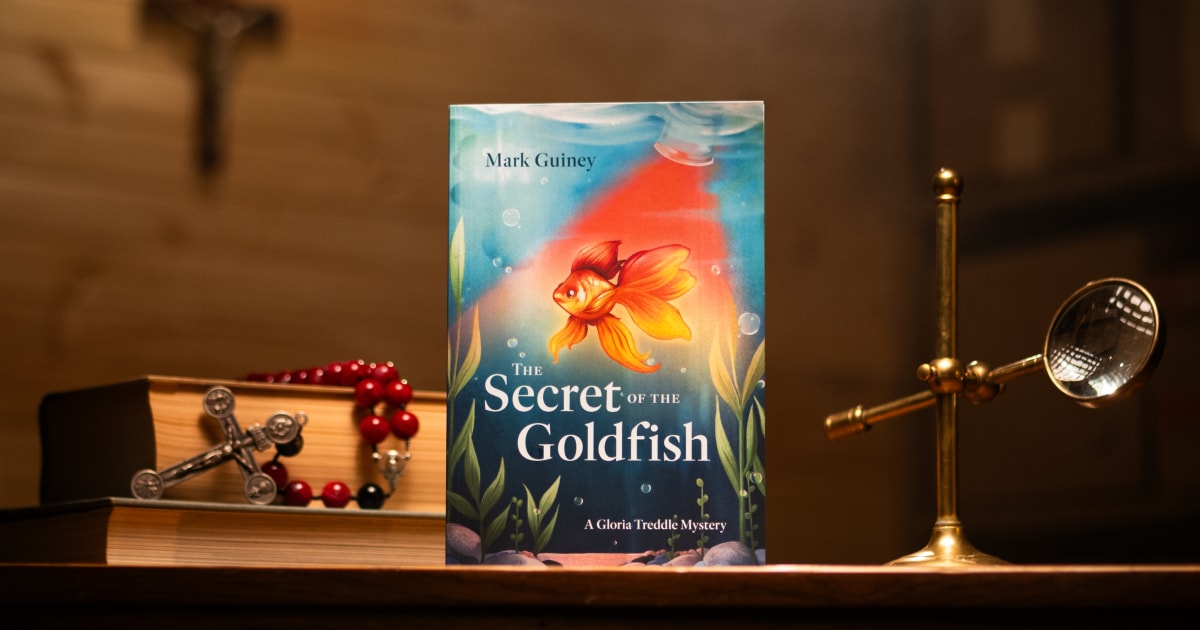



The Secret of the Goldfish: A Gloria Treddle Mystery, by Mark Guiney (204pp, Our Sunday Visitor)
Attentive Catholic parents are rightly cautious about giving their children contemporary stories. Children’s books, once safely outside the bounds of the kulturkampf, have in the last decade become one of its main battlegrounds, leading many parents to rely entirely on trusted classics. There is nothing wrong with that. Classics are classic for a reason. Still, we are raising children to live virtuously in the world of today. It is good for them to befriend literary role models who are doing just that. Enter Gloria Treddle.

Gloria stars in The Secret of the Goldfish by Mark Guiney, the first instalment of what will hopefully be many middle-school mystery books. Gloria inhabits a world that will be familiar to many Catholic schoolchildren. She is a middle child in a large, loving, messy family in rural America and attends a Catholic K-8 school. She has a best friend, a sibling rivalry and enough enthusiasm to be trouble. But Gloria is not average in every way. She hunts for mysteries more avidly than a British inspector at a butler convention.
The Secret of the Goldfish centres on the St Anthony School science fair. Gloria is determined to win because the prize is a forensics kit, but even without the kit, she soon realises something sinister is afoot. Just a few days before the fair, her classmate’s trained goldfish, Pokey, suddenly falls ill, removing him from the competition. Gloria’s teachers and parents assure her that Pokey is just going the way of all fish, but Gloria feels sure there is more to the story.
As Gloria hones in on suspects and goes down the list of means, motive and opportunity, false turns and dead ends almost stop her progress and even her trusty sidekick, Olly, is tempted to give up. Pokey is counting on them, along with his shy owner, a boy named Jamie, who recently lost his mother. Gloria is determined not to let them down.
The ending, without giving anything away, is both narratively and morally satisfying, and the journey to reach it is a romp. Guiney’s style is geared towards children while remaining enjoyable for adults. Just a few stretch words are peppered throughout to expand vocabulary, and disarming humour that may be lost on children without detracting from their experience heightens the enjoyment for parents following along. For instance, Olly, an aspiring drummer, worships the fictional band Billy Carp and the Health Code Violations, a parody of Gen X punk rock that makes cameos throughout.
The plot moves at a good clip to complete its arc in 176 generously spaced pages. Yet within its steady pace, Guiney provides memorable scenes and character descriptions. For instance: “St Anthony School had originally opened in the 1930s as a high school. There was lots of lacquered wood and wavy glass and lockers painted twenty times over.” One teacher is introduced as a retired New York actress who forgets her classroom is offstage. “Mrs Green tended to wear long, drapey dresses, most of them embroidered with things like elephants and palm trees.” During a community theatre production of Les Misérables, “she had landed a role as a background fishmonger. For most of the show, Gloria was very distracted by Mrs Green pivoting around the stage, waving a plastic fish.” Mrs Green, the good-cop/bad-cop lunch ladies, Gloria’s childlike classmates and all the other characters will doubtless amuse readers as just slightly exaggerated versions of the people in their own extended circles.
The Secret of the Goldfish carries more than just entertainment value. It delivers authentic moral messages as well. When Gloria allows her own flaws and jealousies to guide her judgement, bad things happen. Setting them right puts her back on the right path. She also has healthy relationships with the adults in her life. Many times, child protagonists are surrounded by clueless adults who have to be managed and deceived while the children do all the work. Naturally, that is not a dynamic a parent would want their child to imitate, and happily it is not one they will find in Guiney’s work. While Gloria is the detective and sees things the grown-ups missed, the grown-ups are still in charge, and Gloria needs her parents and teachers in the end.
It will be interesting to see how Guiney handles that dynamic going forward with more Gloria Treddle stories because, wholesome as it is, it does present some limitations. If there is one bone to pick with The Secret of the Goldfish, it is that the stakes could be higher. While Guiney does a good job making the plot about much more than just a goldfish, it remains a very domestic mystery. Both Nancy Drew and The Hardy Boys, staples of childhood detective fiction, frequently find themselves in bigger scrapes chasing bigger villains. Middle-school readers of those books may come to want more action as the Treddle series continues.
Still, Gloria’s enthusiastic, lovably nerdy and good-hearted character already holds her own among her literary peers. The Secret of the Goldfish is a delightful introduction to her. I hope it will be followed by many more chapters and believe that, if it is, Gloria will take her place among the trusted classics loved for generations.