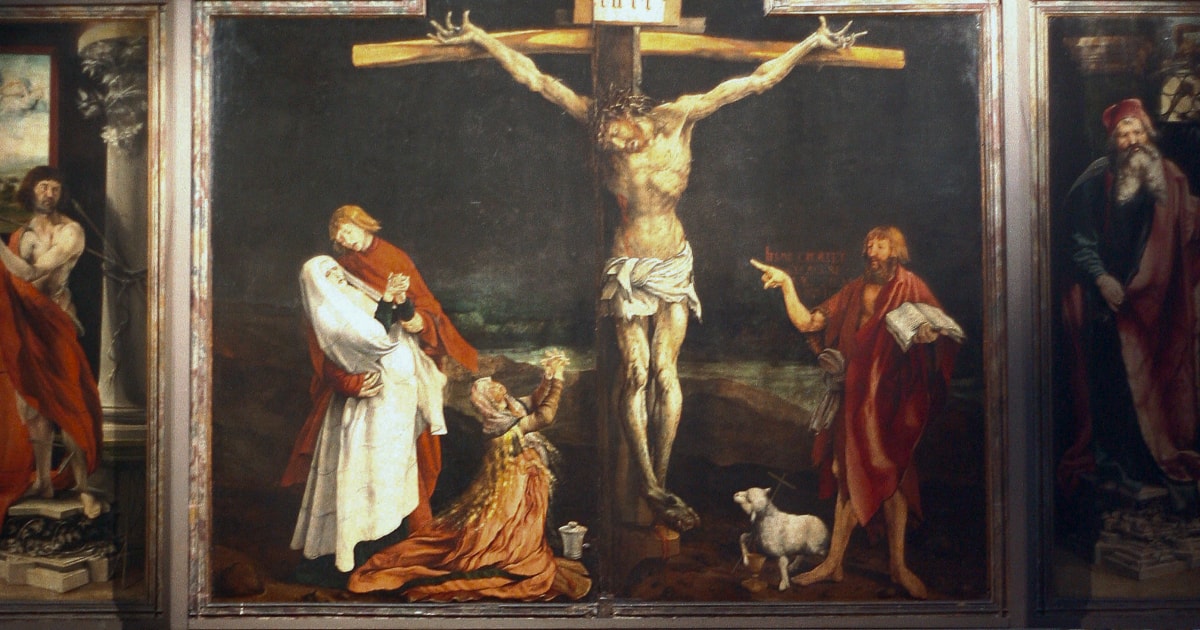


The Isenheim Altarpiece is exhibited in the Unterlinden Museum, Colmar, France. It was originally located in the Monastery of St Anthony on the outskirts of the village of Isenheim, halfway between Colmar and Basel. The altarpiece has three sets of wings, which were opened on certain feast days, but these have now been separated and are displayed simultaneously in the main hall of the museum.
The massive work was painted between 1512 and 1516 by the shadowy figure we mistakenly call Matthias Grünewald. In fact, his actual name was Mathis Gothardt. Nikolaus of Hagenau executed the exquisitely crafted sculptures in the innermost panel.

The first panel, which was the one normally exposed to view behind the altar, is a shockingly gruesome depiction of Christ on the Cross. On the inside panels we find paintings of, among others, the Annunciation, the Birth of Jesus, the temptation of St Anthony, and finally a glorious rendering of the Resurrection of Jesus.
It is the lonely Crucifixion scene, however, that is best known. It is unlike any ever painted before. For the art historian James Snyder, ‘the body of Christ, while heroic in proportions, is one of the most gruesome and disturbing ever painted’. The depiction of the dead body of Christ on the Cross against a brooding, dark background is disturbing: the fingers on Christ’s impaled hands stick out horribly in rigor mortis; his head hangs under the crown of thorns covering his whole scalp; his mouth hangs open in death. Blood flows from his pierced side, and his feet are deformed, almost animal-like, impaled by a single nail. But perhaps most striking are the wounds to his skin: his entire distorted body is covered in ugly lesions and thorn-like pricks.
It is only when we know the setting in which the altarpiece was originally displayed that we realise that Grünewald had a very good reason for such a depiction. The monastery belonged to the French Order of Hospitallers of St Anthony, who specialised in the care of those afflicted with ergotism. Ergotism, also known as St Anthony’s Fire, is a devastating skin disease caused by ingesting ergot fungus in grain and rye. Symptoms included burning skin – hence its name, St Anthony’s Fire – the onset of gangrene, and often the loss of limbs. As well as being depicted in another panel of The Isenheim Altarpiece, the gruesome disease is famously represented in Hieronymus Bosch’s The Temptation of St Anthony. Given the ravages wrought by ergotism in medieval Europe, it is no surprise that Antonine monasteries such as that of Isenheim became oases of consolation for those suffering, or simply fearing, such infirmities.
Furthermore, it forms part, of course, of an altarpiece and so this art is not merely decorative nor didactic, but sacramental in that it formed the normal backdrop to the celebration of the Mass. What is made visible in the dramatic painting is made present on the altar in front of it through the sacramental action of the celebrating priest.
Almost the first thing the afflicted saw on entering the Isenheim monastery was this enormous depiction of Christ himself in complete solidarity with their own dreadful afflictions. His skin too was marred by mark after mark; his sacred body hanging on the Cross was contorted in pain; and his mouth gaped slightly in death. For some, at least, this must have brought to mind the prophetic Suffering Servant passage of Isaiah 53 in which the prophet reveals that the Messiah ‘has borne our griefs and carried our sorrows’. What a consolation it must have been for them to see, in all its starkness, Jesus’s solidarity with them in the agony of their condition – that Christ had even become, like them, terrifyingly ugly. He knows what it is to suffer. He knows what it is to become an object of disgust in the eyes of other men; to him on the Cross the words of the psalmist are applied: ‘But I am a worm, and no man; scorned by men, and despised by the people’ (Ps 22:6).
And yet this consoling solidarity is not where things end for them. In the next inner panel Grünewald presents a far greater and definitive source of consolation: the Risen Christ soars from the tomb, released from his terrible sufferings, a smile on his bright face and light emanating from his wounds, and, most strikingly, that once repulsive skin has become ethereally clear and translucent. Here was a reminder to those flocking to the monastery with their ravaged skin that, whatever about cures, natural or supernatural, in this life, the resurrected body was their ultimate consolation. It is as if the artist wanted to assure them that the more repulsive their appearance had been in this life, the more beautiful it would be in the next for those who join their sufferings with those of Jesus on the Cross.