




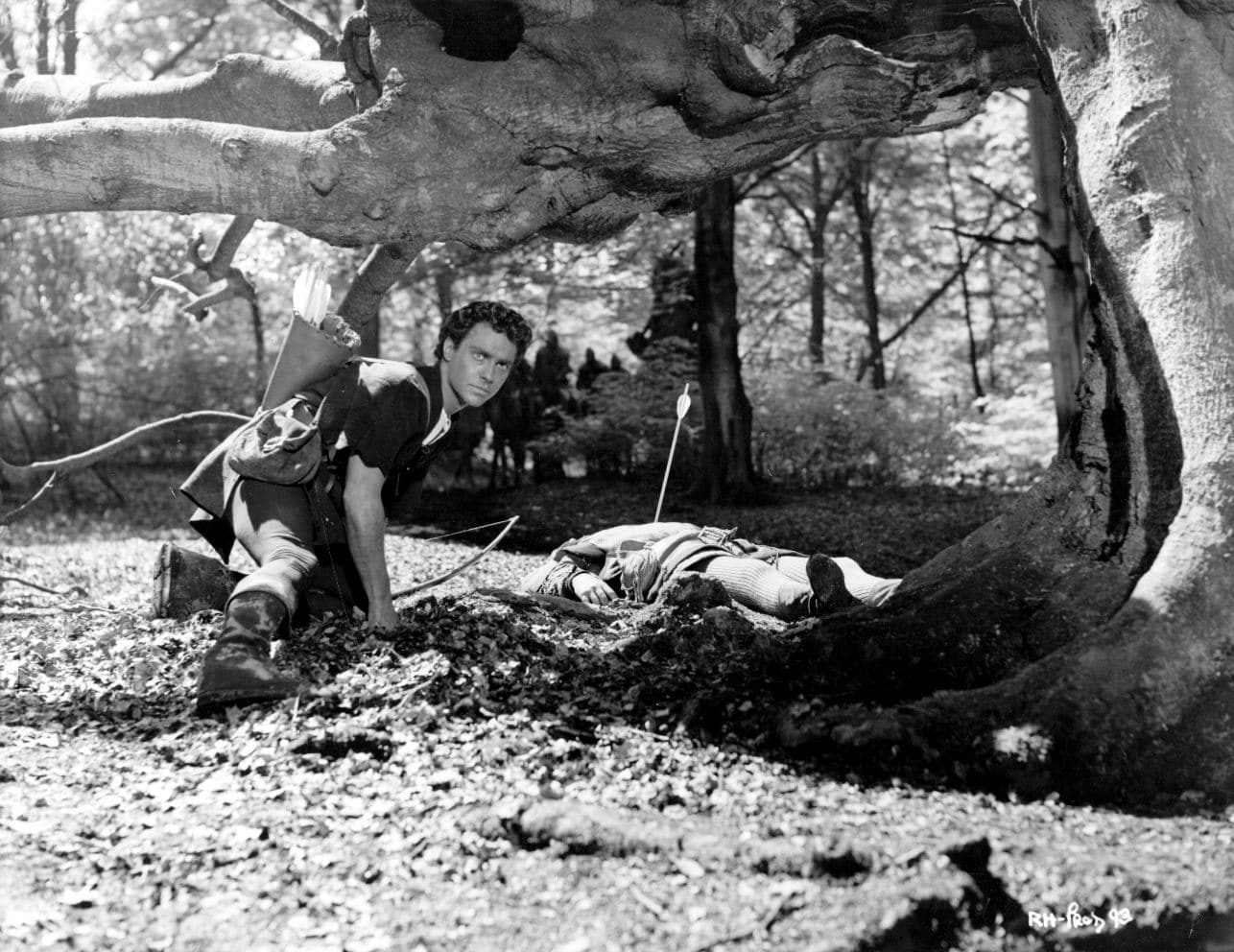
In the collective imagination of the Anglosphere, Robin Hood is second only to King Arthur in the hold he has on the public mind. The idea of the Merry Men living in self-constructed freedom “all under the merry greenwood tree” in Sherwood Forest – robbing the rich and helping the poor and staying loyal to King Richard the Lionheart during the regency of his brother – has been embraced by countless generations. Robin, his chaste but passionately loved Maid Marian, doughty Little John, fat but lethal Friar Tuck, the minstrel Alan-a-Dale and the evil Sheriff of Nottingham have been loved and reimagined in ways congenial to each new audience. The socialist is attracted by the Merry Men’s opposition to authority; the Tory by their unshakeable loyalty to their rightful King; the English nationalist by the theme of Anglo-Saxon resistance to the Norman conquerors; the harassed urbanite by their life of freedom in the forest; and the endangered hunter by their pursuit of his favourite sport at the government’s expense. In all of these there is some truth mixed with a little distortion – but the most bizarre of all, and expressed clearly in the 1980s British TV series Robin of Sherwood – is the association of Robin Hood with paganism. Before we can understand just how silly and recent that now widespread (thanks to the TV series) notion is, we have to look at who Robin Hood was in reality. That is an even harder assignment than figuring out the historical truth behind King Arthur. Although there are a few earlier references, the earliest outright mention of Robin that we have is in 1377, by William Langland in his Piers Plowman: “I know not perfectly my Pater Noster as the priest sings it; but I know rhymes of Robin Hood and Ranulph, Earl of Chester.” The earl was in fact an historical figure, known for his loyalty to King Richard during Prince John’s regency. Although only a glancing reference, it does sound as though Langland expected his audience to be acquainted with Robin – and bracketing him with a Ricardian loyalist like the Earl would seem to imply that he held similar views. Starting in the 1400s, we have an ever-increasing crop of ballads and folk plays about Robin Hood appearing in writing. Ever more characters were added – both friendly and inimical – to the stories, and the tales themselves became ever more complex. Robin and Maid Marian became popular characters in plays on May Day, and Robin’s lady love may have had a separate existence before being subsumed into his stories. With the Reformation came, as with King Arthur, some lessening of interest in the tales, though Robin’s anticlericalism was sometimes (wrongly, as we shall see) turned into anti-popery. But it was Sir Walter Scott’s portrayal of him in Ivanhoe that fixed the bandit of Sherwood in the guise we know today. With a huge amount of legendary and literary material at hand, 19th- and 20th-century writers amplified and added to his story. When the movies dawned, Robin and his Merry Men came into their own – the apogee of which was Errol Flynn’s portrayal of him in the 1938 extravaganza, The Adventures of Robin Hood. Sean Connery performed as an older Robin reuniting with his lady love (Audrey Hepburn) in 1971’s Robin and Marian, and Connery’s King Richard would be the only thing worth watching in Kevin Costner’s dreadful vehicle, Robin Hood Prince of Thieves. But where older films and television had maintained Robin’s Christian religiosity, Robin of Sherwood introduced Herne the Hunter (legendary denizen of Windsor Forest in folklore) as a pagan priest. Other recent versions claim that Robin is an incarnation of the Green Man, a character in medieval iconography whom modern neopagans like to lay claim to. These pagan identifications were made on a twofold basis: that anything to do with a forest would be related to paganism, and that Robin must therefore be a pagan himself. The claim about Robin is easily dispatched. Despite its many claims on innumerable blogs, the truth is that like the age-old Wiccan faith itself, the Robin-as-pagan myth was actually invented in the 1920s by one Margaret Murray. But what about the supposed paganism of forests? Unravelling that question is key to understanding the legendary Robin Hood.
3:34 PM
The movies ignore it, but Robin Hood was a very Catholic hero
Charles Coulombe

8 min read



Already a subscriber? Sign in
5freearticles every month
Continue reading with a free account. No card needed.
- Five free articles every thirty days, on any device you sign in on
- The Catholic Herald newsletter, every morning
- Subscribe whenever you like for everything: every article and the magazine
Related articles
 Newsroom
Church leaders urge Drumcree dialogue: ‘Too much is at stake’
The Catholic and Church of Ireland Archbishops of Armagh have urged a renewed commitment to peace and reconciliation amid the Drumcree stand-off
Corrie Douglas-Young Newsroom
Thousands of Irish children to join global Rosary campaign
Corrie Douglas-Young Newsroom
TikTok priest urges young people to stand with persecuted Christians
Nathalie Raffray Newsroom
Baby born at 25 weeks reunites with neonatologist two years after leaving hospital
The Catholic Herald Newsroom
Joe Biden honoured by Planned Parenthood after defending abortion rights
Christine Rousselle
subscribe to the catholic herald today
Our best content is exclusively available to our subscribers. Subscribe today and gain instant access to expert analysis, in-depth articles, and thought-provoking insights—anytime, anywhere. Don’t miss out on the conversations that matter most.
Subscribe



