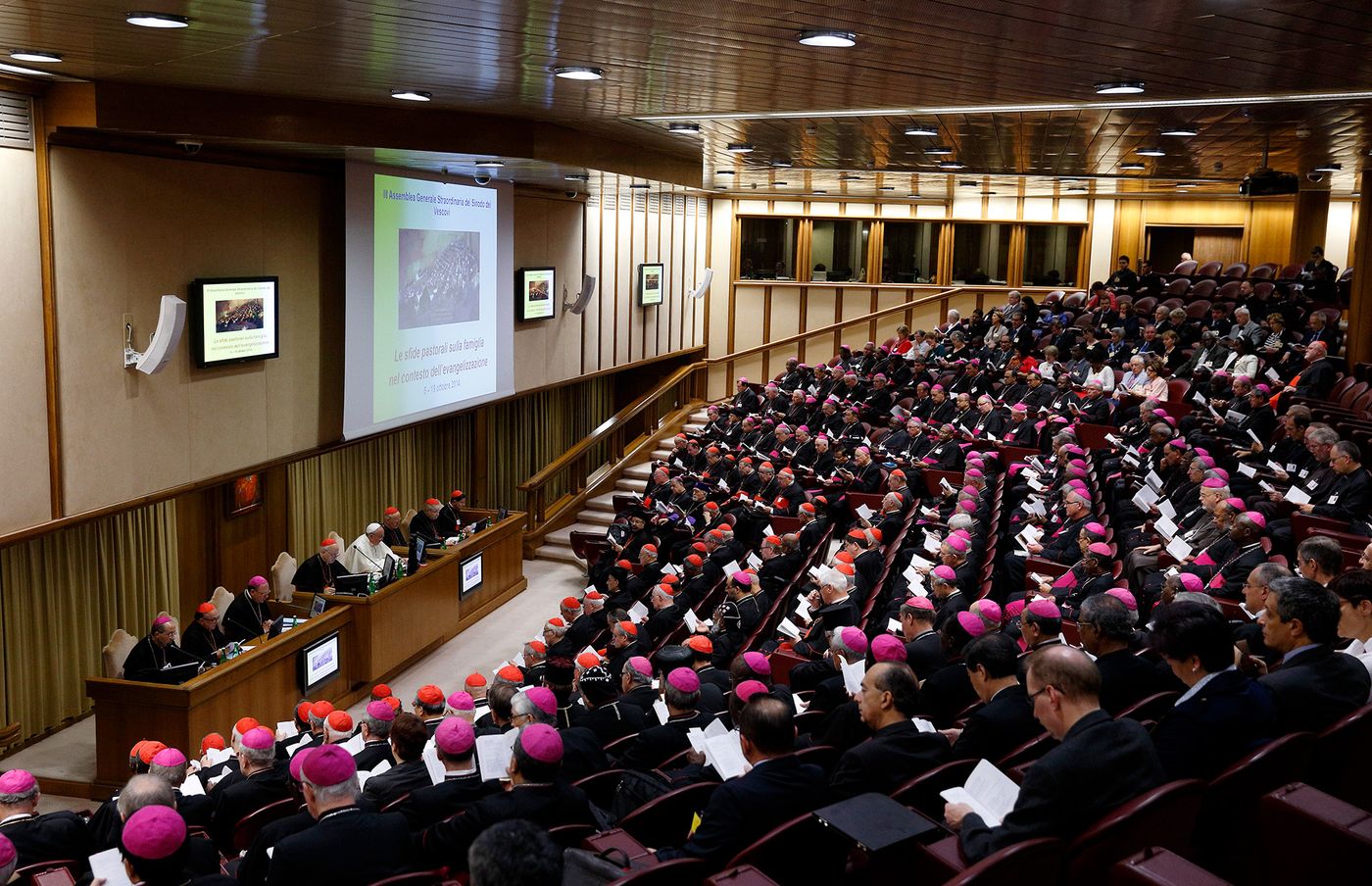


Vatican insiders say there will be no mid-term report and that a summary of the discussions will not be made public
Instead, he says, there will just be a final address by Pope Francis, representing the conclusions of the synod, a speech that is likely to be endlessly pored over. The rest of the vaticanisti, unable to provide crucial insight, can only study the list of synod attendees. Most of the names were elected by their bishops’ conferences or are there by right as head of a Vatican department, religious order or Eastern Catholic church. But 45 have been appointed by the Pope, giving clues as to how he would like the debate to play out. For the traditional lobby group Voice of the Family the appointments indicate that a “grave crisis” looms. Among names of concern are Cardinal Walter Kasper, who has led efforts to allow divorced and remarried Catholics to receive Communion, and Archbishop Blase Cupich, who has defended giving Communion to pro-abortion politicians. The group also pointed to prelates it believes are sympathetic to changing the Church’s stance on homosexuality, including Cardinal Christoph Schönborn and Archbishop Bruno Forte. Sandro Magister, journalist for the magazine L’Espresso, agreed that the appointments seemed to give impetus to the Kasper wing of the Church. He wrote that the absence of Cardinal Zenon Grocholewski and Cardinal Raymond Burke was telling. “The latter is an especially blatant absence,” he wrote. “Burke was and is one of the most resolute defenders of the traditional doctrine and pastoral care of marriage. The Pope sent him into forced retirement after the synod of 2014, and has now made a point of not including him among the 45 synod fathers chosen at his discretion.” Cardinal Burke said earlier in the year that last October’s extraordinary synod was full of “manipulation” and that as a result “confusion is spreading, really, in an alarming way”. But commentator Andrea Gagliarducci argues that the papal appointments have been made “without any clear and definite criteria”. Writing at MondayVatican.com, he said: “For any rule you can find, you can also find at least an exception. The appointments appear to be the fruit of Pope Francis’s will to hacer lìo, which means to ‘make noise’ in the Buenos Aires’ dialect. So it appears that the Pope wants every position possible to be represented in the debate.” One might simply call this “inviting a debate”, then. More darkly, there is even talk of a schism. The speculation was prompted by Cardinal Reinhard Marx, who remarked that the German Church was “not a branch of Rome”. He said: “Each conference of bishops is responsible for pastoral care in its cultural context and must preach the Gospel in its own, original way. We cannot wait for a synod to tell us how we have to shape pastoral care for marriage and family here.” Earlier this month Cardinal Gerhard Müller, prefect of the Congregation for the Doctrine of the People, appeared to warn that the Church in Germany risked repeating the split of 1517. One should “be very vigilant and not forget the lesson of Church history”, he said, criticising “a climate of the German claim to leadership for the universal Church”. Gagliarducci, meanwhile, has expressed fear that any vague statements from the Pope in his final message might be used by Germans to justify a widely different approach to family. “The doctrinal revolution will thus not be achieved through precise documents, but through the exploitation of every vague expression that comes out of the synod,” he said. Few will know exactly what is going because of the closed natured of the synod. It is probable that, much like Las Vegas, what is said at the synod will stay at the synod, apart from titbits provided by daily press conferences. Such an approach is hardly geared towards inspiring the faithful, who may end up just as confused as a year ago. Key facts: ✣ More than 200,000 people left the Church in Germany last year ✣ The number of Catholics in Africa has more than doubled since 1980


.png)
.png)
.png)
.png)