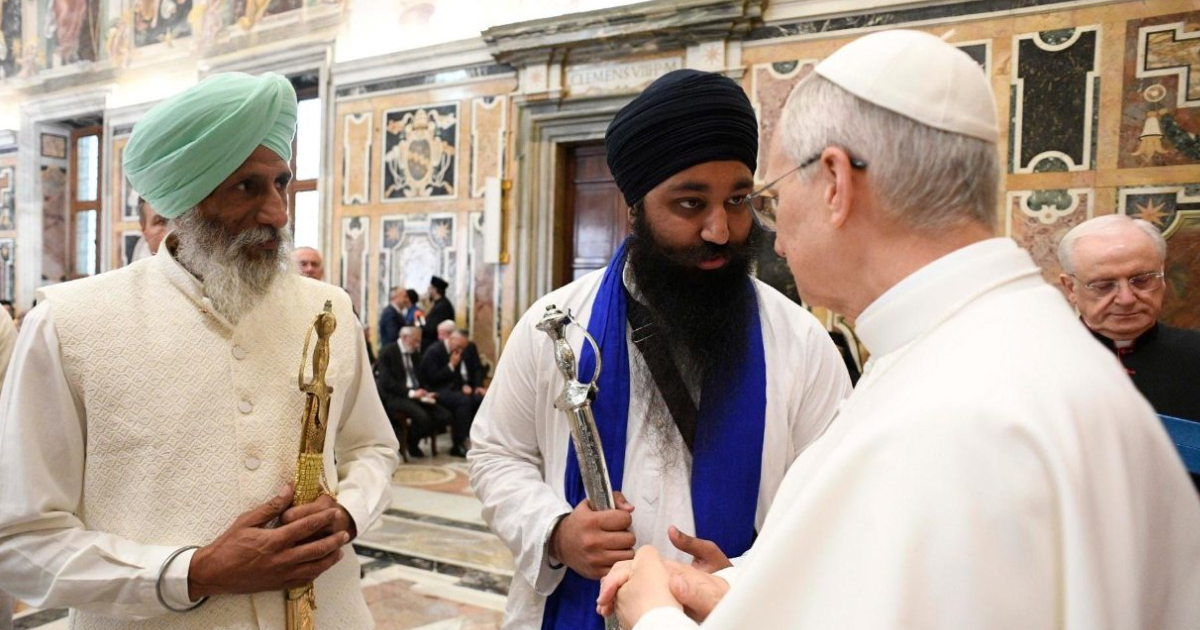



The Vatican has released a document marking the 60th anniversary of the Second Vatican Council’s Nostra aetate, praising the ecumenical efforts which the text engendered and calling for a renewed “shift in mindset” to produce a “new ethic of dialogue”.
In a Note published on September 16, the Holy See commented on its ecumenical efforts of the past six decades and welcomed the “shift in perspective” which has developed between religious leaders, resulting in a “culture of dialogue and a ‘culture of encounter.’” This must continue with renewed impetus so that fraternity may be built up between the various creeds, the Note “A journey of hope” stated.
“No respectful relationship with other religions can be sincere or feasible without a corresponding respect for the religious freedom of others,” read the Note.
Promulgated on October 28, 1965 by Pope Paul VI, Nostra Aetate concerns the Catholic Church’s relationship with non-Christian creeds and especially with Judaism. The Vatican II text called on Catholics that through “dialogue and collaboration with the followers of other religions, carried out with prudence and love and in witness to the Christian faith and life, they recognise, preserve and promote the good things, spiritual and moral, as well as the socio-cultural values found among these men.”
It has become one of the chief reference texts for subsequent ecumenical efforts, with some of its key themes of interreligious fraternity being bolstered under Pope Francis by Fratelli Tutti and the Abu Dhabi document.
The newly released Note marking the anniversary of Nostra Aetate was approved by Pope Leo XIV on June 22 and jointly issued by three offices of the Roman Curia: the Dicastery for the Doctrine of the Faith, the Dicastery for Promoting Christian Unity, and the Dicastery for Interreligious Dialogue.
“A journey of hope” is rooted heavily in the themes and linguistic style of Nostra Aetate and the ensuing ecumenical texts of recent years. It praises the work of past decades and in particular the efforts of Paul VI, John Paul II, Benedict XIV, Francis and Leo XIV. Nostra Aetate’s fruits with Judaism, Islam and other religions “are evident”, the text stated. This has been demonstrated through “a shift in perspective” between religious leaders as friendships are formed while joint projects and statements are undertaken.
In spite of this, the Note referenced difficulties which persist “regarding the very nature of dialogue”. Rising “fundamentalism”, prejudice and religious based violence “undermine the very foundations of dialogue”. Here the Note pointed to difficulties between Christianity and Islam, but as is a common theme in such Vatican ecumenical texts, it remained light in any criticism of Muslims. A short, unspecified reference was made to Christians persecuted for the faith “at the hands of extremist religious groups”, decrying this as “always a violation of human dignity”.
The Note directly rejected suggestions of establishing a new creed founded on the lowest common denominator, which is an image often portrayed by modern ecumenical efforts and much cited by critics. “It is not a matter of founding one great world religion in which all beliefs are flattened,” read the text. “Such a possibility must be excluded out of respect for oneself and for others.” Indeed, while referencing Judaism, the Note stated clearly that “the Church teaches that Christ is the one and only Redeemer.”
Instead, the Vatican’s Note pointed to the future of interreligious dialogue as being “a matter of building a fraternal society capable of accepting differences.”
Such an intention is at the “heart of interreligious dialogue, just as it was in the Declaration Nostra Aetate and in the efforts that have characterised the decades following its promulgation.”
According to the Note, this could only be accomplished by “a genuine shift in mindset is necessary: abandoning the logic of defensiveness, hostility, or conquest in order to adopt an attitude that is open, benevolent, and courageous.”
Ecumenical efforts of the Church in the future must be built around the “the logic of encounter and mutual dialogue as the path, common cooperation as the code of conduct, and reciprocal knowledge as a method and standard.” Such a method would lead to “a new paradigm for resolving conflicts and help foster greater understanding and the protection of creation,” the Note attested.
Speaking to the Vatican’s in-house news outlet about the new text, the prefects of the respective Curial offices emphasised that peace, opposition to antisemitism and the cultivation of fraternity are some of the key themes of their joint work.
For DDF prefect Cardinal Victor Manuel Fernández, the Church’s ecumenism centres itself on peace efforts and fraternity: “The Church seeks, on the one hand, to offer a witness of fraternal love when encountering believers of other religious traditions; on the other, it feels a natural desire to engage in dialogue and collaboration with those traditions, enabling every human being to grasp the truth that only those who love their neighbour are truly capable of happiness.”
Cardinal Koovakad – prefect of the Dicastery for Interreligious Dialogue – highlighted the Note’s revelation about the Vatican’s move to dialogue with “new religious experiences” and movements, adding that such conversations are not ecumenical dialogue but simply based on “social life, values, and the possibility of working together for the common good.”
“A journey of hope” seeks to celebrate the action taken by the Holy See since Vatican II; it reads especially in the manner of the ecumenical spirit and interreligious fraternity heavily promoted by Pope Francis and continued with the current work of the Roman Curia.
Given this aspect it will be met with very mixed reactions from various areas of the Church. Loyal fans of Nostra Aetate and the current ecumenical movement will welcome the new Note as both a celebration of past success and a blueprint for the future. They will point to events like the visit of King Charles III to the Vatican as evidence of a healthy ecumenical dialogue which was not possible a century ago.
In contrast, some Vatican II scholars have warned that Nostra Aetate – along with Dignitatis Humanae – has fostered a blossoming syncretism and stripped the Church of its former evangelising spirit. Critics of the new Note will reiterate concerns that modern ecumenism has strayed from the original aim of conversion into this bland form of syncretism, noting also that pleasant words cannot change the fact that persecution against Christians remains exceptionally high.
Michael Haynes is an English journalist in the Holy See Press Corps. He serves as Vatican Correspondent for the Catholic Herald, while readers can follow him at Per Mariam and on X @MLJHaynes.