


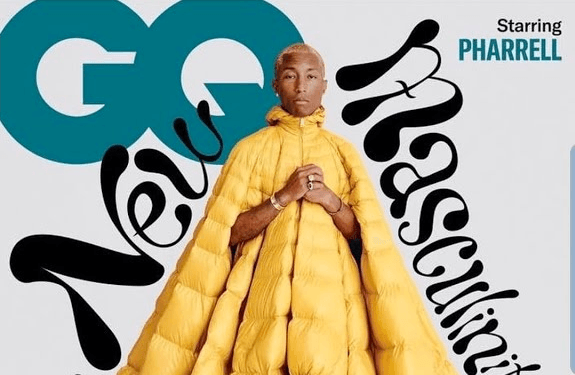
The latest craze is to go “gender fluid”. The name of the game is playing with identity, mixing things up, blurring lines. The male musician Pharrell Williams is on the front cover of GQ magazine wearing a frock that resembles a teepee, or even – dare I say it? – a religious vestment. Yes, he could be a cardinal imagined by Fellini. His rather pompous gaze is infallible: “This is what men look like now. Get with it or be damned forever!” The post-Christian West is full of reconstituted idols. Greta Thunberg is the new Joan of Arc, Mr Williams plays at pontiff and GQ would very much like to be the Bible of men’s fashion, although, as social critic Douglas Murray has pointed out, it is desperately trying to catch up with a trend rather than set one. The kids set the tone in Western culture; adults follow. Some of the US presidential candidates have gone gender-fluid without actually being gender-fluid by imitating the trend of introducing oneself by setting out your preferred pronouns: “I like to be known as he/she/it/ze” etc. Elizabeth Warren says she would like to be known as “She/her”, which is unflattering because it implies there was some doubt. My conservative friends get rather angry about all of this. Even the real Pope has denounced gender ideology, which suggests a long-term threat to society. But I trust it’s really just a question of fashion and, like all fashions, is passing and cyclical. The West has done gender-fluid many times before – most recently in the Sixties and Seventies, when men wore long hair, women embraced feminism and there was a hope that the sexes could somehow evolve towards each other, meeting at an androgynous horizon of pure equality. It had its virtues. The best of that spirit lives on in the idea that men should be equal partners in child-rearing or in the long march of women through the workplace and politics. Politics directs fashion, as Paul Connerton illustrated in his brilliant book How Societies Remember. He showed that in France in the 1790s, in the wake of the French Revolution, fashion was first austere and sexless, imitating the simple clothes of the Parisian poor, the heroes of the day. In the latter half of the decade, in reaction to the excesses of the guillotine, the French went the other way and began wearing clothes that emphasised the contours of the body: yin-and-yang, just as the soft-centred Seventies were followed by power dressing in the Eighties. In recent decades, we’ve seen uniforms of consciousness come and go – the punk’s safety pin, the goth’s black nails – and they react to one another. I’m sure it’s no coincidence that the gender-fluid revolution coincides with the return of the beard. Many men look more determinedly masculine now than they did in my youth, but also better groomed. This costs money. It always costs money. Fashion, no matter how altruistic its intent, is ultimately about selling us stuff. War is being waged on gender ideology by conservatives, but I suspect the real route of what’s going on isn’t a conspiracy to turn men into women and vice-versa, but an even older phenomenon of restless human self-invention supplied by consumerism. I wonder if a more effective objection to fashion might be its attempt to turn the human body into an object, a dress horse, a mask, a thing of clay – rather than what it really is, which is a human being made in the image of God. Note that the most compelling faces are untouched by fashion. Babies are the most beautiful; old faces are the most interesting. One contains possibility, the other betrays experience and character. And as older people will tell you: “We’ve seen it all before.”
12:00 AM
We've seen the 'new masculinity' before
the latest craze is to go “gender fluid”. the name of the game is playing with identity, mixing things up, blurring lines. the male musician...
Tim Stanley

5 min read



Already a subscriber? Sign in
5freearticles every month
Continue reading with a free account. No card needed.
- Five free articles every thirty days, on any device you sign in on
- The Catholic Herald newsletter, every morning
- Subscribe whenever you like for everything: every article and the magazine

subscribe to the catholic herald today
Our best content is exclusively available to our subscribers. Subscribe today and gain instant access to expert analysis, in-depth articles, and thought-provoking insights—anytime, anywhere. Don’t miss out on the conversations that matter most.
Subscribe



