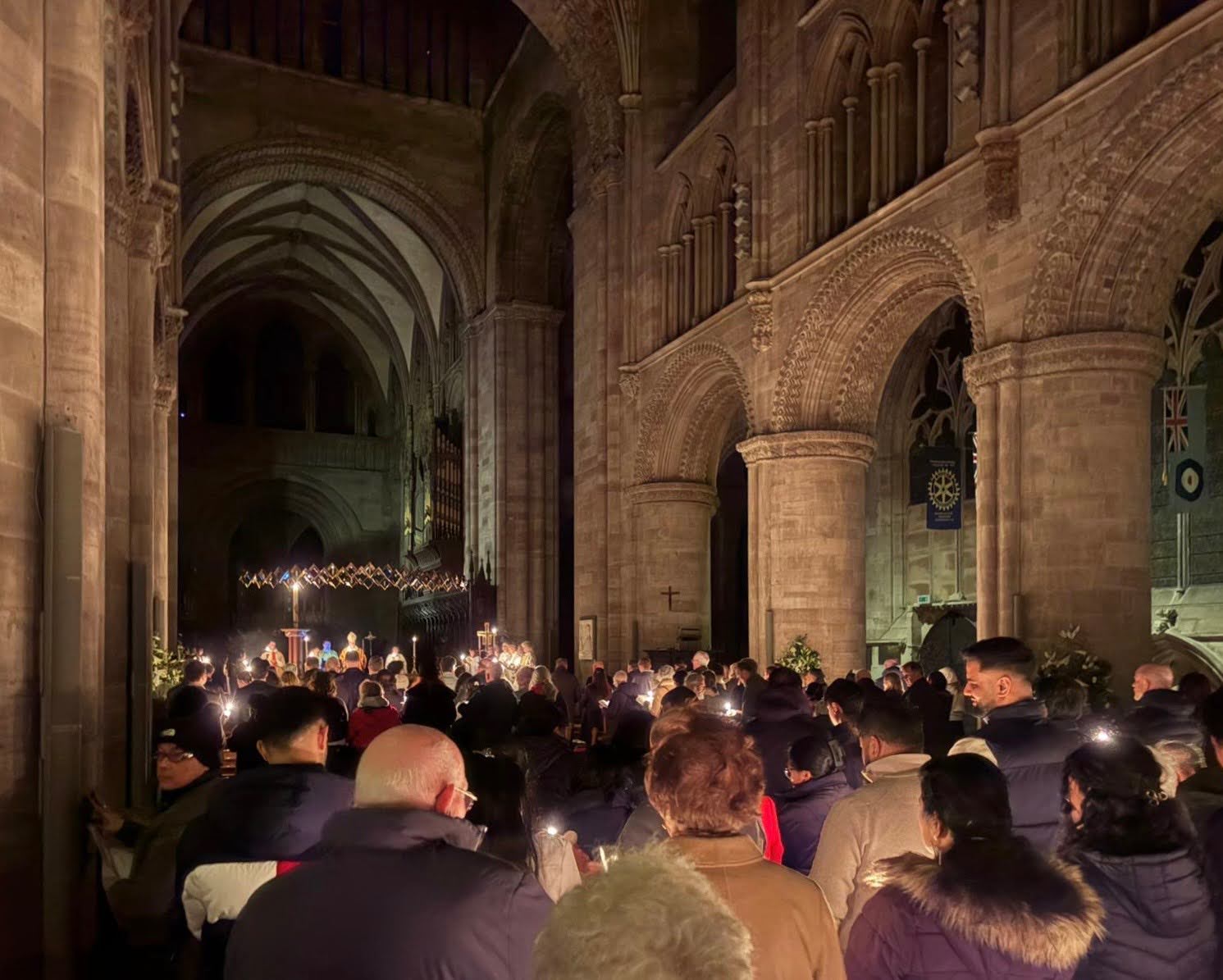

I tend to enjoy my liturgy much like my pasta: Roman. Yet, as I am sure we might all privately admit, a little double cream in one’s carbonara can add a gentle sophistication. Hereford’s Easter Vigil was much the equivalent of a gentle dollop of cream to the carbonara, as the Anglican cathedral and Roman Catholic parish of St Francis Xavier came together once again for their joint celebration (a tradition which began in 2002). The ceremonies began in the Catholic parish in darkness. The procession entered in silence. About 30 Catholic teenage altar servers, another 10 more aged Anglican servers, followed by the Anglican clergy in woollen capes, before the Catholic parish priest of Hereford, Dom James Hood, entered coped
The Vigil began not with the traditional Service of Light, but the Liturgy of the Word in darkness. While this was a slight variation from the rubrics, the repetitive format of reading, psalm, collect, repeat gave an appropriate feeling of Lenten austerity. Finally, with the end of the typological feast of the Old Testament readings and theologically direct collects with ‘may the whole world know and see that what was cast down is raised up’, a packed church processed the 77 steps (or thereabouts) to the west door of Hereford Cathedral.
Despite the best efforts of Storm Dave’s wind, a raging fire was burning. The Anglican clergy now vested, including the Bishop of Hereford, the Rt Rev Richard Jackson. This was the first joint moment of the Vigil. Dom James Hood and Bishop Jackson jointly blessed the fire following the rubrics of the Missale Romanum. This would be thematic for the rest of the evening’s worship. The Roman Catholic faithful could be satisfied that the necessary aspects of the Vigil Mass which required a Catholic priest were done so, all whilst being celebrated in an ecumenical fashion. Then, with two paschal candles blessed and lit, the congregation entered the ancient nave of Hereford Cathedral. The west door is usually reserved for the most important of visitors, making this solemn procession into a dark and cold cathedral laden with symbolism. With the congregation in place, the cathedral thrice echoed with the words ‘The Light of Christ’, with the response ‘Thanks be to God’. Then finally, Easter began with the solemn proclamation of the Exsultet chanted in English by an Anglican deacon
The liturgy followed with the Gloria and was solemnly accompanied by bells and sung to the tune of ‘Ode to Joy’, the Gospel proclaimed in the Anglican manner (though partially inspired by the Sarum Use) in the nave by a Catholic concelebrant, before the renewal of baptismal vows. There was no sermon nor bidding prayers (God is good!)
The obvious potential point of contention could have been the Eucharist. Instead, after the renewal of vows, those not in communion with Rome were asked to process to the Lady Chapel for an Anglican Communion service. Despite the cathedral remaining full for the Catholic Mass to proceed, there was a polite number who took their leave. After Communion, the Anglican congregation returned for the post-Communion prayer and a joint solemn blessing. The organ trumpeted the seasonal necessity of ‘Thine Be the Glory’
This was not the Easter Vigil that 99 per cent of British Catholics would have experienced. It was English worship. The salient point that this was a joint affair between two traditions received no commentary. Both traditions had much to gain: the Catholics gained the pomp of the cathedral in music, scale and history, whilst the Anglicans had a full cathedral and a share in a richly Catholic liturgy. The distinct privilege, though, was to hear a Catholic Mass of Easter being celebrated in one of England’s ancient cathedrals. For me, there was a personal moment of bliss to make my post-Communion devotions at the pre-Reformation tomb of St Thomas of Hereford.
On Easter Sunday, the Pope makes his biannual Urbi et Orbi blessing. Yet Hereford offered its own distinct and clear witness to the Easter Gospel to the city with its joint Easter Vigil. Unity in the joy of the Resurrection. A remarkably understated occasion and celebration of English Catholicism through fraternal ecumenism.