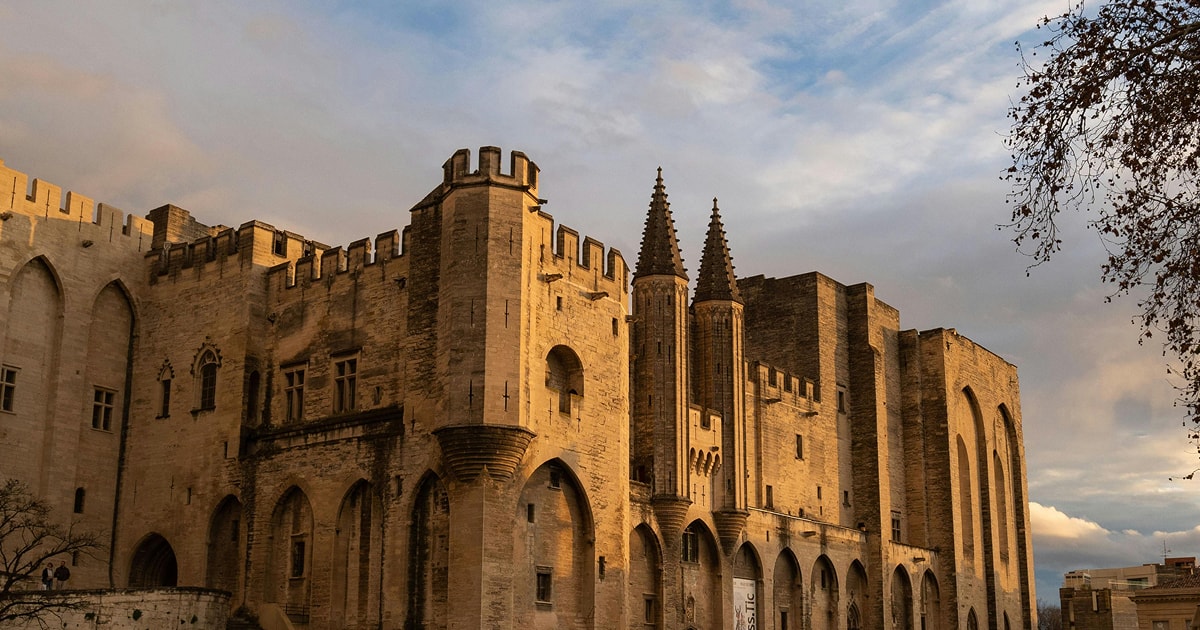
The Avignon papacy – the period from 1305 to 1378 when the papacy resided in southern France rather than Rome – remains one of the most instructive episodes in the history of the Holy See. It represented the victory of France over the masterful Pope Boniface VIII, who had tried to stop Philip the Fair in his dictatorial career as King of France. Speaking more widely, it displays the results that follow when the papacy starts playing politics, and when secular rulers decide to take charge in ecclesiastical affairs.
The crisis that put the papacy under France’s thumb had a long genesis. The 13th-century popes were so anxious to destroy the power of the Hohenstaufen emperors in Italy that they sold themselves politically to the French monarchy, and in the process politicised the College of Cardinals. The first sign was a period from 1261 to 1285 when four of the seven popes were French. On the death of Clement IV in 1268, the deadlock between Italian and French cardinals kept the Holy See vacant for three years. When the Roman Pope Boniface VIII was elected in 1294, he was determined to escape from this subjection and to reassert the authority of the Holy See.
Boniface had the bad luck to be up against Philip IV of France, who was engaged in revolutionising the character of his office and laying the foundations of an absolute monarchy. Prominent in his plan was a campaign of money-grabbing which included the expulsion or arrest of any group he could extort wealth from. In 1296 he expelled from France the Lombard merchants, to whom he owed large sums; in 1306 he drove out the Jews; and in 1307 he arrested all the Templars in his kingdom – thinking to seize their fabled treasure, he had them convicted on trumped-up charges of heresy and burnt their Grand Master at the stake. Philip had no Supreme Court to restrain him, but Pope Boniface made a largely futile effort to remind him of standards of equity in government policy.
The conflict came to a head in 1303. After a propaganda war between the papacy and France, Boniface prepared to excommunicate King Philip. The King sent his powerful minister Guillaume de Nogaret to arrest Boniface in the Papal States. With a band of mercenaries at his back, Nogaret burst in upon the Pope at Anagni. The attack failed, but Boniface died a few weeks later of shock, and within two years the emasculated papacy was installed powerlessly in Avignon. Not until 1378 was it able, under an idealistic incumbent, Gregory XI, to return to Rome.
It would be wrong, however, to think that during the whole of those 73 years the papacy was under French control. For most of that period France was unsuccessfully embroiled with England in the Hundred Years’ War, and was in no position to continue Philip the Fair’s role as an ecclesiastical puppet-master. What kept the papacy from returning to Rome was the disordered state of Italian politics, and the fact that the College of Cardinals had become virtually a monopoly of Frenchmen, with a vested interest in keeping up the ‘Babylonian Captivity’. In these years the spiritual credit of the Holy See went downhill, as its administration honed the methods of taxing the Church, and luxury and nepotism became the note of the papal court. The sorry result was the Western Schism of 1378–1417, when the papacy was contested between two rival candidates, and an even more lasting doctrinal schism, with Hussites in Bohemia and Lollards in England disrupting the previous unity of faith.
Like the kidnapping of the papacy to Avignon, the present conflict between the Pope and the American presidency has a back-story. It is rooted in the previous pontificate, when Pope Francis used his office as a political tool to advance the traditional Latin American resentment of the United States. His selling of Chinese Catholics down the river to Chairman Xi’s dictatorship was essentially an anti-American gesture, an effort to cosy up to America’s chief rival. Rather ironically, Francis’s legacy has been the election of Leo XIV – the first American pope.