

Franciscan spirituality is one of the “most attentive” in “restoring fundamental relationships with God” said Pope Leo, during his Thursday meeting with young people gathered in Assisi as part of anniversary celebrations for St. Francis.
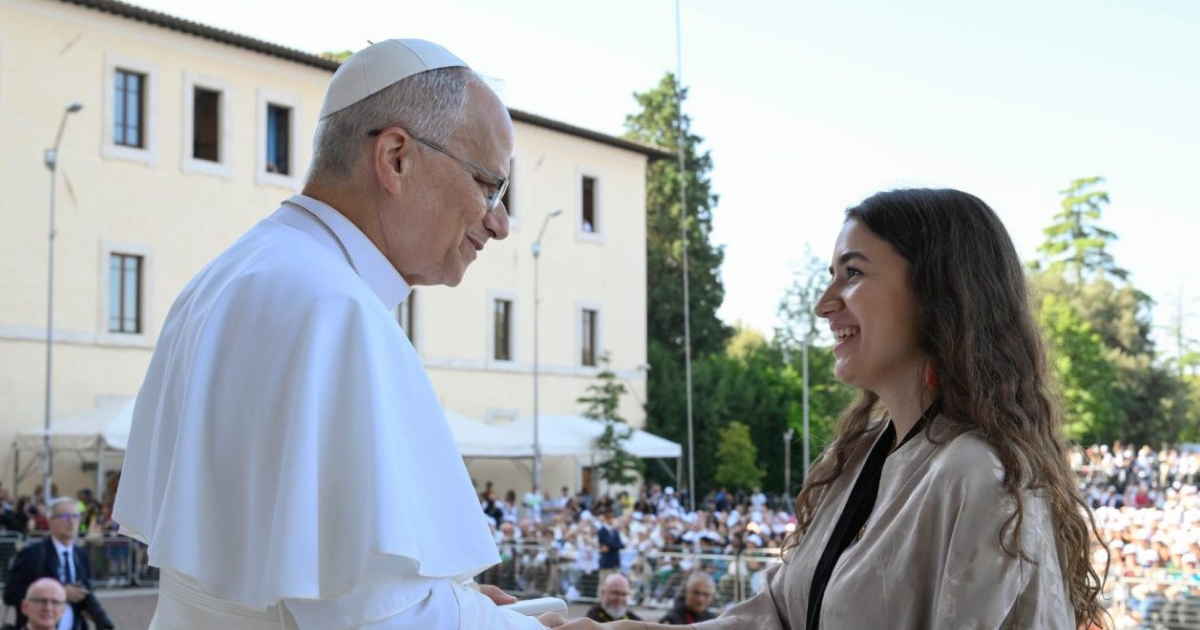
Leo XIV returned to Assisi this morning for a brief visit to a youth gathering held at the hillside town, drawing over 2,500 attendees aged 18 - 33 from all across the world. The “GO! Franciscan Youth Meeting 2026” was convened as part of the celebrations for the 800th anniversary of St. Francis’ death and sought to provide “moments of listening, dialogue, sharing of experiences” centred around the spirituality of St. Francis.
The Pope’s visit marked the highpoint and culmination of the four day event, and saw Leo greet the crowds in the Piazza Santa Maria degli Angeli, before fielding three prepared questions from the youth and then celebrating Mass inside the Basilica which houses the Portiuncula. He is understood to have particularly chosen to visit the event out of a range of possible options in the anniversary calendar.
“Franciscan spirituality”, Leo told the crowd, “is among the most attentive to restoring fundamental relationships with God and with all his creatures. Today, more than ever, this is a harmony that needs to be safeguarded and cultivated.”
The Pope drew on St. Francis’ theme of poverty and Pope Francis’ Evangelii Gaudium as he enjoined the crowd to escape a “culture of power” and instead to commit themselves “to the civilization of love”. He repeatedly referred to the increasing climate of war and “injustice”, while calling on the young people present to embody Christian ideals as a rejection of such things.
“Today Europe and the whole world are looking to you for new saints,” Leo declared. “Dare to believe in the word of the Gospel, become truly human through the freedom of Jesus Christ, and embrace Sister Poverty!”
Echoing also certain themes often employed by Pope Francis, Leo called on the youth to imitate St. Francis by going “to the margins, where the injustice and arrogance of a few deny the dignity and dreams of many, of far too many sons and daughters of God.”
“To trust in God”, he said, “is to rediscover, like Francis and Clare, a world of brothers and sisters to cherish and serve, not to exploit and dominate.”
Leo also drew from his own encyclical Magnifica Humanitas as he addressed the crowd, noting that “whenever humanity is in danger of marring its true identity, we Christians lift our eyes to the Incarnate God, knowing that it is ‘only in the mystery of the Word made flesh that the mystery of humanity truly becomes clear.’”
The meeting was billed as a continuation of the first “Chapter of the Mats” in 1221, when St. Francis gathered with around 5,000 members of the Franciscan order around the tiny chapel of the Portinucula – the place which remains so central to the Franciscan Order’s spirituality and way of life.
Somewhat akin to a mini World Youth Day, the programme was filled with various workshops built around Franciscan themes, including the very prevalent aspect of modern-day Franciscan-linked ecology.
Leo himself did not delve into aspects such as climate change – a notable move given how widely St. Francis is cited by Church figures in advocating for climate issues. Instead he pointed to the spirituality embodied by the saint as a proposed way of life which would touch on every aspect of society. The Pope strongly linked Franciscan spirituality to working for peace in the modern world.
“Increasingly, Christians will be called to become artisans of peace within societies that are tempted to place religion at the service of competing identities,” he noted. “Rejecting the culture of power and building a civilization of love” will not be widely understood, but is part of “being witnesses to Christ”, he added.
He also highlighted how St. Francis teaches that the “radicalism of the Gospel is the very opposite of fundamentalism”, and enables Catholics to be “aware, attentive and always eager to follow Jesus, and therefore humble and welcoming towards everyone.”
Leo’s homily and address were more positive in tone rather than being critical of any current events. Though he lamented the loss of stability which “once characterised traditional societies”, and the widespread increase of war and injustice, his texts tended to avoid anything of great specificity.
He chose to encourage the young people to practices of the saint’s spirituality, while making only a brief reference to sin specifically when noting that sin obscures the “call to communion” and leads to “mistrust, rivalry and suspicion”.
“What matters”, he said, “is that each of us faithfully fulfils the role entrusted to us. Then we shall speak of the Church with the affection one has for a mother, because we shall know that we belong to her.”
Michael Haynes is an English journalist in the Holy See Press Corps. He serves as Vatican Correspondent for the Catholic Herald, while readers can follow him at Per Mariam and on X @MLJHaynes.